Description
- ABCA7 (ATP-binding cassette sub-family A member 7) is a transmembrane protein that utilizes ATP to transport lipids across cell membranes. Recent studies have established ABCA7 gene variants as a significant genetic risk factor for late-onset Alzheimer’s disease, primarily through its roles in lipid metabolism and membrane homeostasis, amyloid-beta (Aβ) clearance pathways, and the regulation of neuroinflammation and microglial function.
- The amino acid at position 1613 is mutated from valine (Val) to methionine (Met) in B-Abca7*V1613M mice.
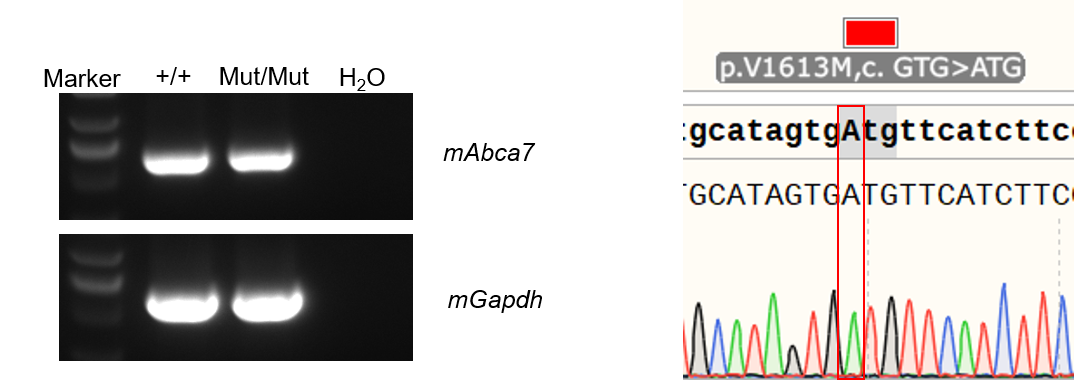
- Mouse Abca7 mRNA was both detectable in wild-type mice and homozygous B-Abca7*V1613M mice, and the point mutation was confirmed via Sanger sequencing.
- This model is useful for studying the mechanisms of ABCA7 point mutations in Alzheimer’s disease (AD).
Targeting Strategy
Gene targeting strategy for B-Abca7*V1613M mice. The amino acid at position 1613 is mutated from valine (Val) to methionine (Met) in B-Abca7*V1613M mice.
mRNA Expression Analysis
Abca7 mRNA expression in wild-type C57BL/6JNifdc mice and homozygous B-Abca7*V1613M mice by RT-PCR. Brain RNA were isolated from wild-type C57BL/6JNifdc mice (+/+) and homozygous B-Abca7*V1613M mice (Mut/Mut), then cDNA libraries were synthesized by reverse transcription, followed by PCR with mouse Abca7 primers. Mouse Abca7 mRNA was both detectable in wild-type mice and homozygous B-Abca7*V1613M mice, and the point mutation was confirmed via Sanger sequencing.
* When publishing results obtained using this animal model, please acknowledge the source as follows: The animal model [B-Abca7*V1613M mice] (Cat# 114002) was purchased from Biocytogen.