

이 페이지에서
염증성 장질환(IBD, Inflammatory Bowel Disease)은 궤양성 대장염(UC, Ulcerative Colitis)과 크론병(CD, Crohn’s Disease)을 포함하는, 위장관의 만성적이고 재발성 있는 염증성 질환입니다. IBD의 임상 증상으로는 반복적인 설사, 복통, 장출혈(혈변), 발열, 체중 감소 등이 자주 나타납니다. 정확한 발병 기전은 아직 완전히 밝혀지지 않았지만, 유전적 감수성, 면역 조절 이상, 환경적 영향, 장내 미생물 균총 불균형 등의 요인이 질환 발병에 주요한 기여를 합니다.
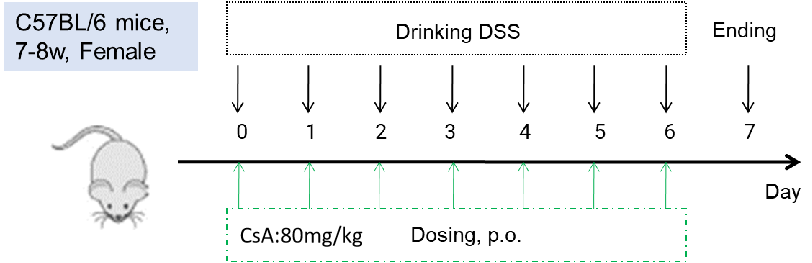
질환 기전을 보다 잘 이해하고 신규 치료제를 평가하기 위해 연구자들은 인간 질환의 병리학적 특징을 재현하기 위해 전임상 IBD 모델 및 IBD 마우스 모델을 널리 사용합니다. 그중에서도 DSS 유도성 대장염 모델은 가장 잘 확립된 생체 내 IBD 모델 중 하나입니다. 덱스트란 황산나트륨(DSS)을 음용수에 투여하면 장상피 장벽이 손상되고 선천성 면역 세포가 활성화되며 사이토카인 방출이 촉진되고 점막 무결성이 파괴되어, 체중 감소, 설사, 혈변, 염증 세포 침윤을 포함한 대장염 증상을 유발합니다. 이러한 증상은 인간 궤양성 대장염과 매우 유사한 특징을 보입니다.
바이오사이토젠(Biocytogen)에서 C57BL/6 마우스를 이용해 개발한 DSS 유도성 IBD 모델은 약물 효능 평가 및 항염증 치료제 시험을 위한 안정적이고 재현성이 높으며 검증된 전임상 플랫폼입니다. 또한 바이오사이토젠의 표적 인간화 IBD 모델(예: B-hTL1A 마우스)은 완전한 인간 TL1A 단백질을 발현하며, 인간 질환과 관련된 표적 검증, IBD 기전 연구 및 전임상 약물 개발을 위한 보다 정확한 트랜슬레이셔널 모델(이행 연구 모델)을 제공합니다.
| Mice strains |
| B-hCXCR2 |
| B-hTL1A |
| B-hTL1A/hIL23A/hIL12B |
| Readout | ||
| Included tests | Clinical scores | Body weight |
| DAI score | ||
| Colon | Colon length | |
| Colon weight | ||
| Histopathology | H&E | |
| Optional tests | Tissue homogenate | Cytokines test |
| Tissue histopathology | IHC | |
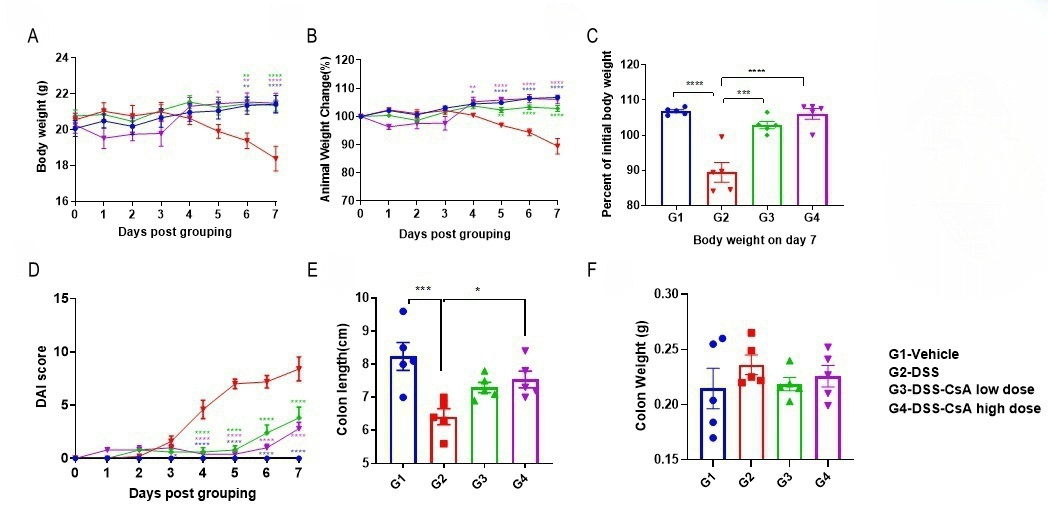
IBD 마우스 모델에서 CsA(사이클로스포린 A)의 효과 검증. C57BL/6 마우스는 연속적으로 7일 동안 DSS를 포함한 음료수를 마시고, 그 동안 체중 변화를 기록하며, 연구 종료 시 임상 점수(A-D)를 기록하고 결장 무게와 길이를 기록했습니다. 이원 ANOVA(A-D) 또는 일원 ANOVA(E-F)를 사용하여 다중 비교를 실시했습니다. 결과는 평균값 ± 표준오차로 표시되며, ****p<0.0001, ***p<0.001, **p<0.01, *p<0.05.
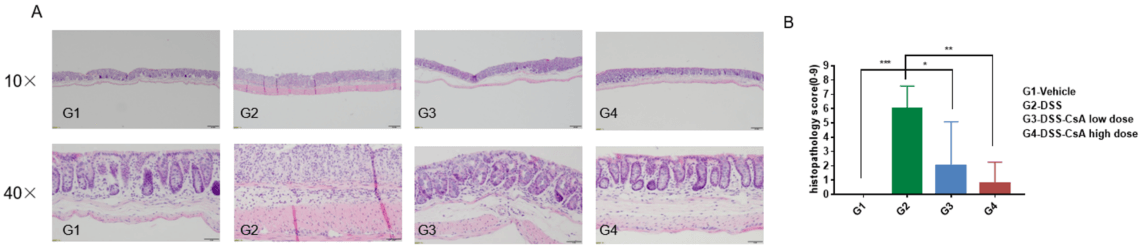
DSS 유도 대장염의 IBD 마우스 모델에서 조직학적 평가. 조직 병리 점수와 H&E 염색의 광학 현미경 사진(10배 및 40배 확대). 결과는 평균값 ± 표준오차로 표시되며, ****p<0.0001, ***p<0.001, **p<0.01, *p<0.05.
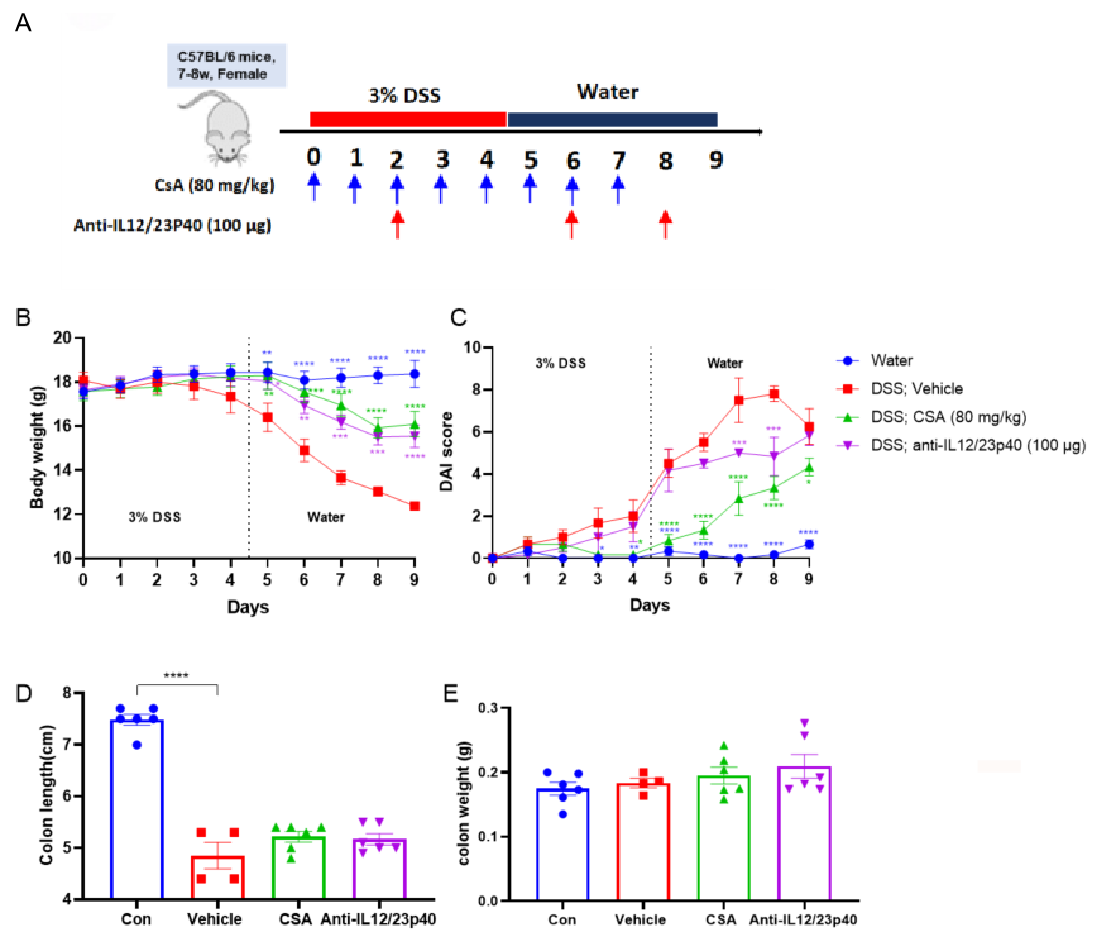
항IL12/23p40이 DSS 유도 급성 대장염에 미치는 영향.
C57BL/6 마우스는 3% DSS를 포함한 음료수를 5일간 마시고, 0일부터 7일까지 매일 CsA를 주사하고, 2, 6, 8일에 항IL12/23P40을 주사했습니다(A). 매일 체중과 배설물(B, C)을 기록하고, 최종적으로 결장을 수집하여 H&E 염색을 실시하고, 결장 길이(D)와 무게(E)를 기록했습니다. CsA와 항IL12/23P40은 3% DSS 유도 궤양성 대장염을 완화했습니다. 이 실험은 이원 ANOVA와 다중 비교를 사용했습니다. 결과는 평균값 ± 표준오차로 표시되며, ****p<0.0001, ***p<0.001, **p<0.01, *p<0.05.
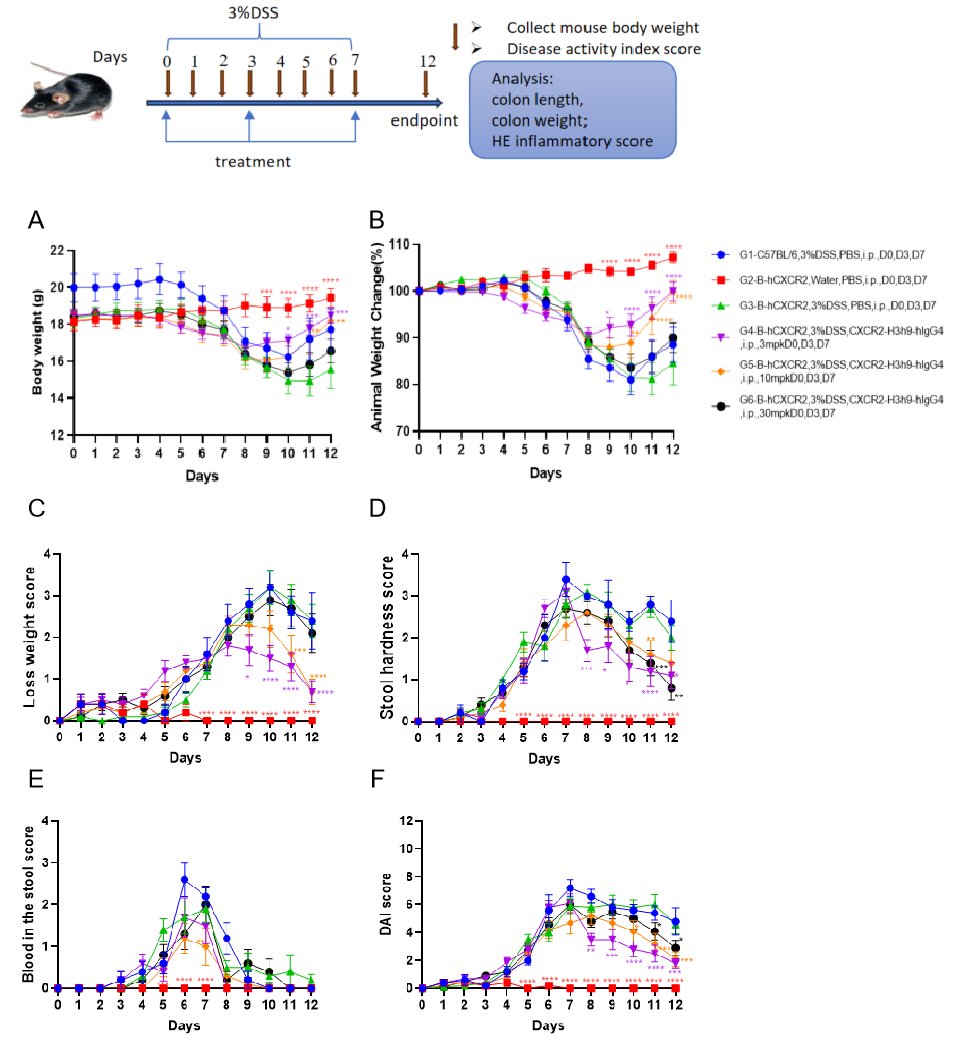
IBD(B-hCXCR2 마우스) 마우스 모델에서 효과 검증.
C57BL/6 마우스와 B-hCXCR2 마우스는 7일간 연속으로 DSS를 포함한 음료수를 마시고, 그 후 정상 음료수로 복귀했습니다. 이 기간 동안 체중 변화와 임상 점수(체중 감소 점수, 대변 경도 점수, 대변 혈액 점수, 총 DAI 점수)를 기록했습니다. 이원 ANOVA와 다중 비교를 사용하여 모든 그룹을 G3 그룹과 비교했습니다. 결과는 평균값 ± 표준오차로 표시되며, ****p<0.0001, ***p<0.001, **p<0.01, *p<0.05.
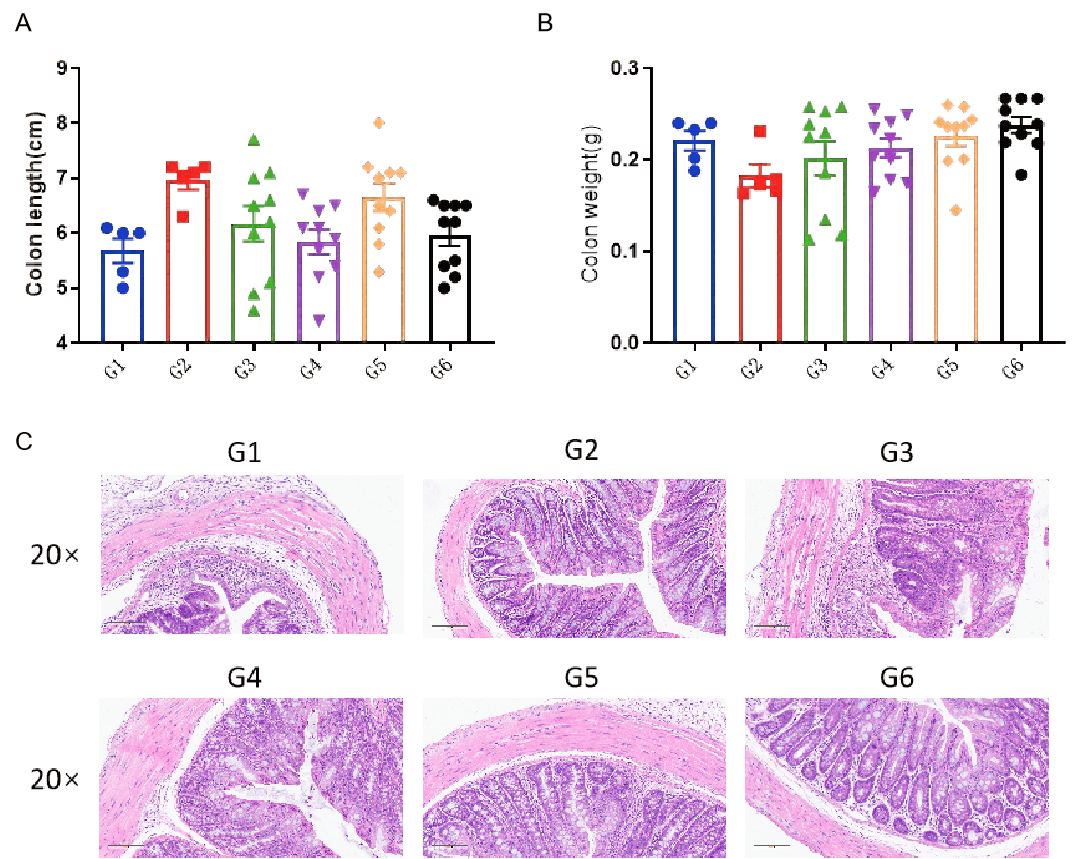
IBD 마우스 모델의 결장 샘플링, 결장 평가 및 조직학적 평가. C57BL/6 마우스와 B-hCXCR2 마우스는 7일간 DSS를 포함한 음료수를 마시고, 그 후 정상 음료수로 복귀했습니다. 연구 종료 시 결장 길이(A)와 결장 무게(B)를 측정하고, 결장 조직은 H&E 염색을 위해 수집되었습니다(C). 일원 ANOVA와 다중 비교를 사용하여 모든 그룹을 G3 그룹과 비교했습니다. 결과는 평균값 ± 표준오차로 표시되었습니다.
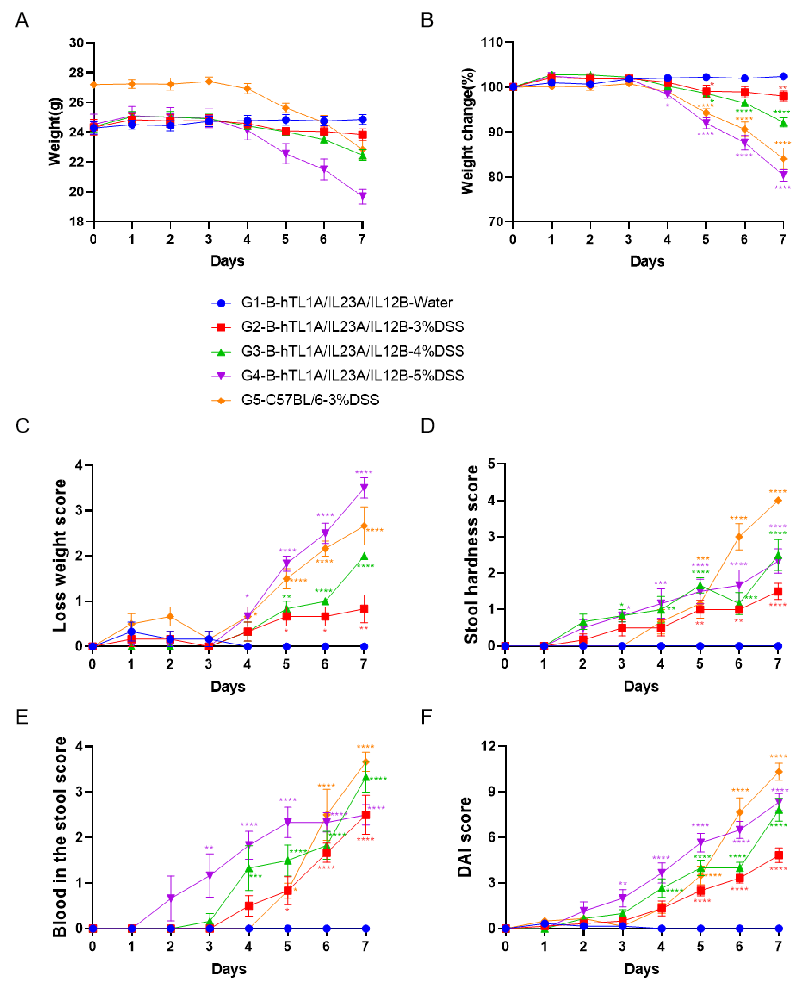
C57BL/6 마우스와 B-hTL1A/IL23A/IL12B 마우스는 다른 농도의 DSS가 포함된 물을 7일간 연속으로 섭취했습니다. 체중 변화와 임상 점수(체중 감소 점수, 대변 경도 점수, 대변 내 혈액 점수, 총 DAI 점수)를 기록했습니다. 이원 ANOVA와 다중 비교를 사용하여 모든 그룹을 G1 그룹과 비교했습니다. 데이터는 평균 ± SEM으로 나타냅니다. ****p<0.0001, ***p<0.001, **p<0.01, *p<0.05.
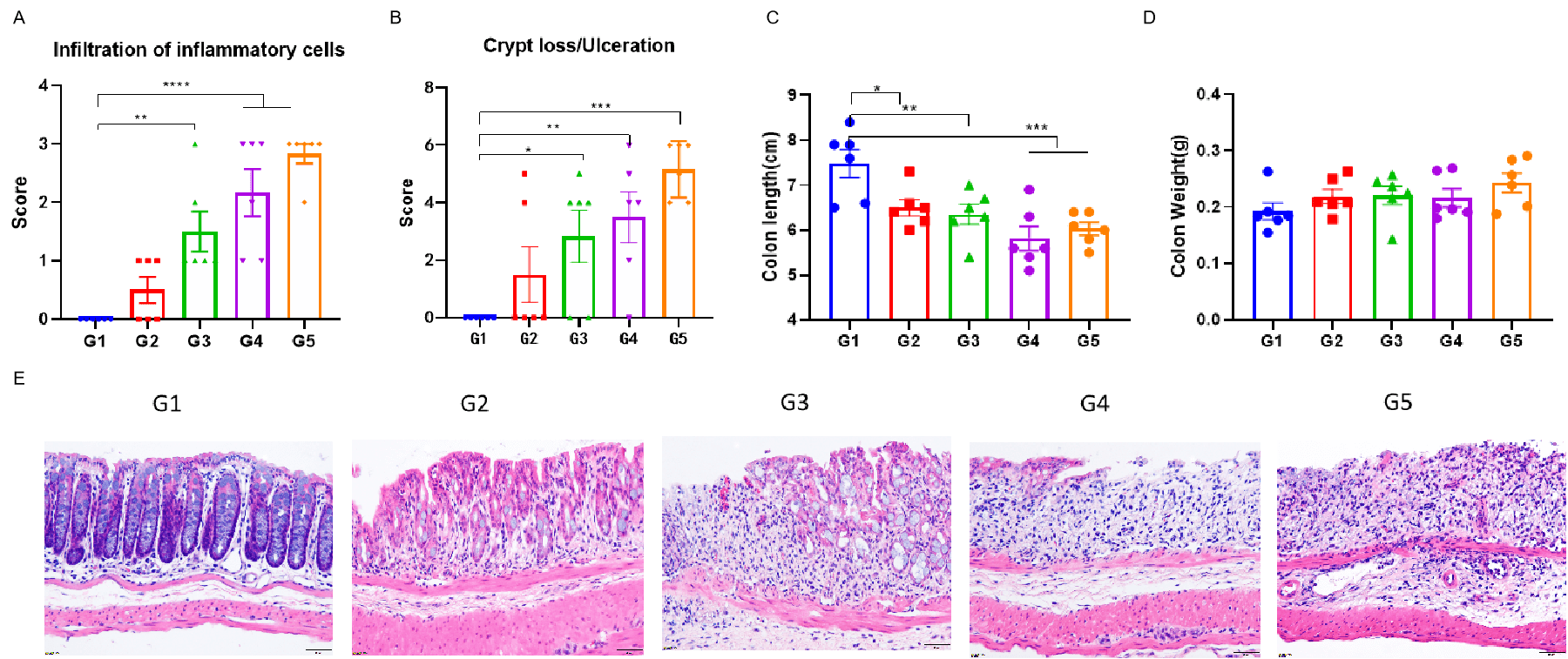
C57BL/6 마우스와 TL1A/IL23A/IL12B 인간화 마우스(B-hTL1A/IL23A/IL12B 마우스)는 다른 농도의 DSS가 포함된 물을 7일간 연속으로 섭취했습니다. 실험 종료 시 대장 길이와 대장 무게를 측정하고 대장 조직을 H&E 염색했습니다. 일원 ANOVA와 다중 비교를 사용하여 G1 그룹과 비교했습니다. 데이터는 평균 ± SEM으로 나타냅니다. ****p<0.0001, ***p<0.001, **p<0.01, *p<0.05.

| Mice strains |
| B-hTL1A |
| Readout | ||
| Included tests | Clinical scores | Body weight |
| DAI score | ||
| Colon | Colon length | |
| Colon weight | ||
| Histopathology | HE | |
| Sirius Red staining | ||
| Optional tests | Tissue homogenate | Cytokines test |
| Tissue histopathology | IHC | |
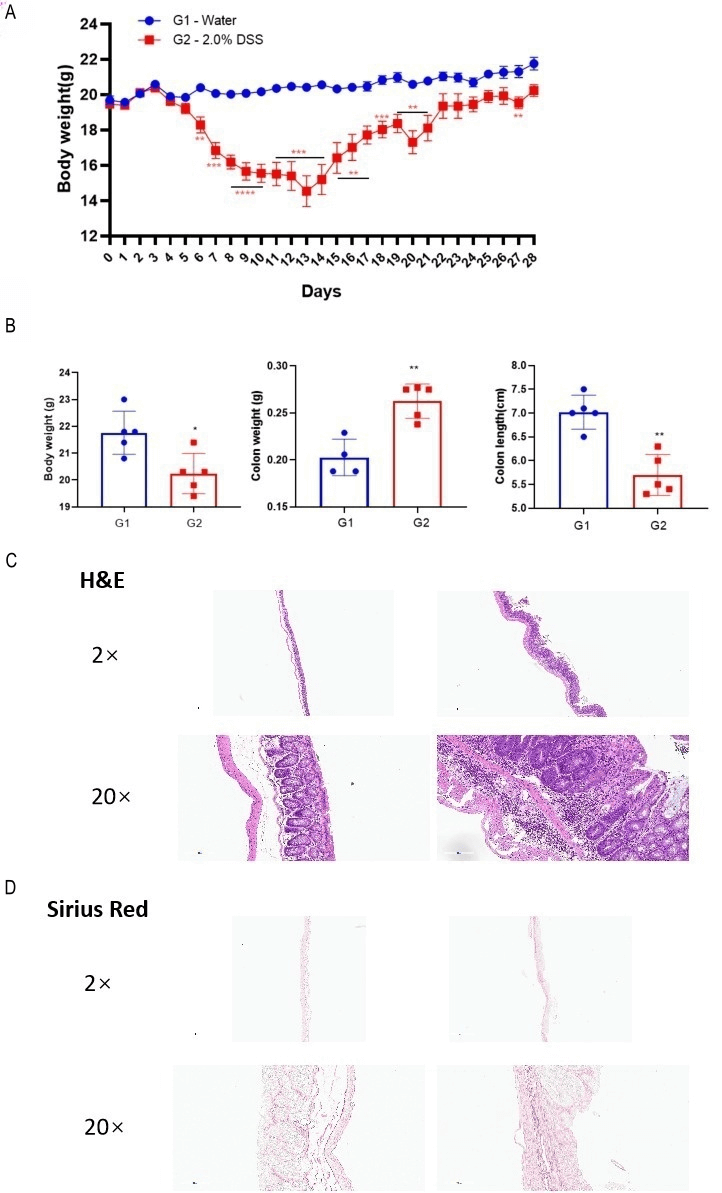
DSS 유도 만성 대장염. 마우스는 DSS 4 주기를 반복적으로 노출시켰습니다. 각 주기는 2% DSS로 5일 처리한 후 2일 간 물 처리했습니다(A). 체중, 대장 무게 및 대장 길이를 기록했습니다(B). H&E(C) 및 Sirius Red(D)로 조직 병리학적 염색을 했습니다. 대장을 수집하여 조직학적 분석을 수행했습니다. DSS를 받은 마우스는 물을 받은 마우스에 비해 체중이 낮고 대장 무게는 높으며 대장 길이가 짧았습니다. 다중 T 검정을 사용했습니다. 평균 ± SEM, n=5, ****p<0.0001, ***p<0.001, **p<0.01, *p<0.05.
| Mice strains |
| B-hTL1A |
| Readout | ||
| Included tests | Clinical scores | Body weight |
| Colon | Colon length | |
| Colon weight | ||
| Histopathology | HE | |
| Optional tests | Tissue homogenate | Cytokines test |
| Tissue histopathology | IHC | |
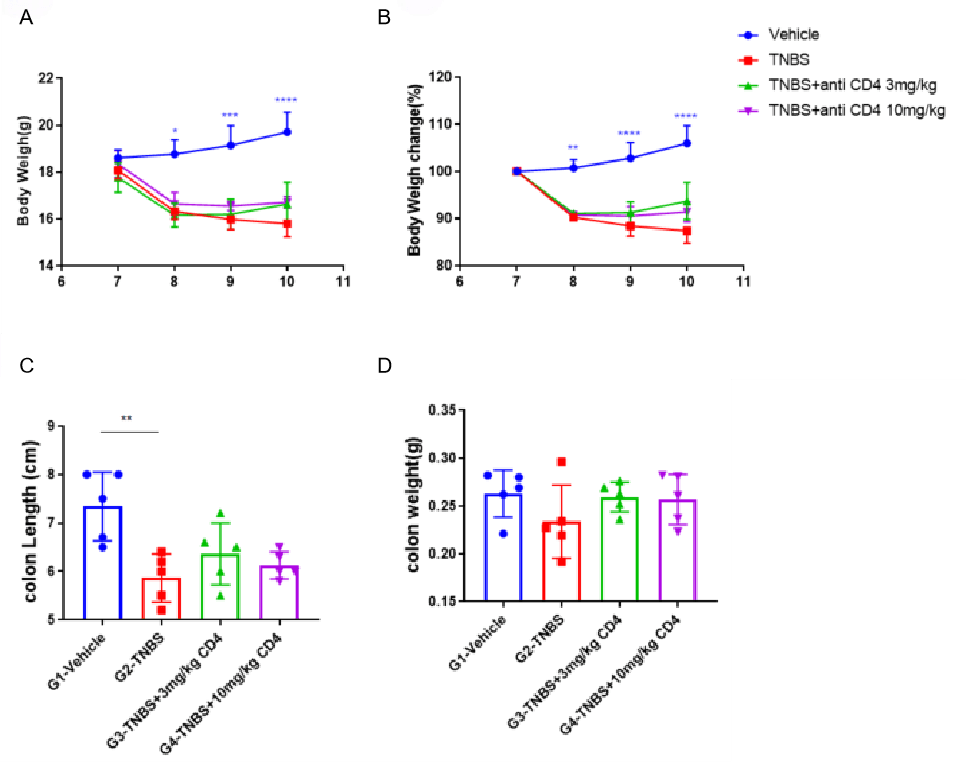
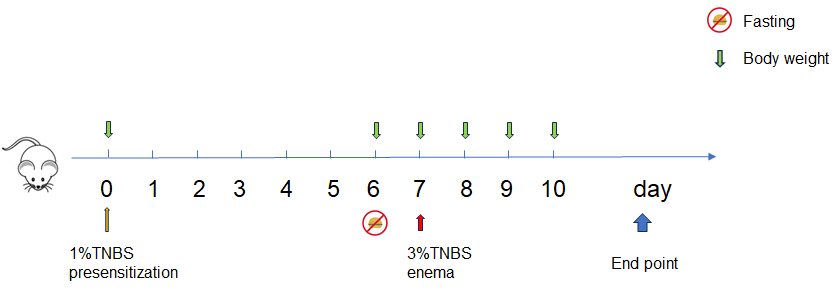
CD4-GK1.5-mlgG2a가 TNBS 유도 급성 장 염증에 미치는 영향. 동물은 0일에 TNBS 용액으로 피부를 긁어 과민반응을 유도한 후 7일에 TNBS를 직장으로 투여했습니다. 매일 체중(A)과 체중 변화(B)를 기록하고 6일째에 CD4-GK1.5-mlgG2a(3, 10 mg/kg, i.p.)를 투여했습니다. 마우스는 10일째에 희생되었으며 대장 길이(C)와 대장 무게(D)를 기록했습니다. 이원 ANOVA 또는 일원 ANOVA와 Dunnett 다중 비교를 사용하여 각 그룹을 상호 비교했습니다. 데??터는 평균 ± SEM으로 나타냅니다. ****p<0.0001, ***p<0.001, **p<0.01, *p<0.05.
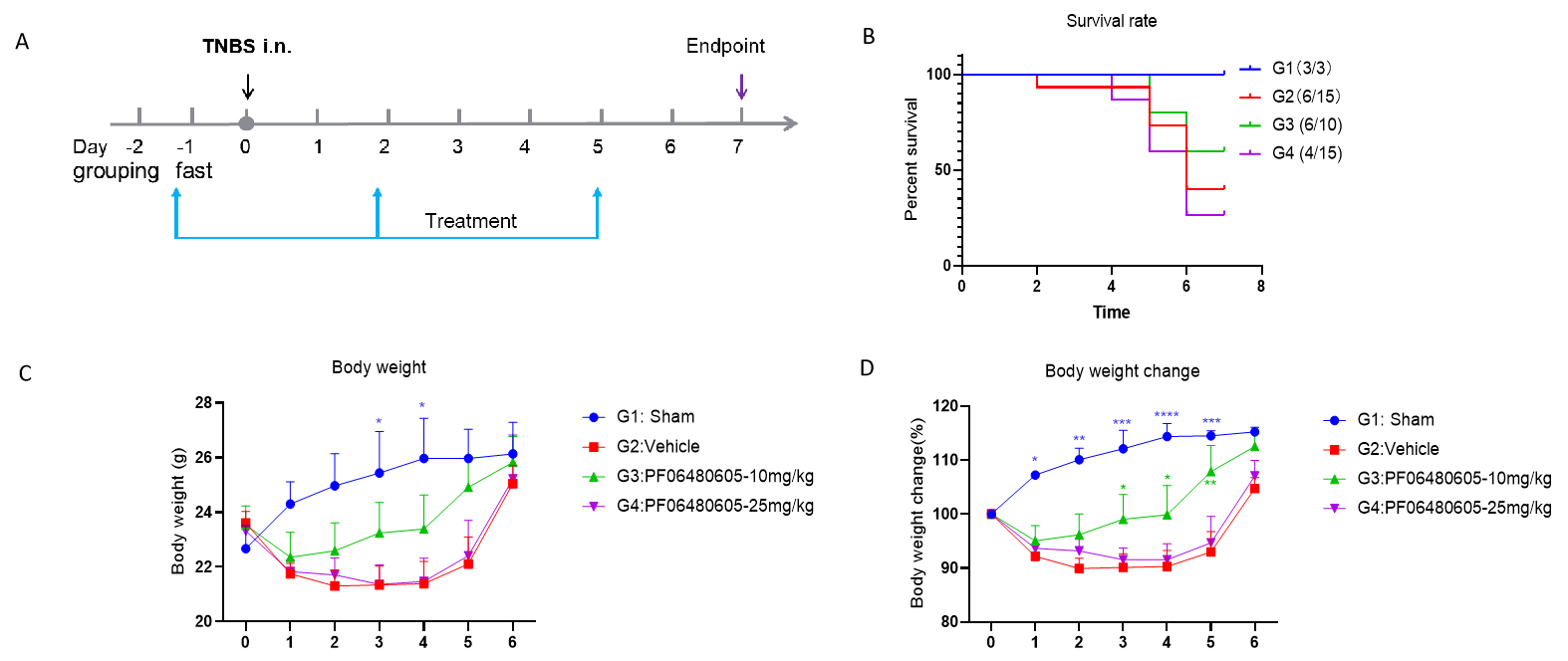
PF06480605가 TNBS 유도 급성 IBD에서 B-hTL1A 마우스에서의 효능. 동물은 0일에 TNBS를 직장으로 투여했습니다. TA 투여 시 -1일, 2일, 5일에 각각 10 또는 25 mg/kg의 PF06480605를 투여했습니다. 계획 도식(A). 생존률(B)을 계산하고 매일 체중(C-D)을 기록했습니다. 이원 ANOVA와 Dunnett 다중 비교를 사용하여 각 그룹을 G2 그룹과 비교했습니다. 데이터는 평균 ± SEM으로 나타냅니다. ****p<0.0001, ***p<0.001, **p<0.01, *p<0.05.
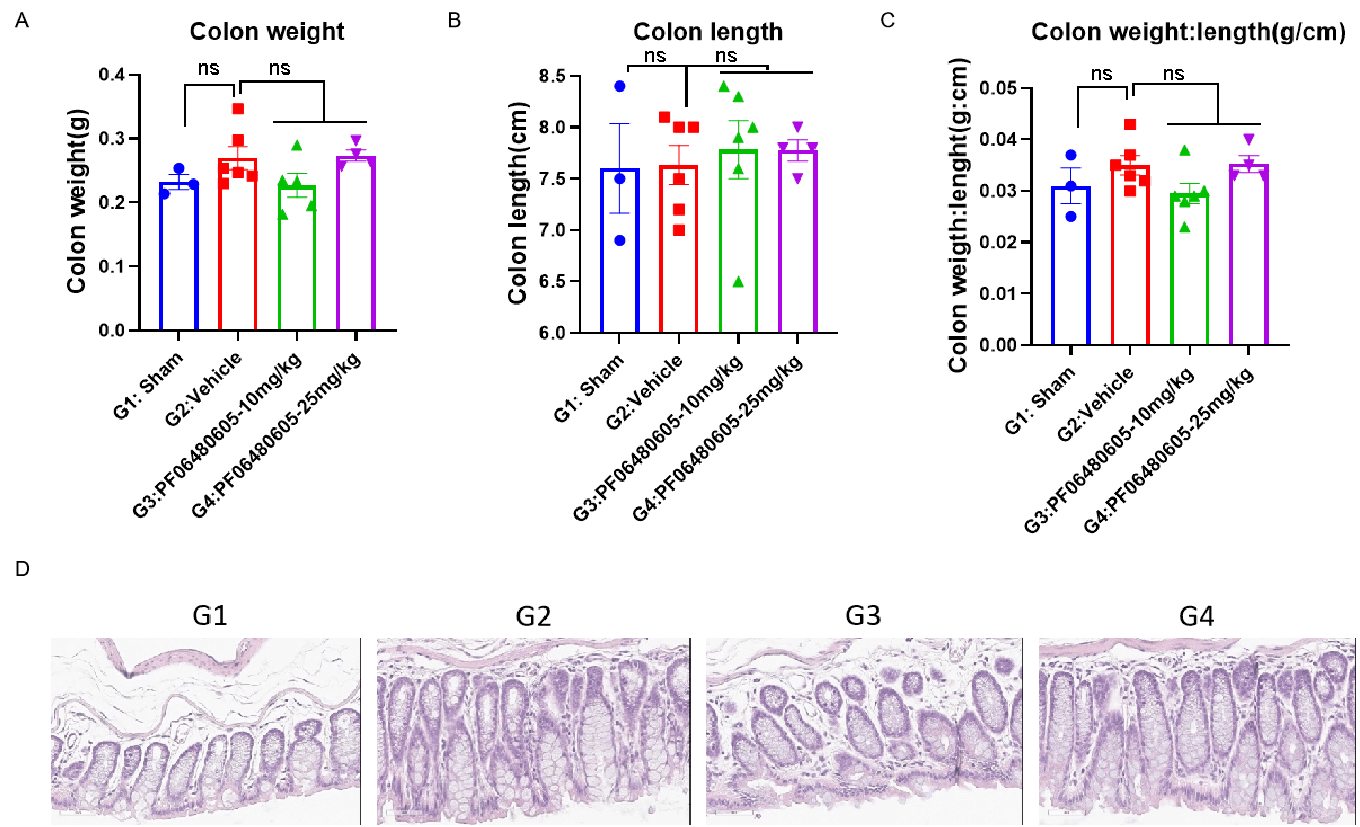
동물은 0일에 TNBS를 직장으로 투여했습니다. 매일 체중을 기록하고 생존률을 계산했습니다. TA 투여 시 -1일, 2일, 5일에 각각 10 또는 25 mg/kg의 PF06480605를 투여했습니다. 7일째에 마우스는 희생되었으며 대장 무게(A)와 대장 길이(B)를 기록했습니다. 이후 대장 조직을 H&E 염색했습니다. 일원 ANOVA와 다중 비교를 사용하여 모든 그룹을 G2 그룹과 비교했습니다. 데이터는 평균 ± SEM으로 나타냅니다. ****p<0.0001, ***p<0.001, **p<0.01, *p<0.05.
| Mice strains |
| B-hPSGL1(spleen donor) |
| Readout | ||
| Included tests | Clinical scores | Body weight |
| DAI score | ||
| Colon | Colon length | |
| Colon weight | ||
| Histopathology | H&E | |
| Optional tests | Tissue homogenate | Cytokines test |
| Tissue histopathology | IHC | |
| Histopathology | Sirius Red staining | |
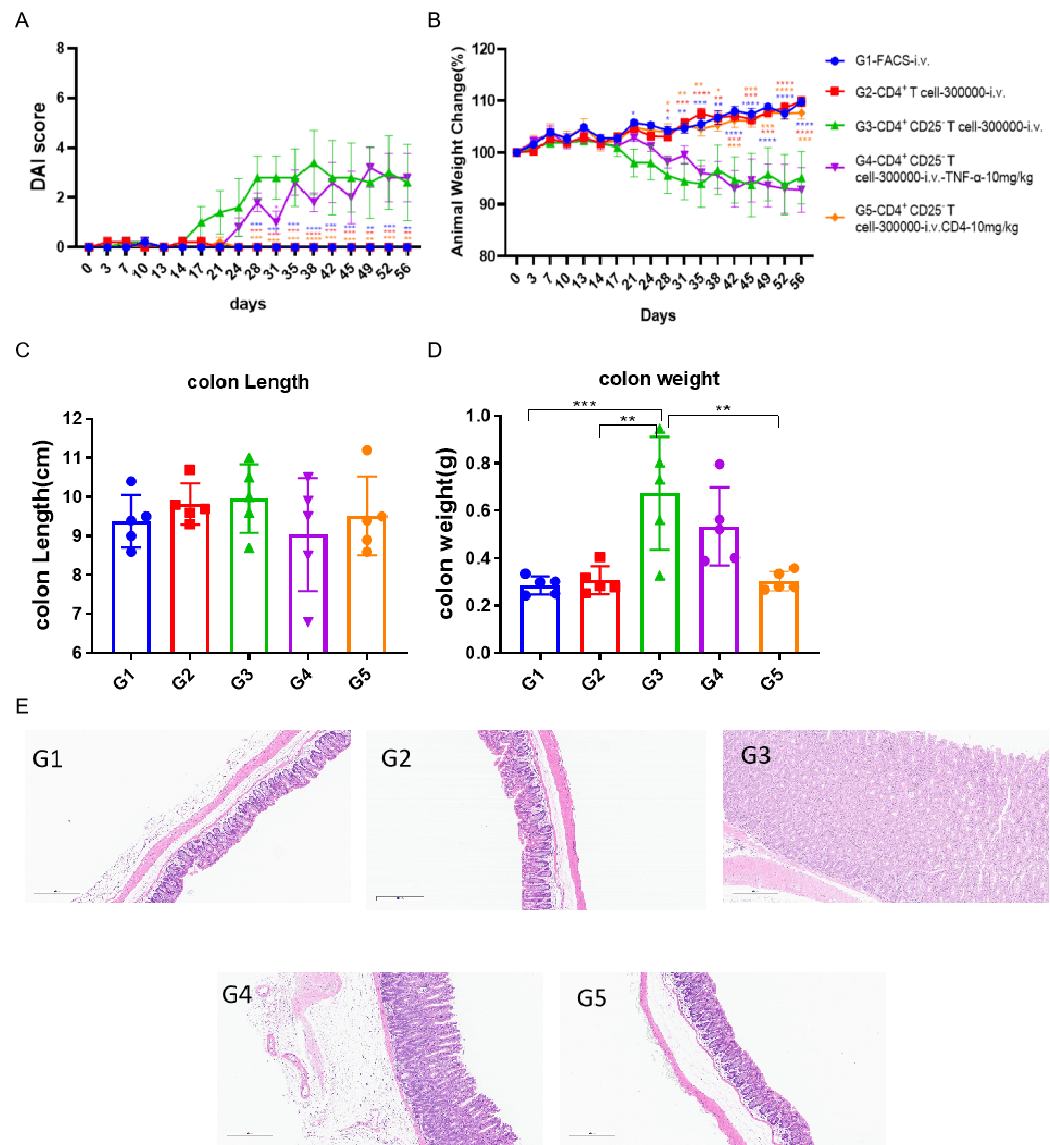
이식 T 세포 유도 IBD 모델에서의 효능.
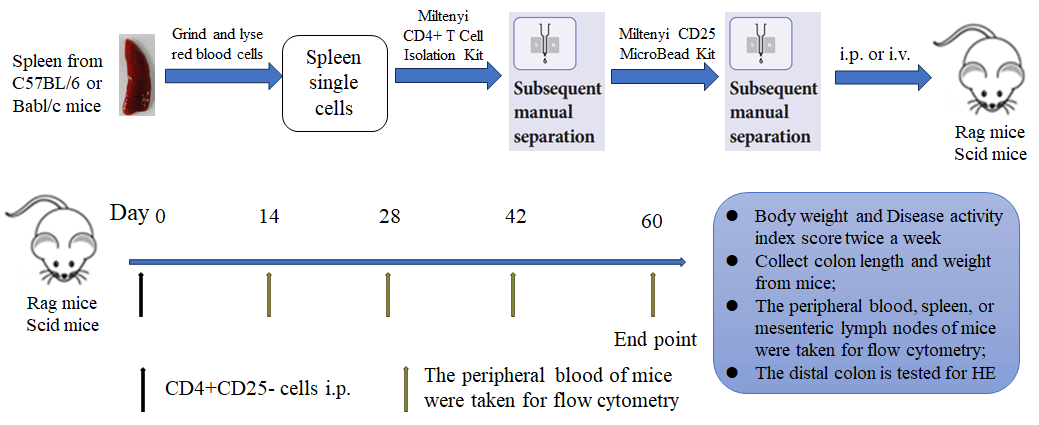
Balb/c 마우스의 비장으로부터 CD4+CD25- T 세포 또는 CD4+ T 세포를 상용 키트를 사용해 분리했습니다. G2 그룹의 동물은 3×10⁵ CD4+ T 세포를 주입하고, G3-G5 그룹의 동물은 동일한 수의 CD4+CD25- T 세포를 주입했습니다. 치료는 G4 그룹에 매주 10 mg/kg의 항TNFα를, G5 그룹에 매주 10 mg/kg의 항CD4를 주입했습니다. 이원 ANOVA 또는 일원 ANOVA와 다중 비교를 사용하여 각 그룹을 G3 그룹과 비교했습니다. 데이터는 평균 ± SEM으로 나타냅니다. ****p<0.0001, ***p<0.001, **p<0.01, *p<0.05.