C57BL/6JNifdc-Acvr1ctm2(ACVR1C)Bcgen/Bcgen • 114181

Description
Key Advantages
Validation
Applications

The region spanning exon 2 through exon 9 of the endogenous mouse Alk7 gene, including the 3′ UTR region, was replaced with P2A and the full-length human ALK7 coding sequence (CDS), including the human ALK7 3′ UTR, in ALK7 humanized mice.
The endogenous mouse Alk7 promoter and 5′ UTR regions were retained to preserve physiological transcriptional regulation. Human ALK7 expression is driven by the endogenous mouse Alk7 promoter, while endogenous mouse Alk7 transcription and translation are disrupted.


Strain-specific analysis of ALK7 mRNA expression in wild-type C57BL/6JNifdc mice and ALK7 humanized mice was performed by RT-PCR. Subcutaneous fat RNA was isolated from wild-type C57BL/6JNifdc mice (+/+) and homozygous ALK7 humanized mice (H/H). cDNA libraries were synthesized by reverse transcription, followed by RT-qPCR using human ALK7-specific primers. Human ALK7 mRNA was detectable in ALK7 humanized mice but not in wild-type mice. Human sequences were further confirmed by Sanger sequencing.
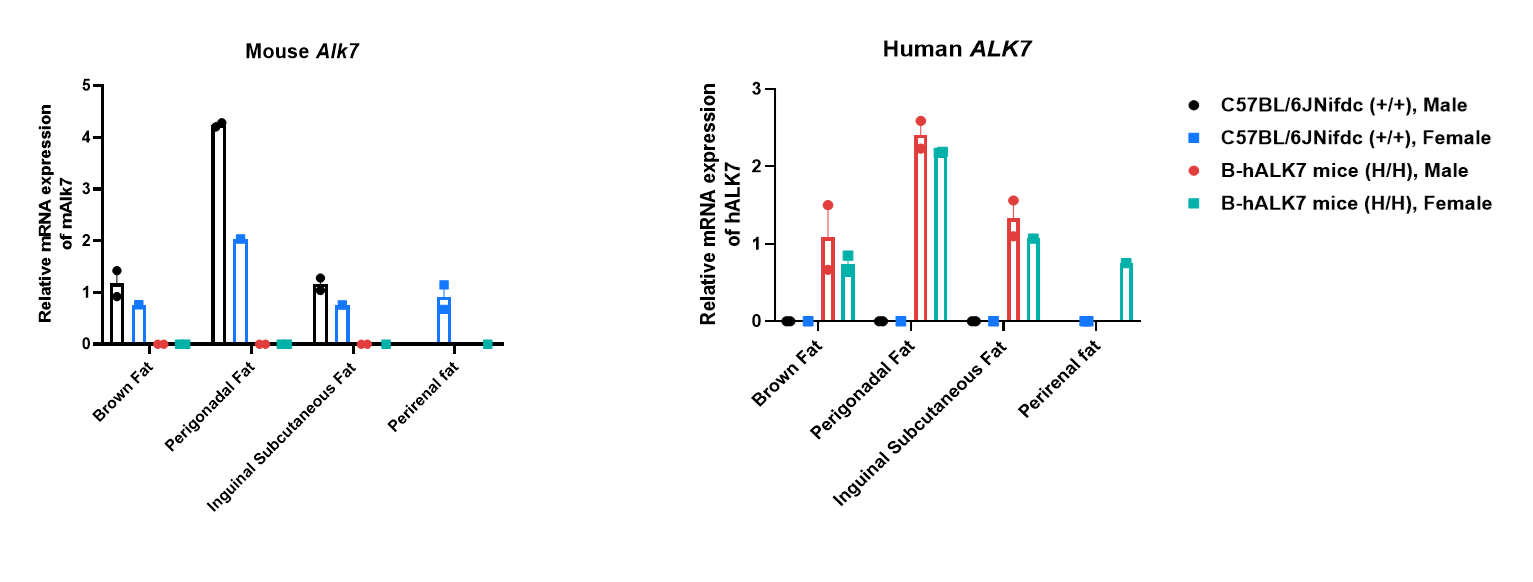
Strain-specific analysis of human ALK7 mRNA expression in wild-type C57BL/6JNifdc mice and ALK7 humanized mice was performed by RT-qPCR. RNA was isolated from perirenal fat, perigonadal fat, inguinal subcutaneous fat, and brown fat of wild-type C57BL/6JNifdc mice (+/+) and homozygous ALK7 humanized mice (H/H). cDNA libraries were synthesized by reverse transcription, followed by RT-qPCR using mouse- or human-specific ALK7 primers. Human ALK7 mRNA was detectable in ALK7 humanized mice but not in wild-type mice.
Note: Male perirenal fat samples were not collected.

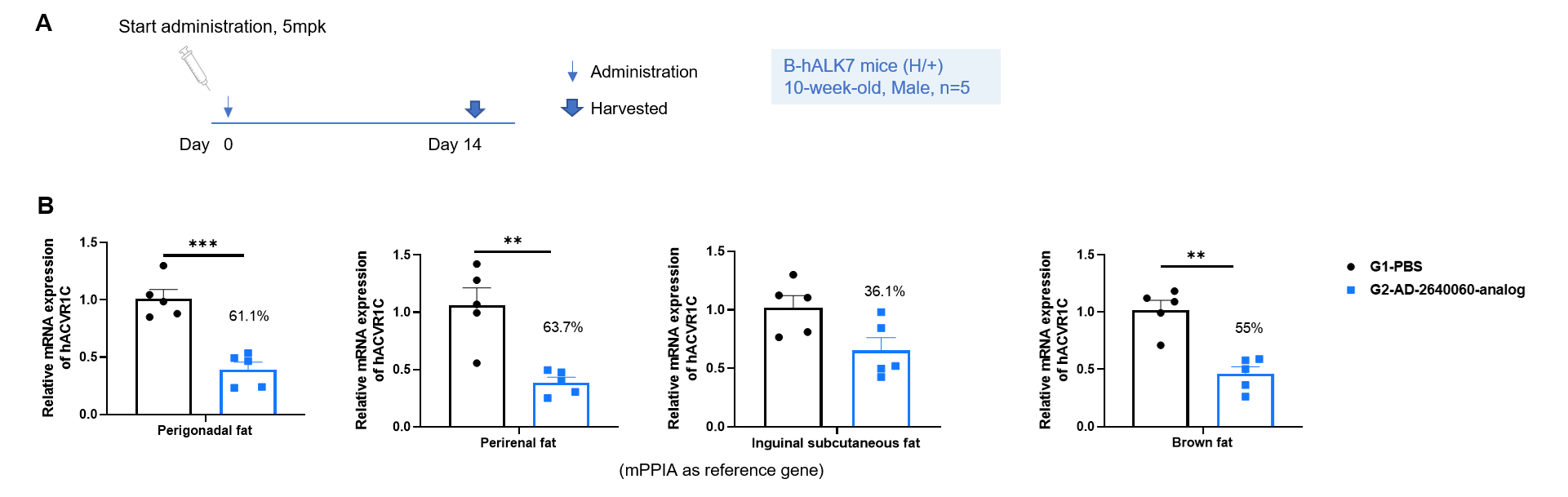
The inhibitory efficiency of nucleic acid drug against human ALK7 was evaluated in heterozygous ALK7 humanized mice. Heterozygous ALK7 humanized mice (H/+) were randomly divided into two groups (male, 10 weeks old, n=5). Human ALK7-targeted nucleic acid drug synthesized according to patented sequences and PBS control were individually administered to mice in the form of aqueous PBS solutions.
Mice were sacrificed on Day 14, and adipose tissues were collected for analysis of human ALK7 mRNA expression by qPCR.
(A) Schematic diagram of experimental design
(B) Human ALK7 mRNA expression levels in adipose tissues
Human ALK7 expression in the siRNA-treated group was significantly reduced compared with the PBS control group. Significance was determined by a t-test. *P<0.05, **P<0.01, ***P<0.001. Values are expressed as mean ± SEM.

Q1: What are ALK7 humanized mice?
A1: ALK7 humanized mice are genetically engineered mice expressing human ACVR1C/ALK7 under the endogenous mouse Alk7 promoter, enabling translational metabolic disease and obesity research.
Q2: Why is ALK7 considered an important therapeutic target?
A2: ALK7 regulates adipose metabolism and lipolysis. Human genetic studies have linked ALK7 loss-of-function variants with favorable lipid metabolism and reduced obesity risk.
Q3: Can ALK7 humanized mice be used for siRNA drug evaluation?
A3: Yes. This model is specifically designed for preclinical evaluation of human ALK7-targeted nucleic acid therapeutics, including siRNA drugs.
Q4: Does the model express endogenous mouse Alk7?
A4: No. Endogenous mouse Alk7 transcription and translation are disrupted, while human ALK7 is expressed under physiological regulatory control.
Q5: What tissues express human ALK7 in this model?
A5: Human ALK7 expression has been validated in multiple adipose tissues, including subcutaneous fat, perigonadal fat, brown fat, and perirenal fat.