
B-hAPOE4 mice

C57BL/6JNifdc-Apoetm1(APOE*4)Bcgen/Bcgen • 112564

B-hAPOE4 mice

Product nameB-hAPOE4 mice
Catalog number112564
Strain nameC57BL/6JNifdc-Apoetm1(APOE*4)Bcgen/Bcgen
Strain backgroundC57BL/6JNifdc
NCBI gene ID348 (Human)
AliasesAD2; LPG; APO-E; ApoE4; LDLCQ5

이 페이지에서

  • Description
  • Targeting strategy
  • Phenotypic analysis
  • Efficacy

포스터

모두 보기

    출판물

      Description
      • Human APOE is a 34 kDa glycoprotein and polymorphism in the APOE gene is a major genetic risk of late-onset Alzheimer disease, while APOE4 is associated with an increased risk and lower age of onset through multiple pathways, such as the inhibition of amyloid-β (Aβ) clearance, promotion of Aβ aggregation, influencing on tau pathology, impairing microglial responsiveness and lipid transport.
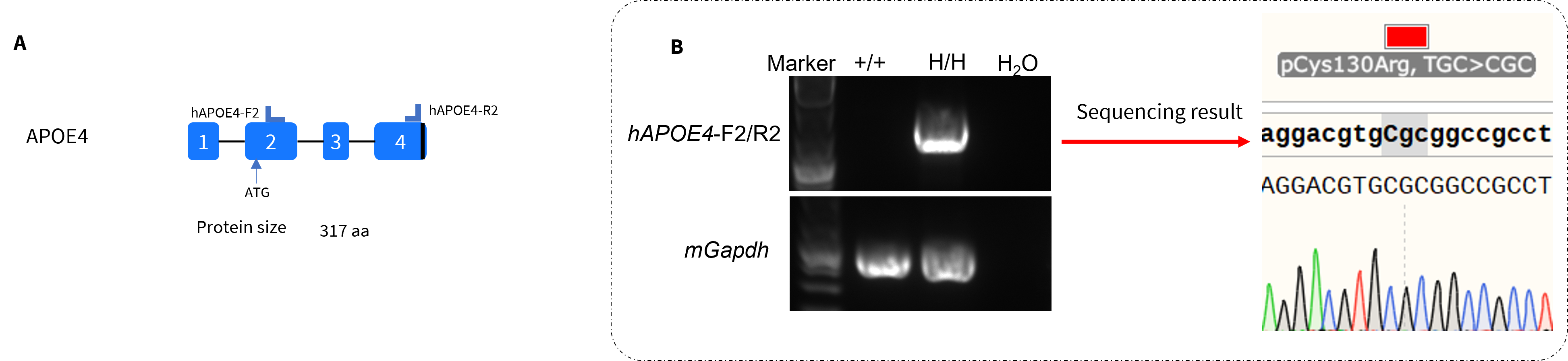
      • The exons 2-4 of mouse Apoe gene that encode the whole molecule (ATG to STOP codon), including 3’UTR were replaced by human counterparts in B-hAPOE4 mice. The promoter and 5’UTR of the mouse gene are retained. The human APOE4 expression is driven by endogenous mouse Apoe promoter, while mouse Apoe gene transcription and translation will be disrupted.
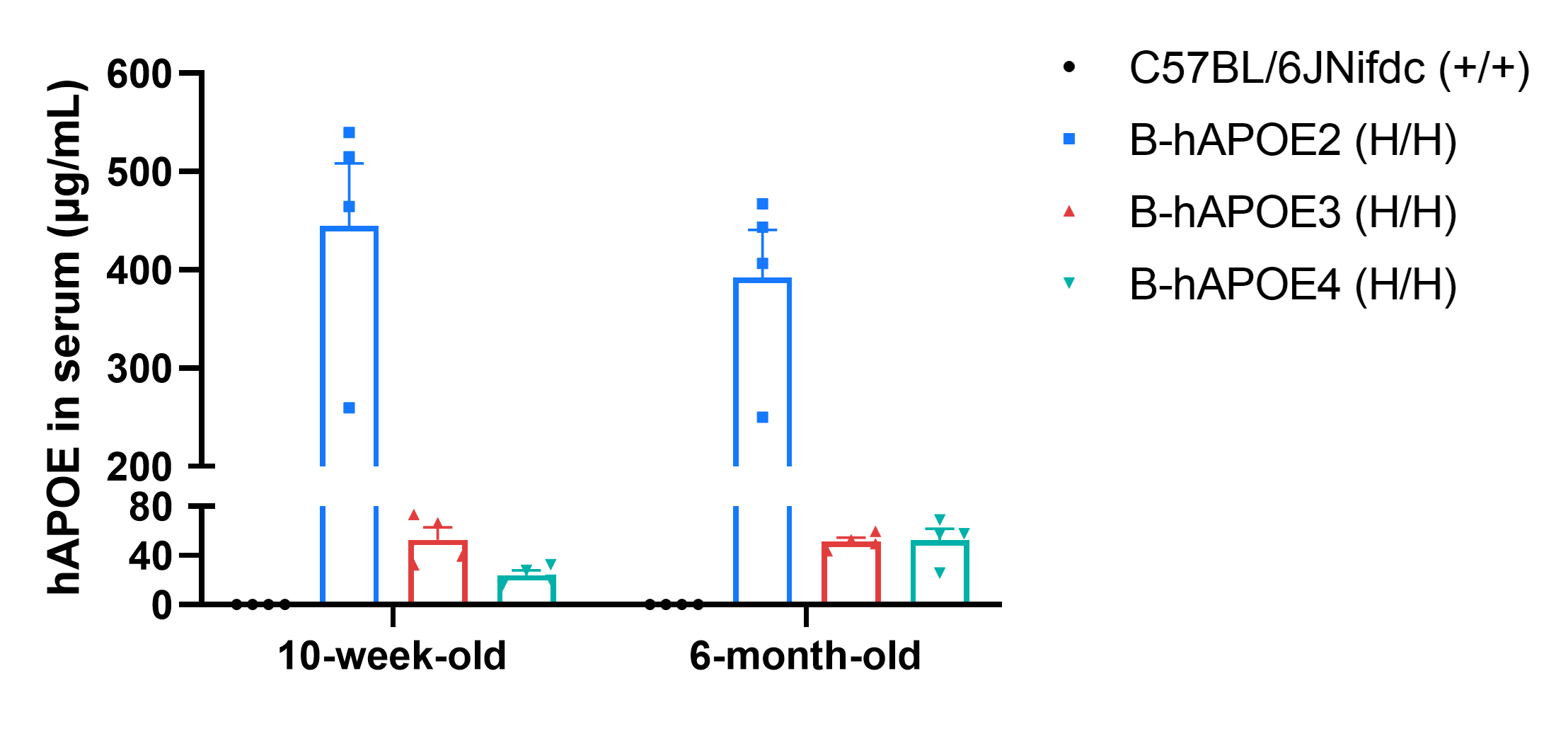
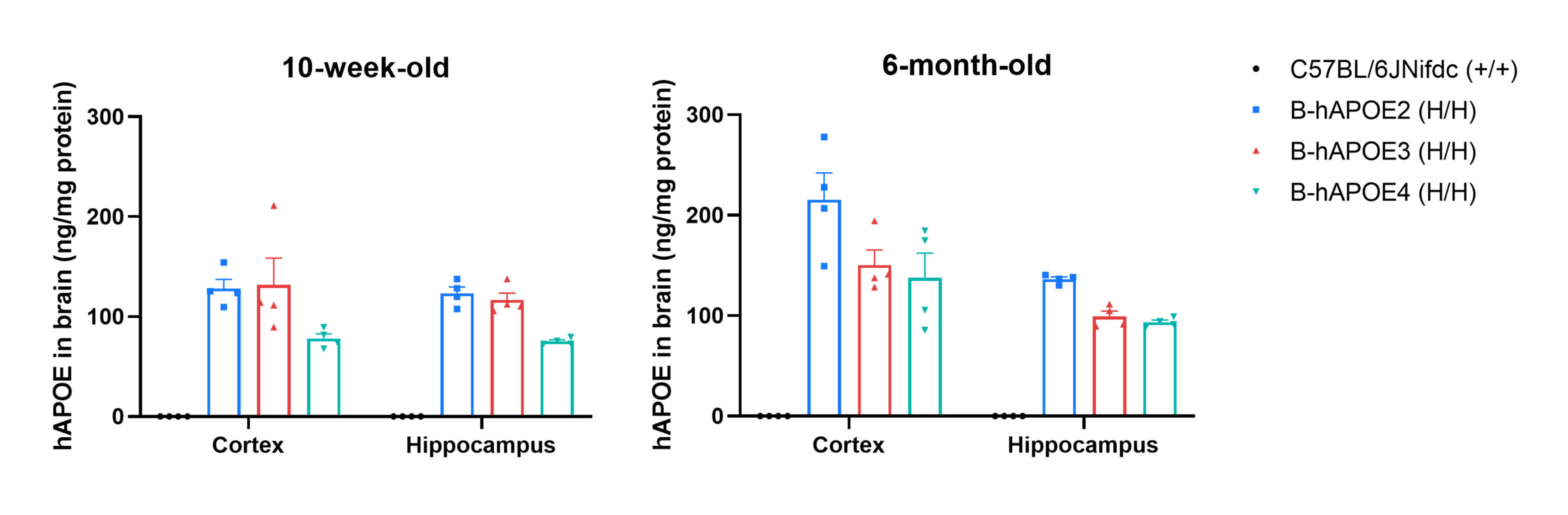
      • Human APOE4 mRNA was detectable only in homozygous B-hAPOE4 mice but not in wild-type mice.  And the results were confirmed via Sanger sequencing. Human APOE was exclusively detectable in homozygous B-hAPOE4 mice but not in wild-type mice. Besides, ELISA results demonstrated a genotype-dependent decrease in APOE expression, following the pattern APOE2 > APOE3 > APOE4.
      • Human APOE4 targeted nucleic acid drug was efficacious in B-hAPOE4 mice.
      • This model can be used to evaluate the efficacy and safety of drugs targeting APOE4. Furthermore, when combined with Alzheimer’s disease (AD)-related mouse models, it can also be applied to study the efficacy of AD therapeutics.
      Targeting Strategy

      Gene targeting strategy for B-hAPOE4 mice. The exons 2-4 of mouse Apoe gene that encode the whole molecule (ATG to STOP codon), including 3’UTR were replaced by human counterparts in B-hAPOE4 mice. The promoter and 5’UTR of the mouse gene are retained. The human APOE4 expression is driven by endogenous mouse Apoe promoter, while mouse Apoe gene transcription and translation will be disrupted.

      mRNA Expression Analysis

      Strain specific analysis of APOE4 mRNA expression in wild-type C57BL/6JNifdc mice and homozygous B-hAPOE4 mice by RT-PCR. Liver RNA were isolated from wild-type C57BL/6JNifdc mice (+/+) and homozygous B-hAPOE4 mice (H/H), then cDNA libraries were synthesized by reverse transcription, followed by PCR with mouse or human APOE primers. Mouse Apoe mRNA was detectable only in wild-type mice. Human APOE4 mRNA was detectable only in homozygous B-hAPOE4 mice but not in wild-type mice.  And the results were confirmed via Sanger sequencing.

      Protein Expression Analysis in Serum

      Strain specific analysis of human APOE expression in homozygous B-hAPOE2, B-hAPOE3, and B-hAPOE4 mice by ELISA. Serum was collected from wild-type C57BL/6JNifdc mice (+/+), homozygous B-hAPOE2 mice (H/H), B-hAPOE3 mice (H/H) and B-hAPOE4 mice (H/H) at 10 weeks and 6 months of age (n=4 each group, Female), then were analyzed by ELISA with human-specific APOE ELISA kit (Abcam, ab233623). No human APOE was detected in wild-type mice. Among the knock-in models, B-hAPOE2 mice exhibit the highest serum APOE levels at both time points, whereas APOE expression in B-hAPOE3 and B-hAPOE4 mice was comparable at 6 months of age.
      Protein Expression Analysis in Brain

      Strain specific analysis of APOE expression in homozygous B-hAPOE2, B-hAPOE3, and B-hAPOE4 mice by ELISA. Cortex and hippocampus were collected from wild-type C57BL/6JNifdc mice (+/+), homozygous B-hAPOE2 mice (H/H), B-hAPOE3 mice (H/H) and B-hAPOE4 mice (H/H) at 10 weeks and 6 months of age (n=4 each group, Female), then were analyzed by ELISA with human-specific APOE ELISA kit (Abcam, ab233623). No human APOE was detected in wild-type mice.

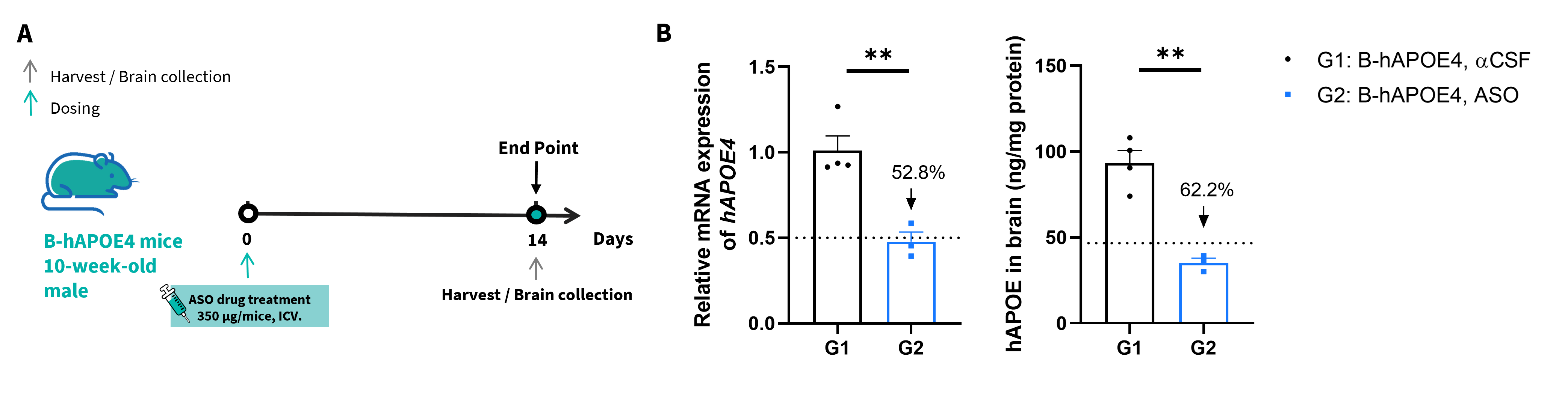
      Inhibitory Efficiency of the Small Nucleic Acid Drugs Against human APOE4

      The inhibitory efficiency of the APOE4-targeted small nucleic acid drug in homozygous B-hAPOE4 mice. B-hAPOE4 mice were randomly divided into 2 groups (n=3, 10-week-old, male). The human APOE4-targeted nucleic acid drug (from literature, doi: 10.1016/j.neuron.2017.11.014) and αCSF were administered to the mice individually. The mice were sacrificed on day 14, and the brains (cortex) were collected to detect the human APOE4 expression by qRT-PCR and ELISA. (A) The schematic diagram of experimental processing. (B) The expression of human  APOE4 mRNA and APOE4 protein in cortex. The human APOE4 mRNA and APOE protein in the treatment group were significantly reduced compared to the control group. Values are expressed as mean ± SEM. Significance was determined by unpaired t-test.  *P < 0.05, **P < 0.01, ***P < 0.001.

      * When publishing results obtained using this animal model, please acknowledge the source as follows: The animal model [B-hAPOE4 mice] (Cat# 112564) was purchased from Biocytogen.