Description
- CD3 consists of four protein chains (CD3E, CD3D, CD3G and CD3Z), which are important biological markers on the T cell membrane. CD3 can form a TCR/CD3 complex with the T cell receptor, participating in the regulation of T cell antigen recognition, signal transduction and T cell development. DLL3 (Delta-like ligand 3) encodes a transmembrane protein that belongs to the Notch ligand family. It primarily functions as a regulatory factor for the Notch signaling pathway, typically acting as an antagonist to inhibit the activation of Notch receptors, which are involved in cell differentiation, proliferation, and apoptosis. Additionally, DLL3 may play roles in cell adhesion and migration. DLL3 expression is limited in normal tissues, primarily observed in the developing central nervous system (e.g., the brain and spinal cord during the embryonic stage). Under pathological conditions, DLL3 is frequently overexpressed in tumor cells, particularly in neuroendocrine tumors such as small cell lung cancer (SCLC), pulmonary neuroendocrine carcinoma, and certain brain tumors. DLL3 is an attractive therapeutic target. Current research and development efforts focus on targeted monoclonal antibodies, antibody-drug conjugates (ADCs), and combinatorial immunotherapy.
- B-hCD3EDG/hDLL3 mice were obtained by mating B-hCD3EDG mice (110039) and B-hDLL3 mice (110926). In B-hCD3EDG/hDLL3 mice, chimeric human CD3EDG were expressed, while mouse Cd3edg were knocked out. The exons 2-7 of mouse Dll3 gene that encode extracellular domain were replaced by human counterparts in B-hCD3EDG/hDLL3 mice.
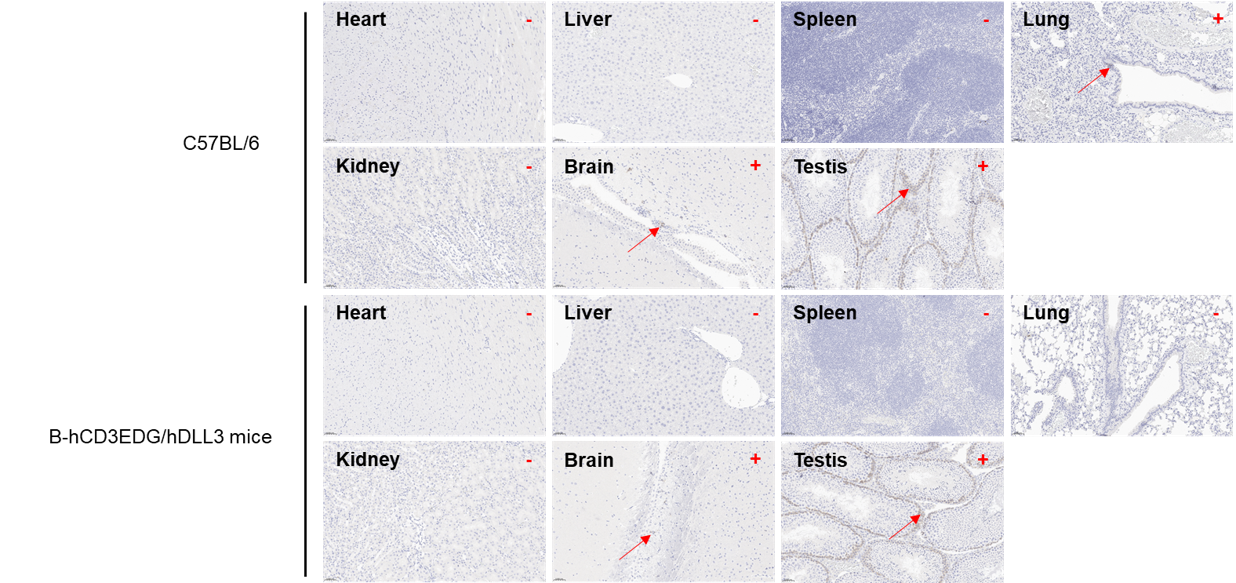
- DLL3 expression was detected in the brain, testis, and lung of C57BL/6 mice, but only in the brain and testis of homozygous B-hCD3EDG/hDLL3 mice.
- Anti-human CD3/DLL3 bispecific antibodies, AMG-757 analog, inhibited B-hDLL3 B16-F10 tumor growth in B-hCD3EDG/hDLL3 mice.
- This model is suitable for pharmacological and safety evaluation of TCE (T Cell Engager)-related drug candidates.
Protein expression analysis
Immunohistochemical (IHC) analysis of DLL3 expression in homozygous B-hCD3EDG/hDLL3 mice. The heart, liver, spleen, lung, kidney, brain, and testis were collected from C57BL/6 mice (+/+) (male, n=2) and homozygous B-hCD3EDG/hDLL3 mice (H/H) (male, n=2) , analyzed by IHC with anti-hDLL3 (abcam, ab229902). DLL3 expression was detected in the brain, testis, and lung of C57BL/6 mice, but only in the brain and testis of homozygous B-hCD3EDG/hDLL3 mice. This may reflect reduced DLL3 expression in the lung of B-hCD3EDG/hDLL3 mice. The arrow indicates tissue cells with positive DLL3 staining (brown). “+” indicates that the tissue is positive and “-” indicates that the tissue is negative.
In Vivo Efficacy Evaluation of AMG-757 in B-hCD3EDG/hDLL3 mice
Antitumor Activity of Anti-Human CD3/DLL3 Bispecific Antibodies (AMG-757 analog, Commercialized) in B-hCD3EDG/hDLL3 mice. B-hDLL3 B16-F10 mouse melanoma cells were subcutaneously implanted into homozygous B-hCD3EDG/hDLL3 mice (female, 11-week-old, n=6). Mice were grouped once tumor volume reached approximately 80 mm³, at which time they were intravenously injected with anti-human CD3/DLL3 bispecific antibodies (indicated in the panel). (A) Anti-human CD3/DLL3 bispecific antibodies inhibited B-hDLL3 B16-F10 tumor growth in B-hCD3EDG/hDLL3 mice. (B) Body weight changes during treatment. Values are expressed as mean ± SEM.
* When publishing results obtained using this animal model, please acknowledge the source as follows: The animal model [B-hCD3EDG/hDLL3 mice] (Cat# 113840) was purchased from Biocytogen.