
C57BL/6-Pdcd1tm1(PDCD1)BcgenCd274tm1(CD274)BcgenKdrtm1(KDR)Bcgen/Bcgen • 112494

Gene targeting strategy for B-hPD-1/hPD-L1/hVEGFR2 mice. The exon 2 of mouse Pdcd1 gene that encodes the IgV domain was replaced by human PDCD1 exon 2 in B-hPD-1/hPD-L1/hVEGFR2 mice. The exon 3 of mouse Cd274 gene that encodes the IgV domain was replaced by human CD274 exon 3 in B-hPD-1/hPD-L1/hVEGFR2 mice. The exons 2-15 of mouse Vegfr2 gene that encode the extracellular region were replaced by human VEGFR2 exons 2-15 in B-hPD-1/hPD-L1/hVEGFR2 mice.

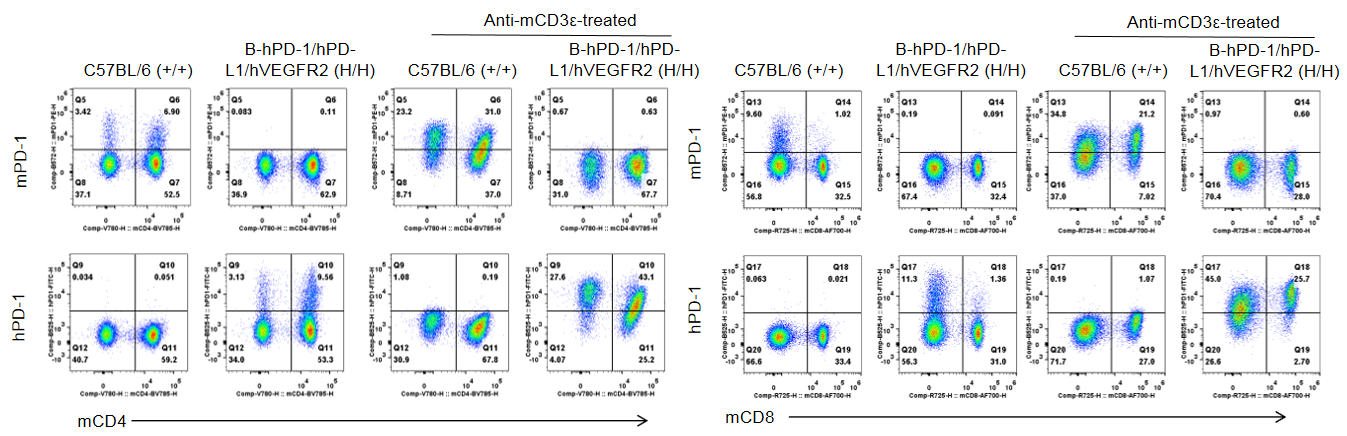
Strain specific PD-1 expression analysis in wild-type C57BL/6 and homozygous B-hPD-1/hPD-L1/hVEGFR2 mice by flow cytometry. Splenocytes were collected from wild-type C57BL/6 mice (+/+) and homozygous B-hPD-1/hPD-L1/hVEGFR2 mice (H/H) after stimulated with anti-CD3ε in vivo or not. Mouse PD-1 was detectable on CD4+ T cells and CD8+ T cell in wild-type C57BL/6 mice. Human PD-1 was exclusively detectable on CD4+ T cells and CD8+ T cell in homozygous B-hPD-1/hPD-L1/hVEGFR2 mice but not in wild-type mice.
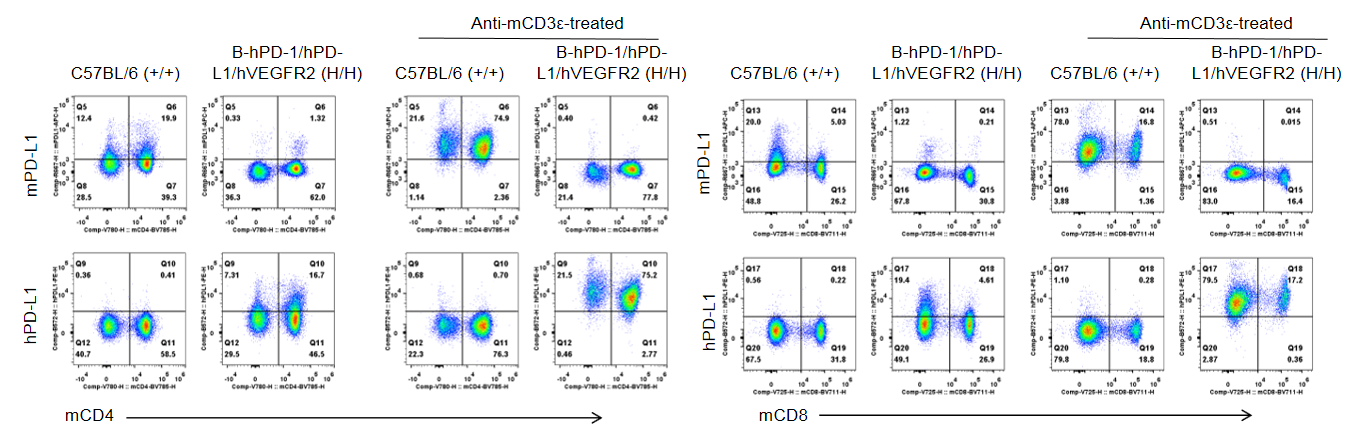
Strain specific PD-L1 expression analysis in wild-type C57BL/6 and homozygous B-hPD-1/hPD-L1/hVEGFR2 mice by flow cytometry. Splenocytes were collected from wild-type C57BL/6 mice (+/+) and homozygous B-hPD-1/hPD-L1/hVEGFR2 mice (H/H) after stimulated with anti-CD3ε in vivo or not. Mouse PD-L1 was detectable on CD4+ T cells and CD8+ T cell in wild-type C57BL/6 mice. Human PD-L1 was exclusively detectable on CD4+ T cells and CD8+ T cell in homozygous B-hPD-1/hPD-L1/hVEGFR2 mice but not in wild-type mice.
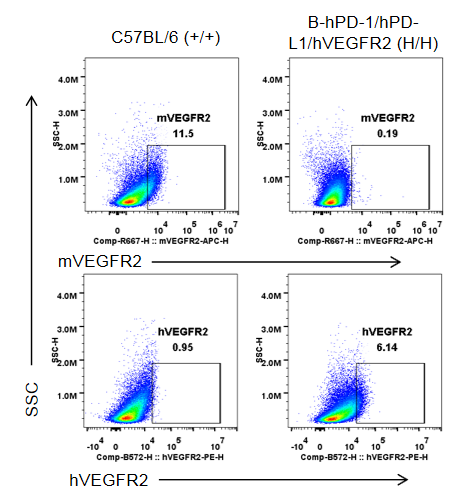
Strain specific VEGFR2 expression analysis in wild-type C57BL/6 and homozygous B-hPD-1/hPD-L1/hVEGFR2 mice by flow cytometry. Lung endothelial cells were collected from wild-type C57BL/6 mice (+/+) and homozygous B-hPD-1/hPD-L1/hVEGFR2 mice (H/H). Mouse VEGFR2 was detectable in lung endothelial cells in wild-type C57BL/6 mice. Human VEGFR2 was only detectable in homozygous B-hPD-1/hPD-L1/hVEGFR2 mice but not in wild-type mice.


Antitumor activity of anti-PD-L1/VEGFR2 BsAbs in B-hPD-1/hPD-L1/hVEGFR2 mice. Murine colon cancer B-hVEGFA/hPD-L1 plus MC38 were subcutaneously implanted into homozygous B-hPD-1/hPD-L1/hVEGFR2 mice (male, 7-week-old, n=6). Mice were grouped when tumor volume reached approximately 80-120 mm3, at which time they were intraperitoneally injected with anti-PD-L1/VEGFR2 bispecific antibody indicated in panel. As shown in panel A, anti-PD-L1/VEGFR2 BsAbs was efficacious in controlling tumor growth in B-hPD-1/hPD-L1/hVEGFR2 mice. The antibody provided by the client. Values are expressed as mean ± SEM.
The overage of this tumor model is 66%.