Description
URAT1: Key Urate Transporter & Gout Therapeutic Target
- Gene Information: Encoded by SLC22A12 gene on chromosome 11q13.1, a member of the solute carrier 22 (organic anion transporter) family.
- Protein Expression: Predominantly located on the apical membrane of renal proximal tubule epithelial cells.
- Signaling Pathway: Acts as an electroneutral anion exchanger, responsible for ~90% of renal urate reabsorption, and is central to human urate homeostasis.
- Therapeutic Inhibition: Small molecules (benzbromarone, verinurad, ruzinurad): Block URAT1 protein function to increase urate excretion and lower serum uric acid. RNA therapeutics: Silence SLC22A12 gene expression, enabling long-acting quarterly/semi-annual dosing and improved patient adherence.
Targeting strategy
- The exons 1-10 of mouse Urat1 gene that encode signal peptide, extracellular domain, cytoplasmic portion and transmembrane domain are replaced by human counterparts in B-hURAT1 mice.
- The promoter, 5’UTR and 3’UTR region of the mouse gene are also replaced by human counterparts. The URAT1 expression is driven by human URAT1 promoter, while mouse Urat1 gene transcription and translation will be disrupted.
mRNA expression analysis
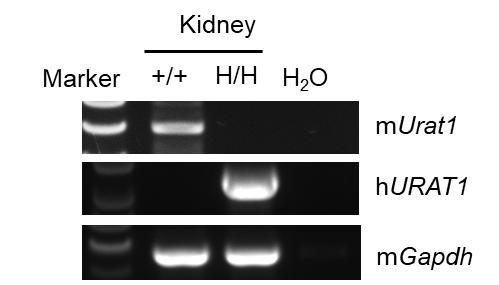
- Mouse Urat1 mRNA was only detected in wild-type mice.
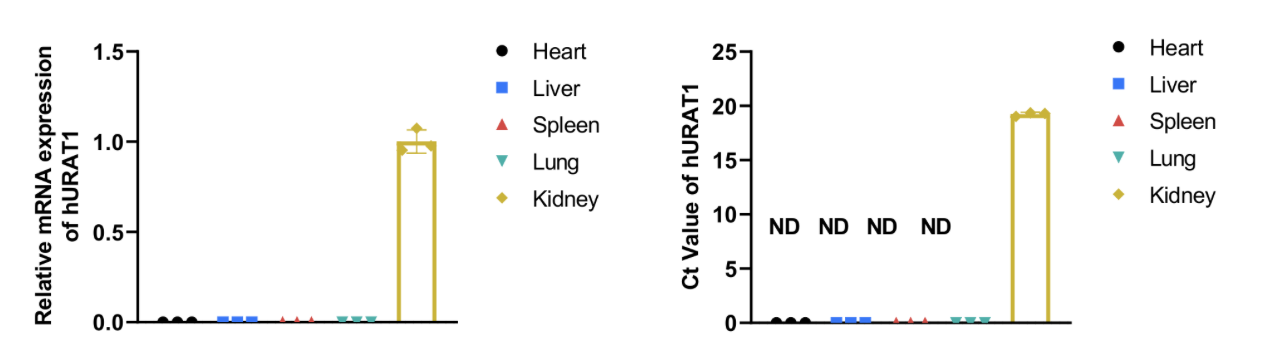
- Human URAT1 mRNA was exclusively detectable in homozygous B-hURAT1 mice but not in wild-type mice.
Strain specific analysis of URAT1 mRNA expression in wild-type C57BL/6JNifdc and B-hURAT1 mice by RT-PCR. Kidney RNA were isolated from wild-type C57BL/6JNifdc (+/+) and homozygous B-hURAT1 mice (H/H), then cDNA libraries were synthesized by reverse transcription, followed by PCR with mouse or human URAT1 primers.
Strain specific analysis of URAT1 gene expression in wild-type C57BL/6JNifdc mice and B-hURAT1 mice by RT-qPCR. Tissue RNA were isolated from wild-type C57BL/6JNifdc mice (+/+) and homozygous B-hURAT1 mice (H/H) (male, 7 week-old, n=3). Values are expressed as mean ± SEM. Significance was determined by unpaired t-test. *P < 0.05, **P < 0.01, ***P < 0.001.
IHC Analysis
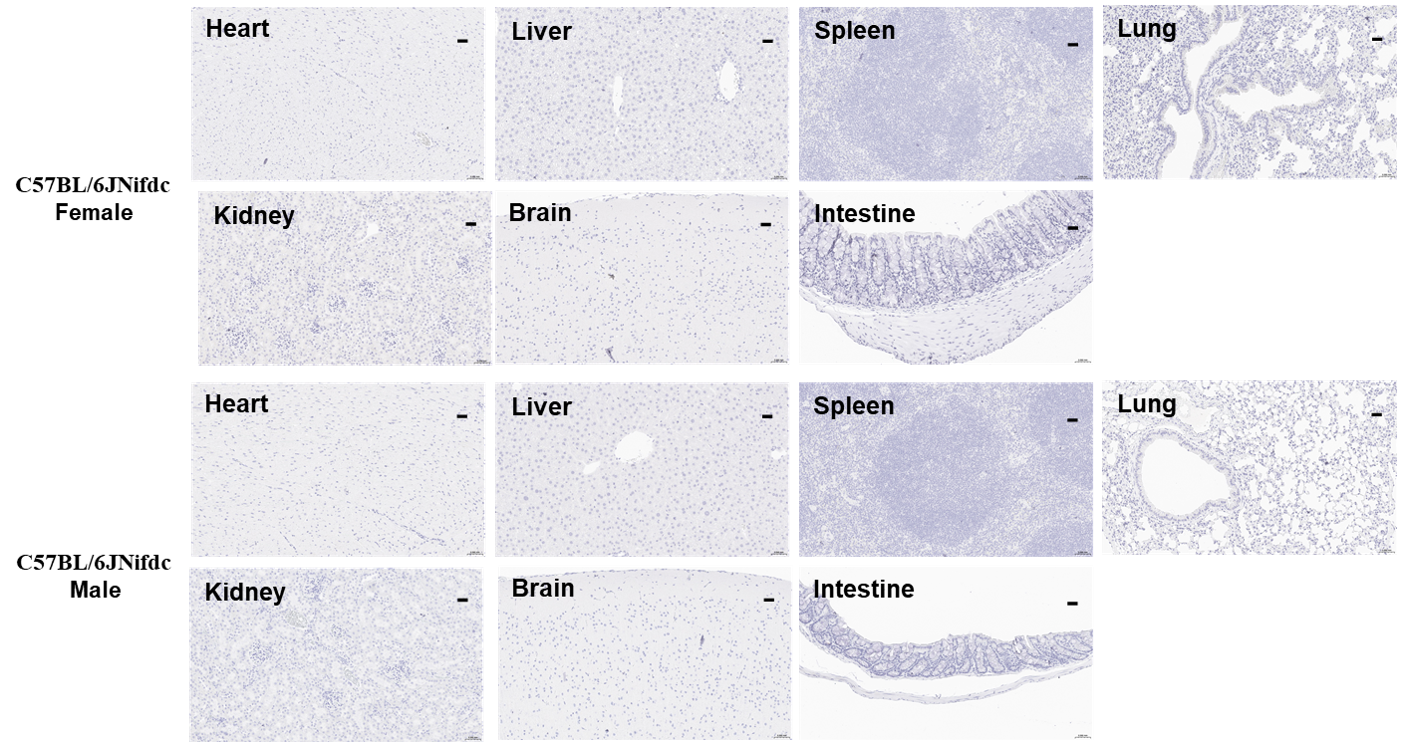
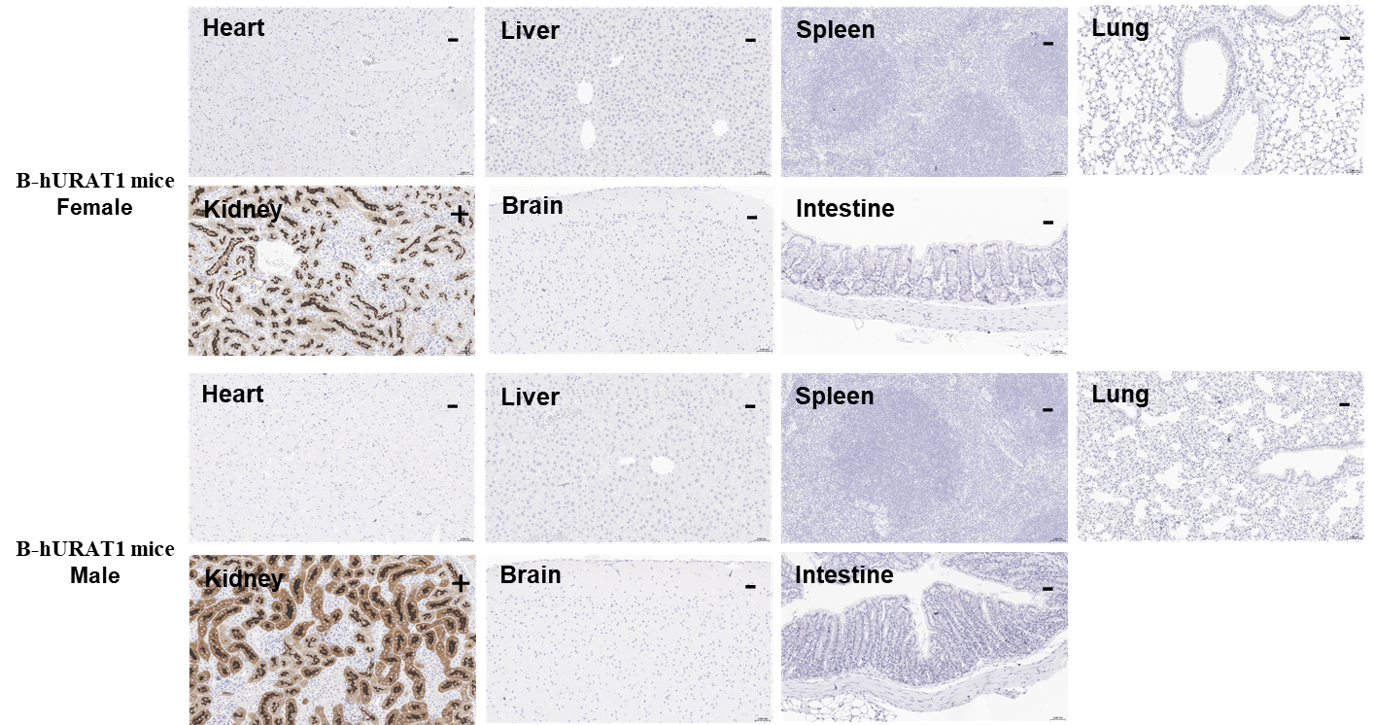
IHC analysis of URAT1 protein expression in wild-type C57BL/6JNifdc mice and homozygous B-hURAT1 mice. Various tissue lysates were collected from wild-type C57BL/6JNifdc mice (+/+) and homozygous B-hURAT1 mice (H/H), and then analyzed by IHC with anti-URAT1 antibody (Abcam, ab181237). Scale, 40x.
- Human URAT1 was detectable only in the kidney tissue of homozygous B-hURAT1 mice but not in wild-type mice.
Functional validation
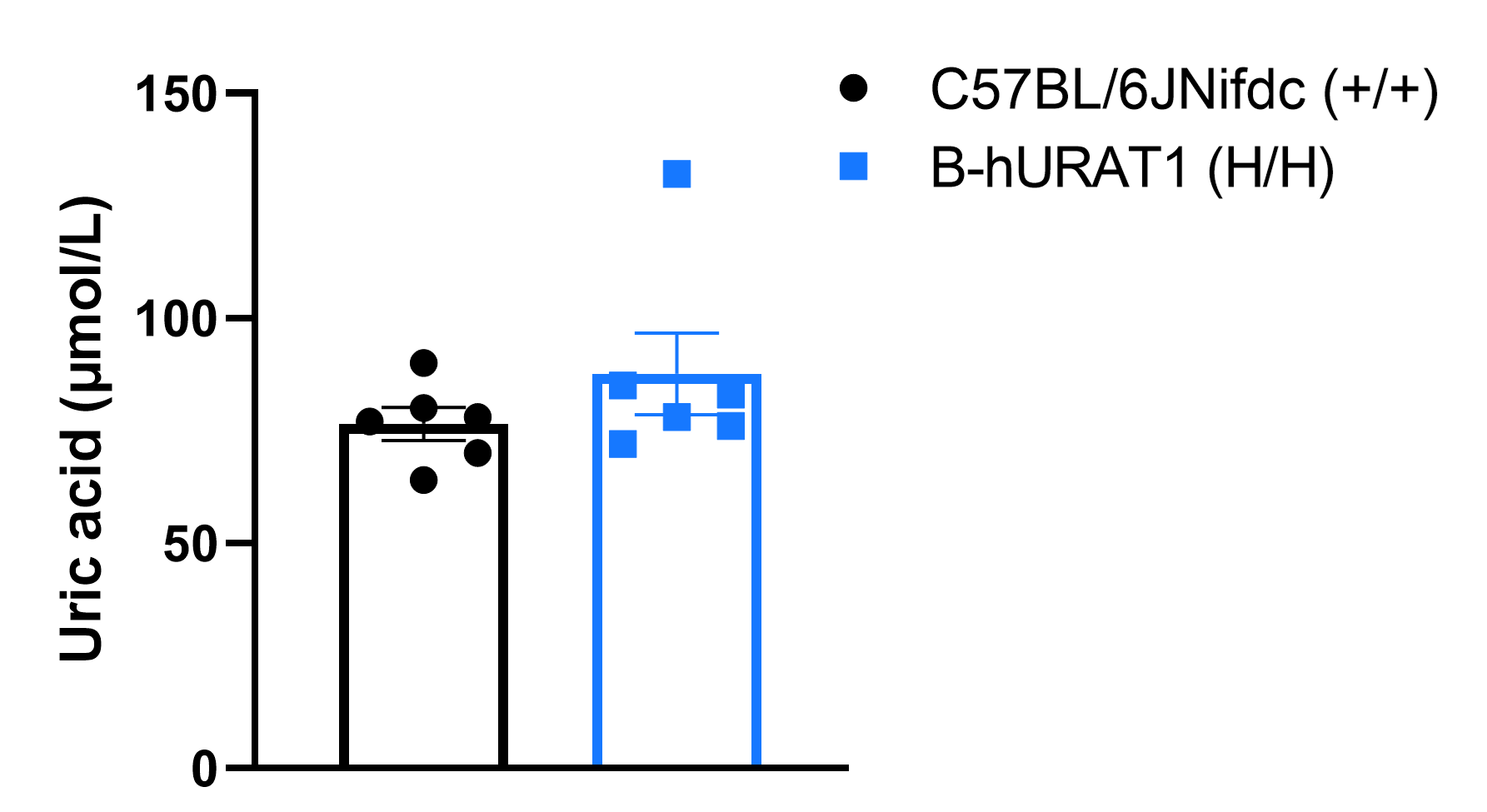
- Basal serum uric acid levels were comparable between homozygous B-hURAT1 mice and wild-type C57BL/6JNifdc mice.
Serum uric acid analysis in wild-type C57BL/6 mice and B-hURAT1 mice. Serum was collected from wild-type C57BL/6JNifdc mice (+/+) and homozygous B-hURAT1 mice (H/H) (male, 7 week-old, n=3). Values are expressed as mean ± SEM.
* When publishing results obtained using this animal model, please acknowledge the source as follows: The animal model [B-hURAT1 mice] (Cat# 113624) was purchased from Biocytogen.