

Human APOE is a 34 kDa glycoprotein and polymorphism in the APOE gene is a major genetic risk of late-onset Alzheimer disease, while APOE4 is associated with an increased risk and lower age of onset through multiple pathways, such as the inhibition of amyloid-β (Aβ) clearance, promotion of Aβ aggregation, influencing on tau pathology, impairing microglial responsiveness and lipid transport. Recently, the R136S point mutation in APOE3 has been identified as a protective variant against early-onset AD.
The exons 2-4 of mouse Apoe gene that encode the whole molecule (ATG to STOP codon), including 3’UTR were replaced by human counterparts with R136S mutation in B-hAPOE3*R136S mice. The promoter and 5’UTR of the mouse gene are retained. The human APOE3 with R136S mutation expression is driven by endogenous mouse Apoe promoter, while mouse Apoe gene transcription and translation will be disrupted.
Human APOE3 mRNA was detectable only in homozygous B-hAPOE3*R136S mice but not in wild-type mice. And the point mutation was confirmed via Sanger sequencing. Human APOE was exclusively detectable in homozygous B-hAPOE3*R136S mice but not in wild-type mice.
This model can be crossed with Alzheimer’s disease models to investigate the protective mechanisms by which this point mutation delays the onset of AD.

Gene targeting strategy for B-hAPOE3*R136S mice. The exons 2-4 of mouse Apoe gene that encode the whole molecule (ATG to STOP codon), including 3’UTR were replaced by human counterparts with R136S mutation in B-hAPOE3*R136S mice. The promoter and 5’UTR of the mouse gene are retained. The human APOE3 with R136S mutation expression is driven by endogenous mouse Apoe promoter, while mouse Apoe gene transcription and translation will be disrupted.

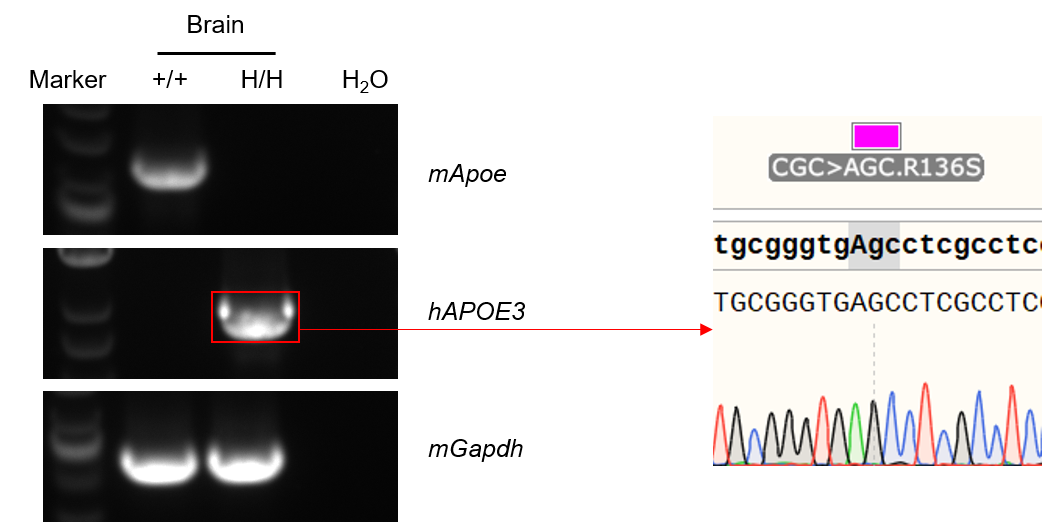
Strain specific analysis of APOE3 mRNA expression in wild-type C57BL/6JNifdc mice and homozygous B-hAPOE3*R136S mice by RT-PCR. Brain RNA were isolated from wild-type C57BL/6JNifdc mice (+/+) and homozygous B-hAPOE3*R136S mice (H/H), then cDNA libraries were synthesized by reverse transcription, followed by PCR with mouse or human APOE primers. Mouse Apoe mRNA was detectable only in wild-type mice. Human APOE3 mRNA was detectable only in homozygous B-hAPOE3*R136S mice but not in wild-type mice. And the R136S point mutation in human APOE3 mRNA were confirmed via Sanger sequencing.

Human specific APOE expression analysis in homozygous B-hAPOE3*R136S mice by ELISA. Serum were collected from wild-type C57BL/6JNifdc mice (+/+) and homozygous B-hAPOE3*R136S mice (H/H, n=2, 5-week-old, male) , and then analyzed by ELISA with human-specific Apo E ELISA kit (Abcam, ab233623). Human APOE was exclusively detectable in B-hAPOE3*R136S mice, but not in wild-type mice.
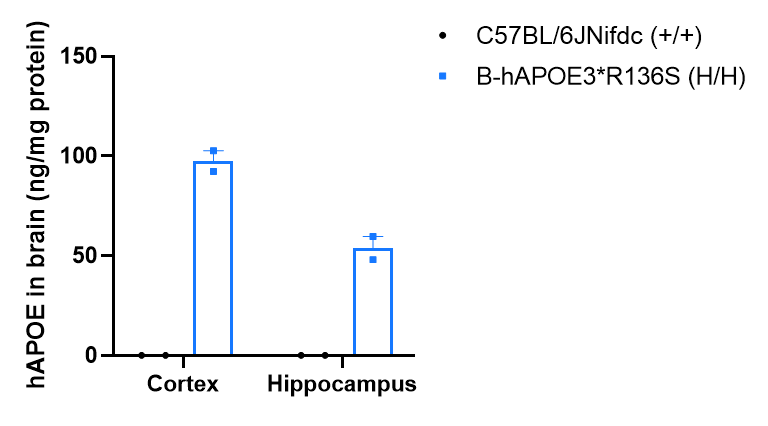
Human specific APOE expression analysis in homozygous B-hAPOE3*R136S mice by ELISA. Cortex and hippocampus were collected from wild-type C57BL/6JNifdc mice (+/+) and homozygous B-hAPOE3*R136S mice (H/H, n=2, 5-week-old, male), and then analyzed by ELISA with human-specific Apo E ELISA kit (Abcam, ab233623). Human APOE was exclusively detectable in B-hAPOE3*R136S mice, but not in wild-type mice.