Description
CD3: An important therapeutic target in immunotherapy
- Gene Information: CD3 is a protein complex that forms part of the T-cell receptor (TCR) signaling machinery. It consists of four chains encoded by the CD3D, CD3E, CD3G, and CD247 genes. Together with the TCR, CD3 transmits antigen recognition signals from the cell surface to the cell interior and is essential for T-cell development and activation.
- Protein Expression: CD3 is expressed on nearly all mature T cells, including CD4⁺ T cells, CD8⁺ T cells, and γδ T cells. It is generally absent from B cells, NK cells, and myeloid cells.
- Signaling Pathway: CD3 mediates TCR signaling through intracellular ITAM motifs. After antigen recognition, CD3 recruits signaling molecules such as ZAP-70, leading to activation of the NFAT, NF-κB, and MAPK/AP-1 pathways.
- Therapeutic Inhibition: CD3 is an important therapeutic target for modulating T-cell activity. Anti-CD3 antibodies, such as teplizumab, can suppress or regulate T-cell responses and are used in autoimmune diseases. CD3 is also widely used in bispecific T-cell engagers, which redirect T cells to kill tumor cells, as seen with blinatumomab.
CLDN6: A tumor-associated tight junction protein and therapeutic target
- Gene Information: Claudin 6 (CLDN6) is a protein-coding gene located on chromosome 16p13.3. It encodes a member of the claudin family of tight junction proteins, which are key components of epithelial cell-cell junctions and contribute to the regulation of paracellular permeability and epithelial barrier integrity.
- Protein Expression: CLDN6 is predominantly expressed during embryonic development, while its expression is generally low or absent in most adult normal tissues. Aberrant CLDN6 expression has been detected in multiple cancers, including ovarian, endometrial, gastric, pancreatic, and lung cancers, making CLDN6 an attractive tumor-associated target for therapeutic development.
- Signaling Pathway: CLDN6 is a four-transmembrane-domain protein localized primarily to tight junctions and interacts with other claudin family members and junction-associated proteins. Beyond its structural role in maintaining epithelial integrity, aberrant CLDN6 expression in cancer cells has been associated with signaling pathways involved in tumor cell proliferation, survival, migration, and epithelial-mesenchymal transition (EMT).
- Therapeutic Targeting: Because CLDN6 is highly expressed in several tumor types but has limited expression in most adult normal tissues, it represents a promising target for cancer therapy. Therapeutic approaches under development include CLDN6-targeted monoclonal antibodies, antibody-drug conjugates (ADCs), bispecific antibodies, and CAR-T cell therapies, aiming to selectively recognize and eliminate CLDN6-positive tumor cells.
Targeting strategy
CLDN6
- Exon 3 of the mouse Cldn6 gene, which encodes the entire protein (from the initiation codon ATG to the stop codon), was replaced with the corresponding human sequence in B-hCD3EDG/hCLDN6 plus mice.
- The endogenous mouse promoter, 5' UTR, and 3' UTR regions were retained. Human CLDN6 expression is driven by the endogenous mouse Cldn6 promoter, while endogenous mouse Cldn6 transcription and translation are disrupted.
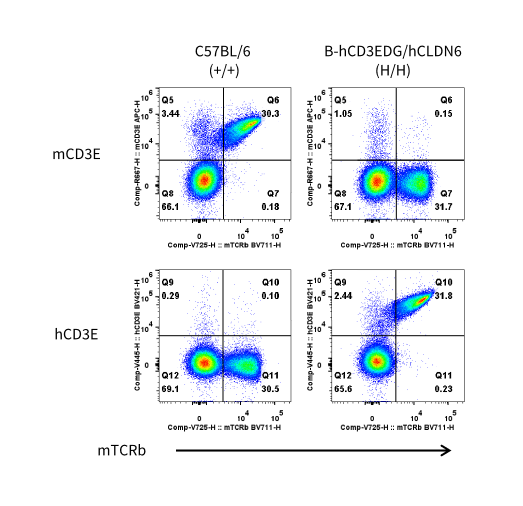
CD3E Protein Expression in Spleen
Mouse and human CD3E expression analysis in splenocytes. Splenocytes were collected from wild-type C57BL/6 mice (+/+) and homozygous B-hCD3EDG/hCLDN6 plus mice (H/H). CD3E expression on T cells was analyzed by flow cytometry using an anti-mouse CD3E antibody (BioLegend, 100312) and an anti-human CD3E antibody (BD Biosciences, 562877).
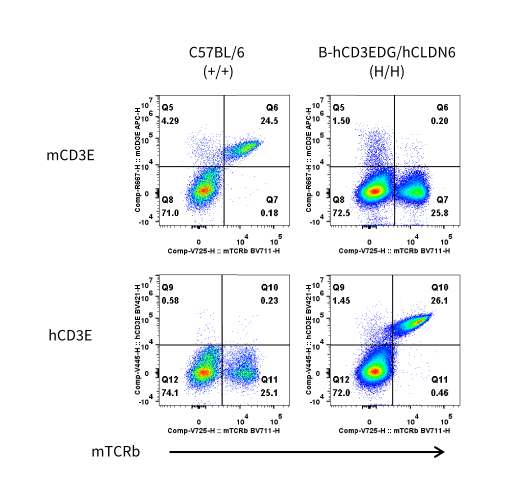
CD3E Protein Expression in Blood
Mouse and human CD3E expression analysis in blood cells. Blood cells were collected from wild-type C57BL/6 mice (+/+) and homozygous B-hCD3EDG/hCLDN6 plus mice (H/H). CD3E expression on T cells was analyzed by flow cytometry using an anti-mouse CD3E antibody (BioLegend, 100312) and an anti-human CD3E antibody (BD Biosciences, 562877).
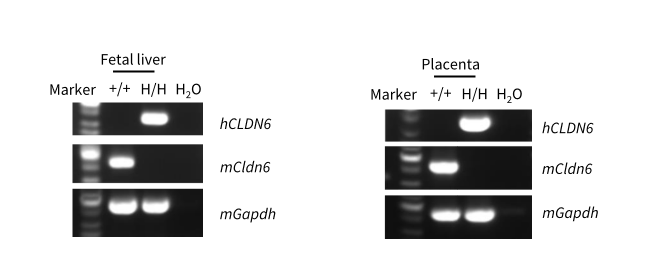
CLDN6 Expression by RT-PCR
Human CLDN6 mRNA was detectable in B-hCD3EDG/hCLDN6 plus mice by RT-PCR and sequencing. Fetal liver (left) and placenta (right) were isolated from wild-type C57BL/6 mice (+/+) and homozygous B-hCD3EDG/hCLDN6 plus mice (H/H). Primers were designed to detect human CLDN6 and mouse Cldn6 transcripts. Sequencing of the PCR products confirmed that the amplified sequences were consistent with database reference sequences.
* When publishing results obtained using this animal model, please acknowledge the source as follows: The animal model [B-hCD3EDG/hCLDN6 plus mice] (Cat# 114694) was purchased from Biocytogen.