Description
Background:
- Hao1 (hydroxyacid oxidase 1) is a protein-coding gene responsible for coding 2-hydroxyacid oxidase, belonging to the FMN dependent α - hydroxyacid dehydrogenase family. The Hao1 gene is highly conserved across a wide range of species, including humans, mice, rats, and zebrafish. The primary physiological role of Hao1 is to serve as the rate-limiting enzyme in the endogenous production of oxalate. Dysregulation of Hao1 is closely linked to Primary Hyperoxaluria type 1 (PH1).
- Primary hyperoxaluria (PH) is an autosomal recessive disorder characterized clinically by elevated urinary oxalate excretion, recurrent calcium oxalate kidney stones, nephrocalcinosis, and systemic deposition of insoluble oxalate. The underlying mechanism of PH involves excessive hepatic oxalate synthesis driven by genetic mutations. Based on the specific gene affected, PH is classified into three subtypes. Among these, PH1 is the most common and most severe form, accounting for approximately 80% of all PH cases, while PH2 and PH3 each represent about 10%.
- Therapeutic insight: Suppressing Hao1 expression or activity has been shown to effectively reduce hepatic oxalate production, offering a promising therapeutic strategy for managing hyperoxalemia in patients with PH1.
Targeting strategy:
- The exons 1-8 of mouse Hao1 gene that encode the whole molecule (ATG to STOP codon), including 3’UTR were replaced by human counterparts in B-hHAO1 mice. The promoter and 5’UTR region of the mouse gene are replaced by human counterparts. The human HAO1 expression is driven by human HAO1 promoter, while mouse Hao1 gene transcription and translation will be disrupted.
Verification:
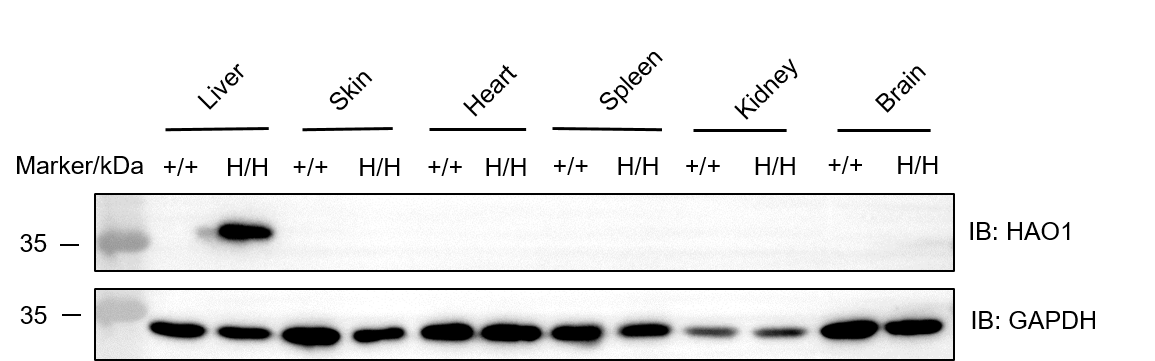
- Human HAO1 protein was only detectable in the liver of homozygous B-hHAO1 mice.
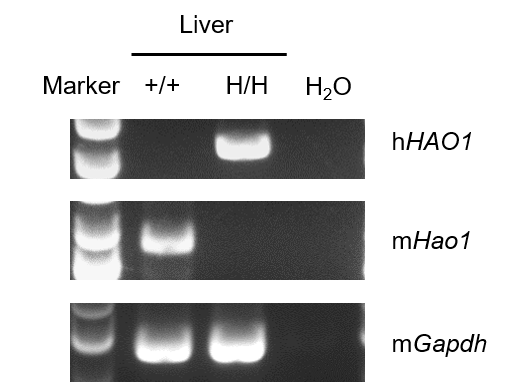
- Mouse Hao1 mRNA was only detected in wild-type mice, human HAO1 mRNA was only detected in homozygous B-hHAO1 mice.
Application:
- This product can be used for efficacy testing and safety evaluation of primary hyperoxaluria (PH), anti-tumor drugs and anti-inflammatory drugs.
Targeting strategy
Gene targeting strategy for B-hHAO1 mice. The exons 1-8 of mouse Hao1 gene that encode the whole molecule (ATG to STOP codon), including 3’UTR were replaced by human counterparts in B-hHAO1 mice. The promoter and 5’UTR region of the mouse gene are replaced by human counterparts. The human HAO1 expression is driven by human HAO1 promoter, while mouse Hao1 gene transcription and translation will be disrupted.
Protein expression analysis
Western blot analysis of HAO1 protein expression in homozygous B-hHAO1 mice. Various tissue lysates were collected from wild-type C57BL/6JNifdc mice (+/+) and homozygous B-hHAO1 mice (H/H), and then analyzed by western blot with anti-HAO1 antibody (Abcam, ab224577). 40 μg total protein was loaded for western blotting analysis. Human HAO1 protein was exclusively detectable in liver from homozygous B-hHAO1 mice, not from wild-type mice.
mRNA expression analysis
Strain specific analysis of HAO1 mRNA expression in wild-type C57BL/6JNifdc mice and homozygous B-hHAO1 mice by RT-PCR. Liver RNA were isolated from wild-type C57BL/6JNifdc mice (+/+) and homozygous B-hHAO1 mice (H/H), then cDNA libraries were synthesized by reverse transcription, followed by PCR with mouse or human HAO1 primers. Mouse Hao1 mRNA was only detectable in wild-type mice. Human HAO1 mRNA was detectable only in homozygous B-hHAO1 mice but not in wild-type mice.
* When publishing results obtained using this animal model, please acknowledge the source as follows: The animal model [B-hHAO1 mice] (Cat# 113277) was purchased from Biocytogen.