Description
- Leptin, a protein hormone secreted by adipocytes, elicits satiety and sustains energy homeostasis through activating the leptin receptor (LepR)–STAT3 signaling cascade in a specific subset of hypothalamic neurons. Notably, leptin signaling becomes impaired in obese individuals: even with elevated circulating leptin concentrations, appetite remains persistently heightened. The anorexigenic effect of leptin is mediated by its binding to LepR expressed on the membrane of select hypothalamic neurons. Upon LepR activation, the transcription factor Signal Transducer and Activator of Transcription 3 (STAT3) undergoes phosphorylation and subsequent activation, which in turn induces the synthesis of anorexigenic peptides; these peptides function to curb food intake and enhance energy expenditure.
- The targeting strategy: The exons 2-3 of mouse Lep gene that encode the whole molecule (ATG to STOP codon), including 3’UTR, were replaced by human counterparts in B-hLEP mice. The promoter and 5’UTR of the mouse gene are also retained. The human LEP expression is driven by the endogenous mouse Lep promoter, while mouse Lep gene transcription and translation will be disrupted.
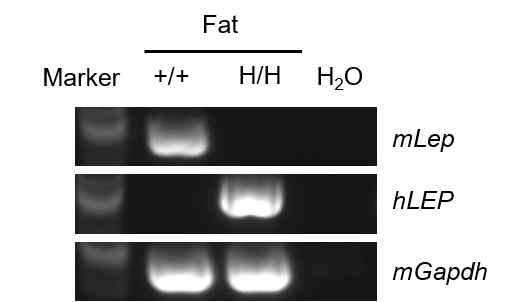
- Mouse Lep mRNA was only detectable in wild-type mice. Human LEP mRNA was exclusively detectable in homozygous B-hLEP mice but not in wild-type mice.
- Human LEP was exclusively detectable in homozygous B-hLEP mice by ELISA, but not in wild-type mice.
- This model can be used to evaluate the efficacy of obesity therapeutics
Targeting Strategy
Gene targeting strategy for B-hLEP mice. The exons 2-3 of the mouse Lep gene that encode the whole molecule (ATG to STOP codon), including 3’UTR, were replaced by human counterparts in B-hLEP mice. The promoter and 5’UTR of the mouse gene are also retained. The human LEP expression is driven by the endogenous mouse Lep promoter, while mouse Lep gene transcription and translation will be disrupted.
Protein Expression Analysis in Serum
Human LEP expression analysis in wild-type C57BL/6JNifdc mice and homozygous humanized B-hLEP mice by ELISA. Serum was collected from wild-type C57BL/6JNifdc mice (+/+) (male, n=3, 10-week-old) and homozygous B-hLEP mice (H/H) (male, n=3, 9-week-old). Expression level of mouse and human LEP was analyzed by ELISA (anti-mouse LEP ELISA kit: Abcam, ab199082; anti-human LEP ELISA kit: Abcam, ab179884). (A) Mouse LEP was exclusively detectable in wild-type mice, and weakly detectable in homozygous B-hLEP mice. We hypothesize that the mouse LEP assay kit has some non-specific binding. (B) Human LEP was exclusively detectable in homozygous B-hLEP mice. Values are expressed as mean ± SEM.
mRNA Expression Analysis
Strain specific analysis of LEP mRNA expression in wild-type C57BL/6JNifdc and B-hLEP mice by RT-PCR. Fat RNA was isolated from wild-type C57BL/6JNifdc (+/+) and homozygous B-hLEP mice (H/H), then cDNA libraries were synthesized by reverse transcription, followed by PCR with mouse or human LEP primers. Mouse Lep mRNA was only detectable in wild-type mice. Human LEP mRNA was exclusively detectable in homozygous B-hLEP mice but not in wild-type mice.
* When publishing results obtained using this animal model, please acknowledge the source as follows: The animal model [B-hLEP mice] (Cat# 113749) was purchased from Biocytogen.