Description
- TPBG (trophoblast glycoprotein; also known as 5T4/WAIF1) is a highly N-glycosylated, type I single-pass transmembrane protein (420 aa) with a large extracellular leucine-rich repeat (LRR) region that mediates protein–protein interactions and a short intracellular tail containing a PDZ-binding motif (Ser-Asp-Val). In normal physiology, TPBG is prominently expressed in trophoblast lineages early in pregnancy (placenta) and shows very restricted expression in adult tissues (limited to a few epithelial cell types), whereas it is overexpressed across many carcinomas (e.g., colorectal, ovarian, gastric, renal), making it a classic “oncofetal” surface antigen. A definitive soluble “ligand” has not been firmly established, but TPBG is reported to functionally associate with the Wnt co-receptor LRP6, inhibiting Wnt3a-dependent LRP6 internalization and thereby modulating canonical Wnt/β-catenin signaling while also promoting pro-migratory, non-canonical Wnt outputs linked to EMT, invasion, and metastasis; TPBG has additionally been implicated in regulating CXCR4 surface expression and CXCL12-driven chemotaxis in model systems. Given its tumor-enriched membrane expression, TPBG is actively pursued as an immuno-oncology target using multiple modalities including therapeutic vaccines, antibody-drug conjugates, T-cell engagers/bispecifics, and cellular therapies such as anti-5T4 CAR-NK/T approaches for advanced solid tumors.
- In B-NDG hTPBG mice, the exon 2 of mouse Tpbg gene that encode the full coding sequences, including signal peptide, extracellular domain, transmembrane domain and cytoplasmic domain was replaced by human counterparts. Human TPBG expression can only be detected in brain and spinal cord of B-NDG hTPBG mice.
- Application: B-NDG hTPBG mice enable in vivo efficacy and safety evaluation of TPBG-targeted therapeutics (e.g., ADCs, bispecifics, and cell therapies) with on-target/off-tumor assessment.
Targeting Strategy
Gene targeting strategy for B-NDG hTPBG mice. The exon 2 of mouse Tpbg gene that encode the full coding sequences, including signal peptide, extracellular domain, transmembrane domain and cytoplasmic domain was replaced by human counterparts in B-NDG hTPBG mice. The promoter, 5’UTR and 3’UTR region of the mouse gene were retained. The humanized TPBG expression was driven by endogenous mouse Tpbg promoter, while mouse Tpbg gene transcription and translation will be disrupted.
mRNA Expression Analysis in B-NDG hTPBG mice
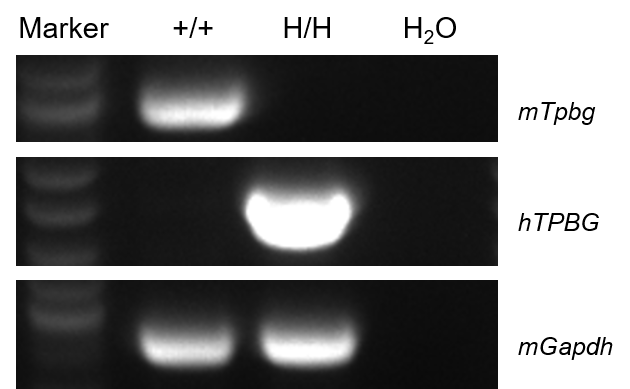
Species specific analysis of TPBG gene expression in wild-type B-NDG mice and homozygous B-NDG hTPBG mice by RT-PCR. The brain tissues were collected from wild-type B-NDG mice (+/+) and homozygous B-NDG hTPBG mice (H/H). Mouse Tpbg mRNA was only detectable in wild-type B-NDG mice. Human TPBG mRNA was only detectable in homozygous B-NDG hTPBG mice, but not in wild-type B-NDG mice.
Protein Expression Profiling Analysis in B-NDG hTPBG mice
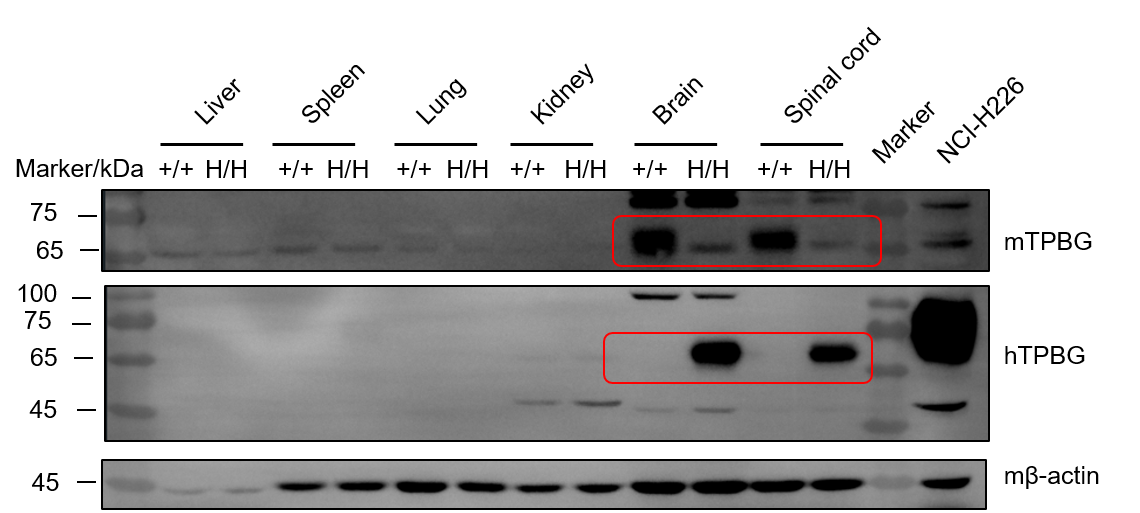
Strain specific TPBG expression analysis in wild-type B-NDG mice (+/+) and homozygous humanized B-NDG hTPBG mice (H/H) by western blot. The tissues of liver, spleen, lung, kidney, brain and spinal cord were collected from wild-type B-NDG mice (+/+) and homozygous B-NDG hTPBG mice (H/H) (female, 7-week-old, n=1). Protein expression was analyzed with anti-mouse TPBG antibody (R&D, AF5049-SP) and anti-human TPBG antibody (Abcam, ab134162) by western blot. Because of the cross-reaction of anti-mouse antibody, TPBG expression can be detected in brain and spinal cord of wild-type B-NDG mice and homozygous B-NDG hTPBG mice. Human TPBG expression can only be detected in brain and spinal cord of B-NDG hTPBG mice, but not in wild-type B-NDG mice.
* When publishing results obtained using this animal model, please acknowledge the source as follows: The animal model [B-NDG hTPBG mice] (Cat# 113221) was purchased from Biocytogen.