Description
- As a member of the TNF receptor superfamily (TNFRS7), CD27 is constitutively expressed on NK cells, naive T cells, and most memory T cells. Its activity is regulated by the unique ligand CD70, which appears only transiently on activated antigen-presenting cells like dendritic cells and B cells. Upon ligation, CD27 recruits TRAF2 and TRAF5 to its cytoplasmic domain, triggering the NF-κB and MAPK/JNK pathways to bolster T cell survival and cytokine synthesis. Consequently, this axis is indispensable for the long-term maintenance of the memory T cell pool, while simultaneously driving plasma cell differentiation and immunoglobulin class switching.
- The exon 1-6 of mouse Cd27 gene that encode the whole molecule were knockout in B-Cd27 KO mice. Mouse Cd27 gene transcription and translation will be disrupted.
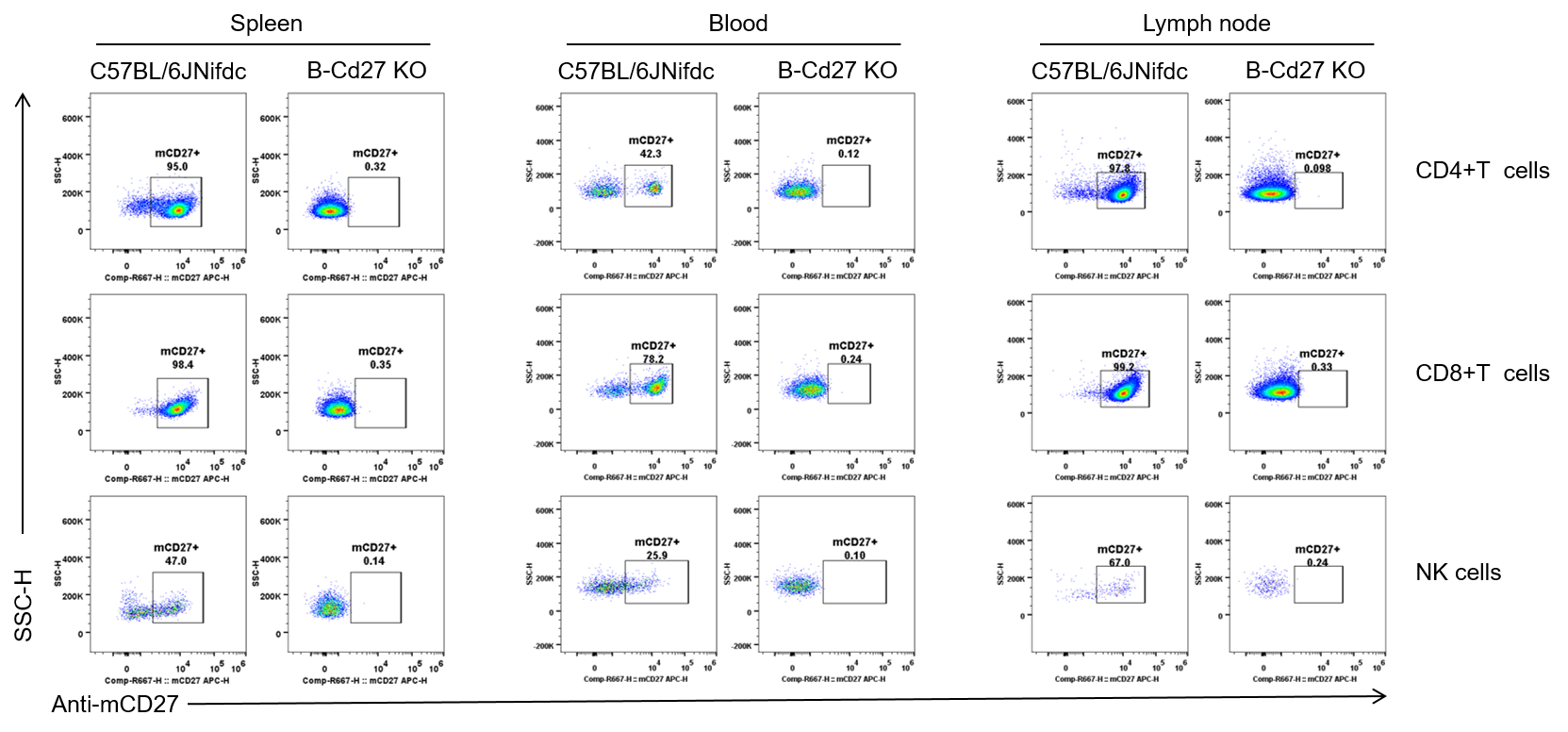
- Mouse CD27 was only detectable in T cells and NK cells of wild-type C57BL/6JNifdc mice, but not in B-Cd27 KO mice.
- Application: This product is used for mechanistic research on tumor immunity, autoimmune neuroinflammation (e.g., EAE,SLE), and metabolic disorders such as obesity, focusing on CD27-dependent immune cell crosstalk and Th17/Th2 modulation.
Targeting Strategy
Gene targeting strategy for B-Cd27 KO mice. The exon 1-6 of mouse Cd27 gene that encode the whole molecule were knockout in B-Cd27 KO mice. Mouse Cd27 gene transcription and translation will be disrupted.
Protein Expression Analysis
Strain specific CD27 expression analysis in wild-type C57BL/6JNifdc mice and B-Cd27 KO mice by flow cytometry. Lymphocytes were collected from wild-type C57BL/6JNifdc mice (+/+) and homozygous B-Cd27 KO mice (-/-). Protein expression was analyzed with anti-mouse CD27 antibody (BioLegend, 124212) by flow cytometry. The mouse CD27 was only detectable in wild-type C57BL/6JNifdc mice, but not in homozygous B-Cd27 KO mice.
* When publishing results obtained using this animal model, please acknowledge the source as follows: The animal model [B-Cd27 KO mice] (Cat# 114883) was purchased from Biocytogen.