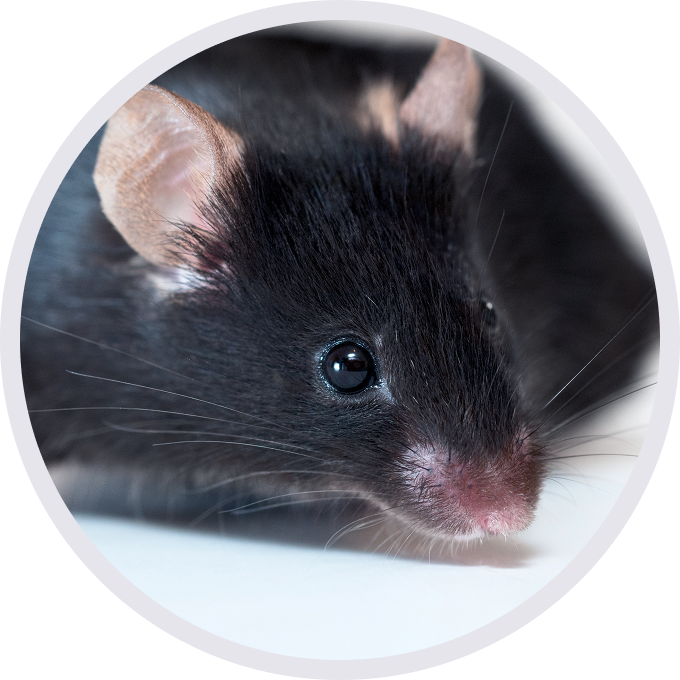

Background: GLUT1, a glucose transporter, encoded by Slc2a1, crucially transports glucose across cell membranes. It ensures glucose supply to the brain via the blood-brain barrier and enables glucose uptake in red blood cells for energy. GLUT1-Deficiency Syndrome (GLUT1-DS), leads to early-onset epilepsy, developmental delay, and movement disorders. A ketogenic diet is the main treatment, as ketone bodies cross the blood-brain barrier to provide alternative energy for neurons.
Targeting strategy: The exons 3~10 of mouse Slc2a1 were knocked out in B-Glut1 KO mice.
Validation:
Application: This strain is a GLUT1-Deficiency Syndrome (GLUT1-DS) disease model mouse, which can be used for the pathological research of GLUT1-DS and the evaluation of drug efficacy.

Gene targeting strategy for B-Glut1 KO mice. The exons 3~10 of mouse Slc2a1 were knocked out in B-Glut1 KO mice.

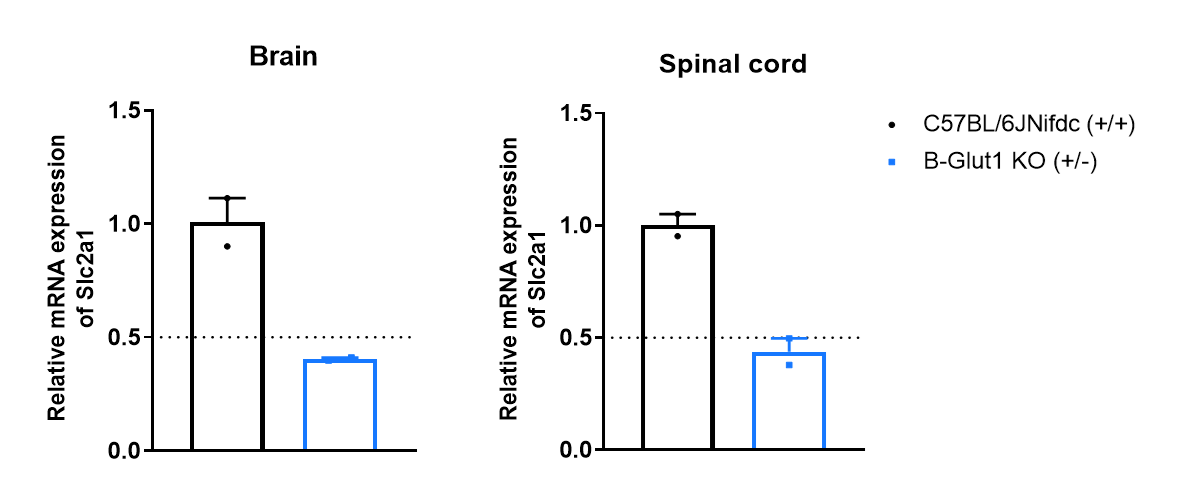
mRNA expression analysis of Slc2a1 in wild-type C57BL/6JNifdc mice and heterozygous B-Glut1 KO mice by RT-qPCR. Brain and spinal cord RNA were isolated from wild-type C57BL/6JNifdc mice (+/+) and heterozygote B-Glut1 KO mice (+/-) (male, 10-week-old, n=2). The mRNA expression of Slc2a1 in heterozygous B-Glut1 KO mice is approximately half that of the wild-type C57BL/6JNifdc mice, which is consistent with the expected expression levels in heterozygous knockout mice. Values are expressed as mean ± SEM.
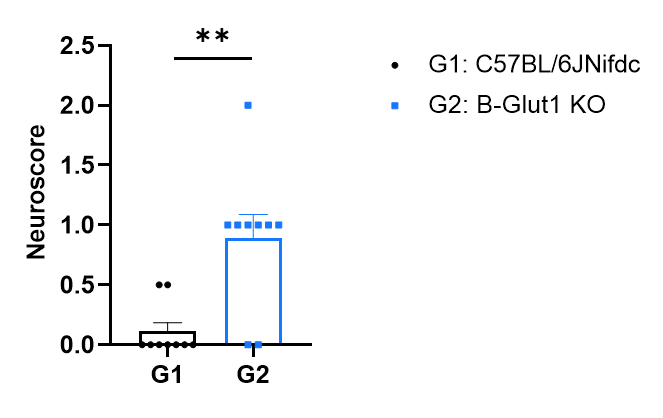
Behavioral performance in wild-type C57BL/6JNifdc and heterozygous B-Glut1 KO mice. Clasping tests were conducted to assay the behavioral performance in wild-type C57BL/6JNifdc (female, 16-week-old, n=9) and heterozygous B-Glut1 KO mice (female, 16-week-old, n=9). B-Glut1 KO mice show higher neuroscores (~1) versus wild-type mice (~0) , suggesting impaired neurological function. Values are expressed as mean ± SEM. Significance was determined by unpaired t-test, ***P < 0.001.
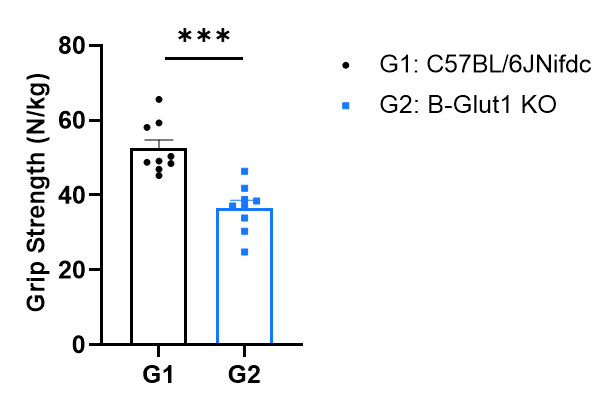
Behavioral performance in wild-type C57BL/6JNifdc and heterozygous B-Glut1 KO mice. Grip strength tests were conducted to assay the behavioral performance in wild-type C57BL/6JNifdc (female, 16-week-old, n=9) and heterozygous B-Glut1 KO mice (female, 16-week-old, n=9). Grip strength results showed the strength produced by forelimb was decreased in heterozygous B-Glut1 KO mice, showing grip strength impairments of the mice. All grip strength measurements are normalized to the individual animal’s body weight. Values are expressed as mean ± SEM. Significance was determined by unpaired t-test. *P < 0.05, **P < 0.01, ***P < 0.001.

Behavioral performance in wild-type C57BL/6JNifdc and heterozygous B-Glut1 KO mice. Rotarod tests were conducted to assay the behavioral performance in wild-type C57BL/6JNifdc (female, 16-week-old, n=9) and heterozygous B-Glut1 KO mice (female, 16-week-old, n=9). The latency to fall, rodspeed and total distance were decreased in heterozygous B-Glut1 KO mice, showing motor impairments of the mice. Values are expressed as mean ± SEM. Significance was determined by unpaired t-test. *P < 0.05, **P < 0.01, ***P < 0.001.