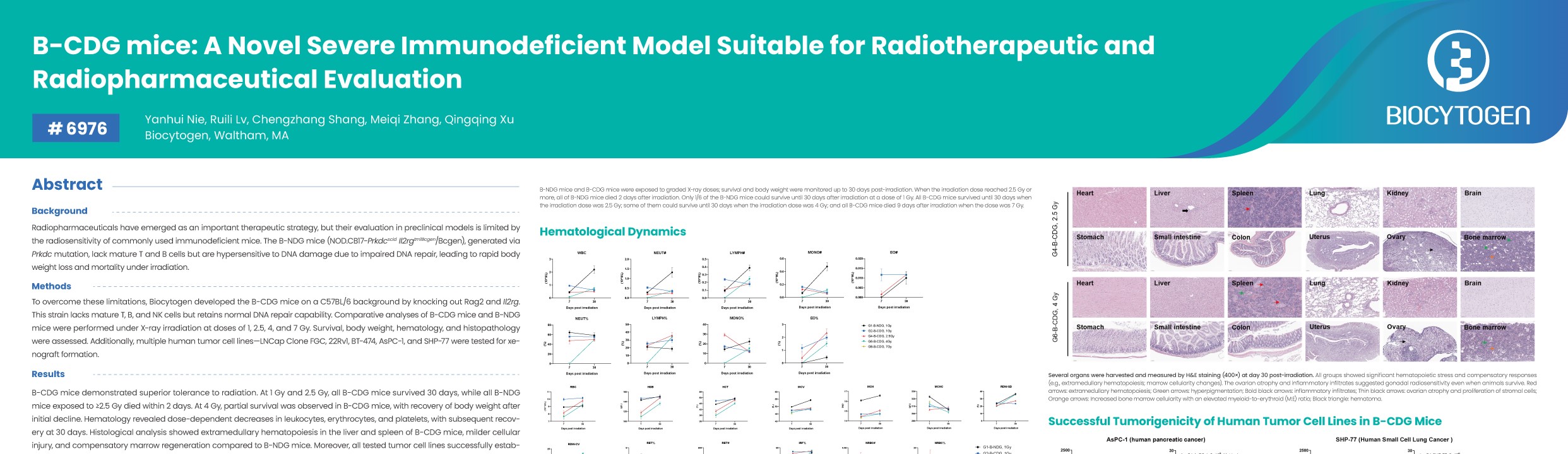
Background: Radiopharmaceuticals have emerged as an important therapeutic strategy, but their evaluation in preclinical models is limited by the radiosensitivity of commonly used immunodeficient mice. The B-NDG mice (NOD.CB17-Prkdcscid Il2rgtm1Bcgen/Bcgen), generated via Prkdc mutation, lack mature T and B cells but are hypersensitive to DNA damage due to impaired DNA repair, leading to rapid body weight loss and mortality under irradiation.
Methods: To overcome these limitations, Biocytogen developed the B-CDG mice on a C57BL/6 background by knocking out Rag2 and Il2rg. This strain lacks mature T, B, and NK cells but retains normal DNA repair capability. Comparative analyses of B-CDG mice and B-NDG mice were performed under X-ray irradiation at doses of 1, 2.5, 4, and 7 Gy. Survival, body weight, hematology, and histopathology were assessed. Additionally, multiple human tumor cell lines—LNCap Clone FGC, 22Rv1, BT-474, AsPC-1, and SHP-77—were tested for xenograft formation.
Results: B-CDG mice demonstrated superior tolerance to radiation. At 1 Gy and 2.5 Gy, all B-CDG mice survived 30 days, while all B-NDG mice exposed to ≥2.5 Gy died within 2 days. At 4 Gy, partial survival was observed in B-CDG mice, with recovery of body weight after initial decline. Hematology revealed dose-dependent decreases in leukocytes, erythrocytes, and platelets, with subsequent recovery at 30 days. Histological analysis showed extramedullary hematopoiesis in the liver and spleen of B-CDG mice, milder cellular injury, and compensatory marrow regeneration compared to B-NDG mice. Moreover, all tested tumor cell lines successfully established xenografts in B-CDG mice.
Conclusion: B-CDG mice are a novel severe immunodeficient strain that maintains DNA repair competence and radiation tolerance. These characteristics make B-CDG mice an ideal platform for evaluating the efficacy and toxicity of radiopharmaceuticals and other DNA-damaging agents.