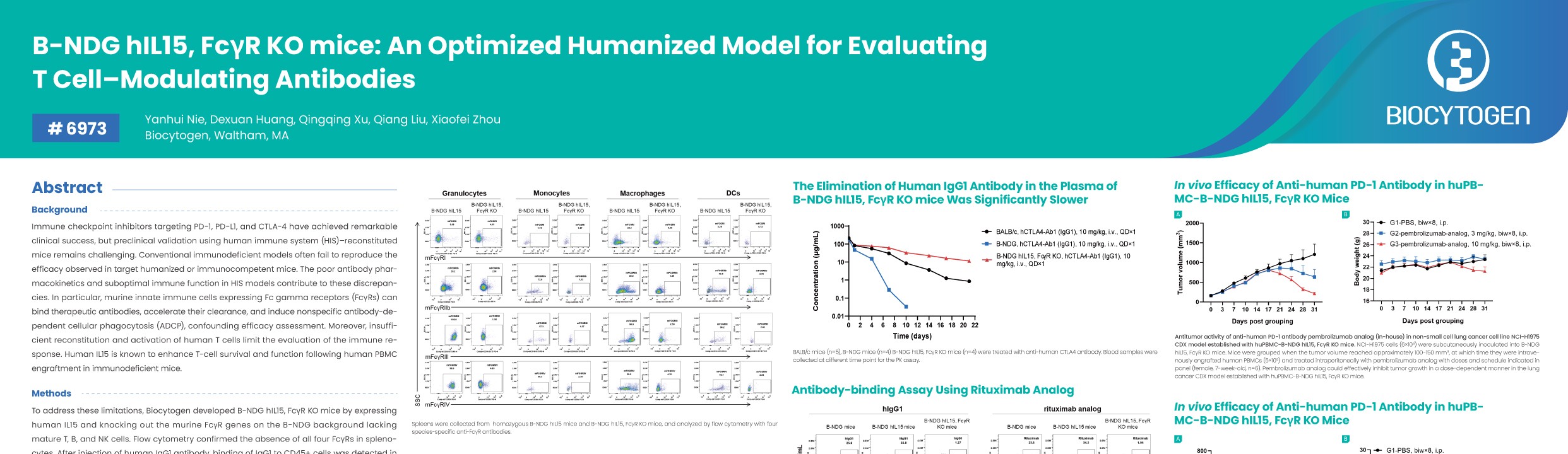
Background: Immune checkpoint inhibitors targeting PD-1, PD-L1, and CTLA-4 have achieved remarkable clinical success, but preclinical validation using human immune system (HIS)–reconstituted mice remains challenging. Conventional immunodeficient models often fail to reproduce the efficacy observed in target humanized or immunocompetent mice. The poor antibody pharmacokinetics and suboptimal immune function in HIS models contribute to these discrepancies. In particular, murine innate immune cells expressing Fc gamma receptors (FcγRs) can bind therapeutic antibodies, accelerate their clearance, and induce nonspecific antibody-dependent cellular phagocytosis (ADCP), confounding efficacy assessment. Moreover, insufficient reconstitution and activation of human T cells limit the evaluation of the immune response. Human IL-15 is known to enhance T-cell survival and function following human PBMC engraftment in immunodeficient mice.
Methods: To address these limitations, Biocytogen developed B-NDG hIL15, FcγR KO mice by expressing human IL15 and knocking out the murine FcγR genes on the B-NDG background lacking mature T, B, and NK cells. Flow cytometry confirmed the absence of all four FcγRs in splenocytes. After injection of human IgG1 antibody, binding of IgG1 to CD45+ cells was detected in B-NDG mice and B-NDG hIL15 mice, but not in B-NDG hIL15, FcγR KO mice, confirming successful gene deletion. Serum human IL-15 concentration was approximately 112 pg/mL. The distribution and frequency of granulocytes, monocytes, macrophages, and dendritic cells were comparable between B-NDG hIL15 mice and B-NDG hIL15, FcγR KO mice.
Results: Pharmacokinetic analysis after intravenous injection of an anti–human CTLA-4 IgG1 antibody revealed that antibody clearance was fastest in B-NDG mice and slowest in B-NDG hIL15, FcγR KO mice, indicating significantly prolonged serum half-life. To evaluate antibody efficacy, human PBMCs were engrafted into B-NDG hIL15, FcγR KO mice, followed by subcutaneous implantation of three human PD-L1–high tumor cell lines (HCC827, NCI-H1975, and MDA-MB-231). Treatment with a Keytruda analog (anti–human PD-1 antibody, in-house) via intraperitoneal injection resulted in significant tumor growth inhibition across all models, demonstrating improved immunotherapeutic responsiveness.
Conclusion: The huPBMC-B-NDG hIL15, FcγR KO mice provide a superior platform for evaluating the efficacy of therapeutic antibodies that modulate human T-cell functions, including immune checkpoint inhibitors.