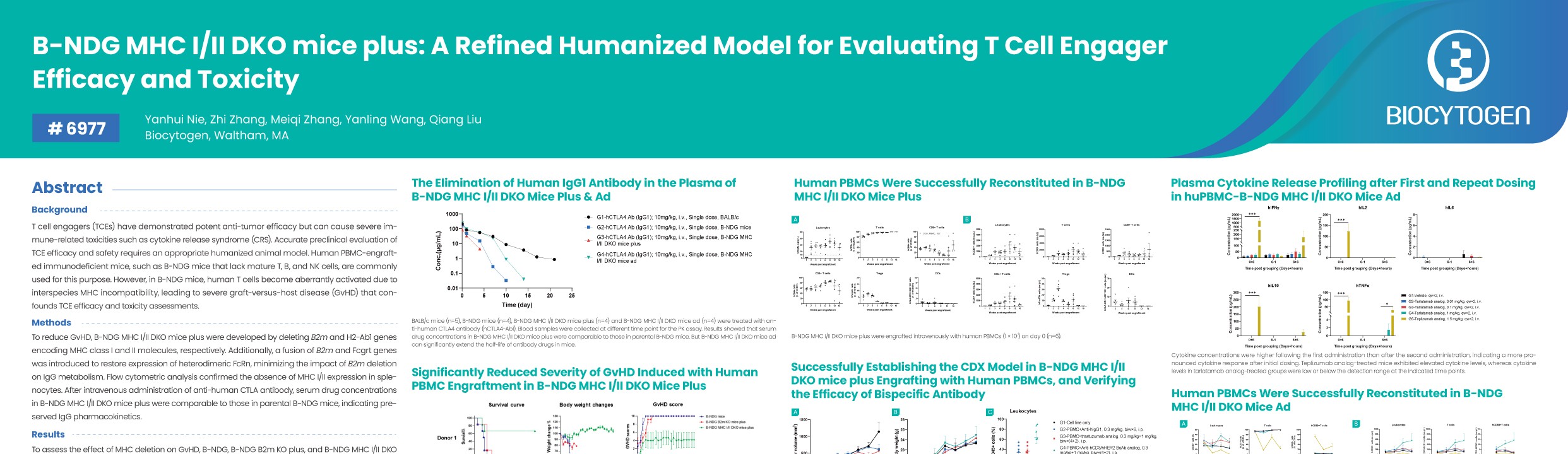
Background: T cell engagers (TCEs) have demonstrated potent anti-tumor efficacy but can cause severe immune-related toxicities such as cytokine release syndrome (CRS). Accurate preclinical evaluation of TCE efficacy and safety requires an appropriate humanized animal model. Human PBMC-engrafted immunodeficient mice, such as B-NDG mice that lack mature T, B, and NK cells, are commonly used for this purpose. However, in B-NDG mice, human T cells become aberrantly activated due to interspecies MHC incompatibility, leading to severe graft-versus-host disease (GvHD) that confounds TCE efficacy and toxicity assessments.
Methods: To reduce GvHD, B-NDG MHC I/II DKO mice plus were developed by deleting B2m and H2-Ab1 genes encoding MHC class I and II molecules, respectively. Additionally, a fusion of B2m and Fcgrt genes was introduced to restore expression of heterodimeric FcRn, minimizing the impact of B2m deletion on IgG metabolism. Flow cytometric analysis confirmed the absence of MHC I/II expression in splenocytes. After intravenous administration of anti-human CTLA antibody, serum drug concentrations in B-NDG MHC I/II DKO mice plus were comparable to those in parental B-NDG mice, indicating preserved IgG pharmacokinetics.
Results: To assess the effect of MHC deletion on GvHD, B-NDG, B-NDG B2m KO plus, and B-NDG MHC I/II DKO mice plus were irradiated and intravenously injected with human PBMCs from three donors. Most B-NDG and B2m KO mice developed severe GvHD and died within four weeks, whereas B-NDG MHC I/II DKO mice plus exhibited markedly alleviated GvHD with donor-dependent variability. These findings indicate that dual MHC I/II deletion significantly mitigates PBMC-induced GvHD. Furthermore, in PBMC-humanized B-NDG MHC I/II DKO mice plus bearing subcutaneous NCI-N87 gastric tumors, treatment with an anti-human CD3/HER2 bispecific antibody analog (in-house) significantly inhibited tumor growth. Similarly, in SHP-77 small cell lung cancer xenografts, Tarlatamab analog treatment suppressed tumor progression and elevated serum cytokines (IFNγ, TNFα, IL10, IL6, IL4, IL2) following dosing, reflecting robust T cell activation.
Conclusion: B-NDG MHC I/II DKO mice plus effectively alleviate human PBMC-induced GvHD while retaining normal antibody pharmacokinetics and enabling reliable assessment of TCE anti-tumor efficacy and cytokine-mediated toxicity. This model provides a refined and translationally relevant platform for preclinical evaluation of TCE therapeutics.