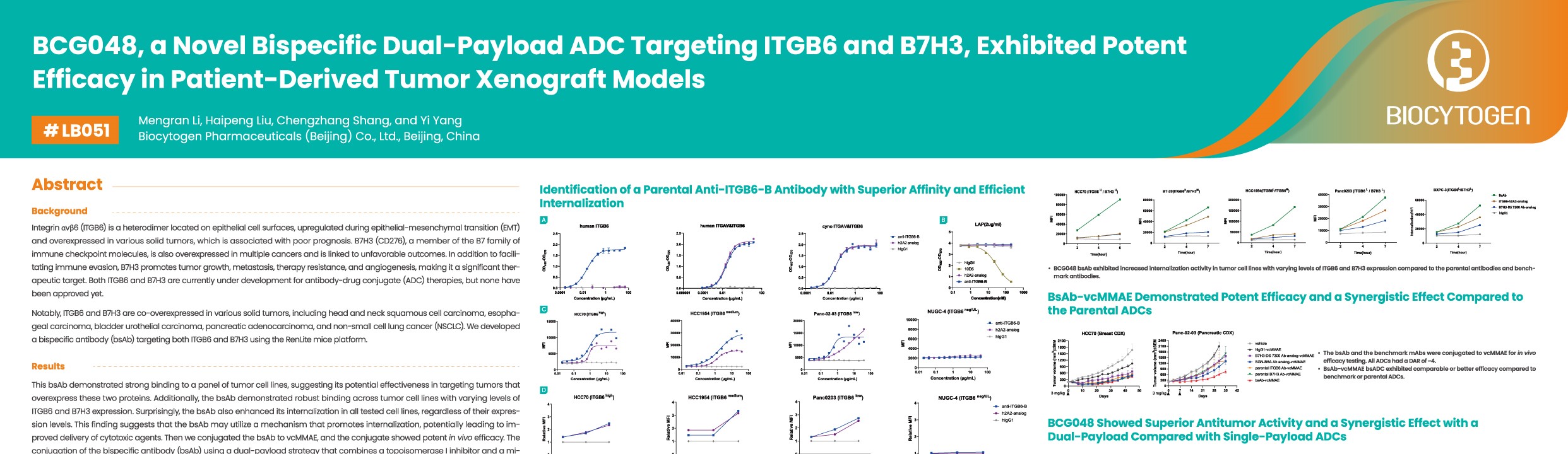
Integrin αvβ6 (ITGB6) is a heterodimer located on epithelial cell surfaces, upregulated during epithelial-mesenchymal transition (EMT), and overexpressed in various solid tumors, which is associated with poor prognosis. B7H3 (CD276), a member of the B7 family of immune checkpoint molecules, is also overexpressed in multiple cancers and is linked to unfavorable outcomes. In addition to facilitating immune evasion, B7H3 promotes tumor growth, metastasis, therapy resistance, and angiogenesis, making it a significant therapeutic target. Both ITGB6 and B7H3 are currently under development for antibody-drug conjugate (ADC) therapies, but none have been approved yet.
Notably, ITGB6 and B7H3 are co-overexpressed in various solid tumors, including head and neck squamous cell carcinoma, esophageal carcinoma, bladder urothelial carcinoma, pancreatic adenocarcinoma, and non-small cell lung cancer (NSCLC). We developed a bispecific antibody (bsAb) targeting both ITGB6 and B7H3 using the RenLite mice platform. This bsAb demonstrated strong binding to a panel of tumor cell lines, suggesting its potential effectiveness in targeting tumors that overexpress these two proteins. Additionally, the bsAb demonstrated robust binding across tumor cell lines with varying levels of ITGB6 and B7H3 expression. Surprisingly, the bsAb also enhanced its internalization in all tested cell lines, regardless of their expression levels. This finding suggests that the bsAb may utilize a mechanism that promotes internalization, potentially leading to improved delivery of cytotoxic agents. Then we conjugated the bsAb to vcMMAE, and the conjugate showed potent in vivo efficacy. The conjugation of the bispecific antibody (bsAb) using a dual-payload strategy that combines a topoisomerase I inhibitor and a microtubule inhibitor has led to the development of BCG048. This innovative compound demonstrates a synergistic effect compared to single-payload ADCs, both when used alone and in combination.
BCG048 outperforms benchmark ADCs in PDX models. These results indicate that BCG048 effectively addresses target expression and tumor heterogeneity, thereby expanding the population of patients who can benefit from its use. Additionally, BCG048 has the potential to overcome primary resistance and delay the acquisition of resistance, ultimately enhancing efficacy in heterogeneous tumors. Further studies will be necessary to evaluate its efficacy and safety in preclinical and clinical settings.