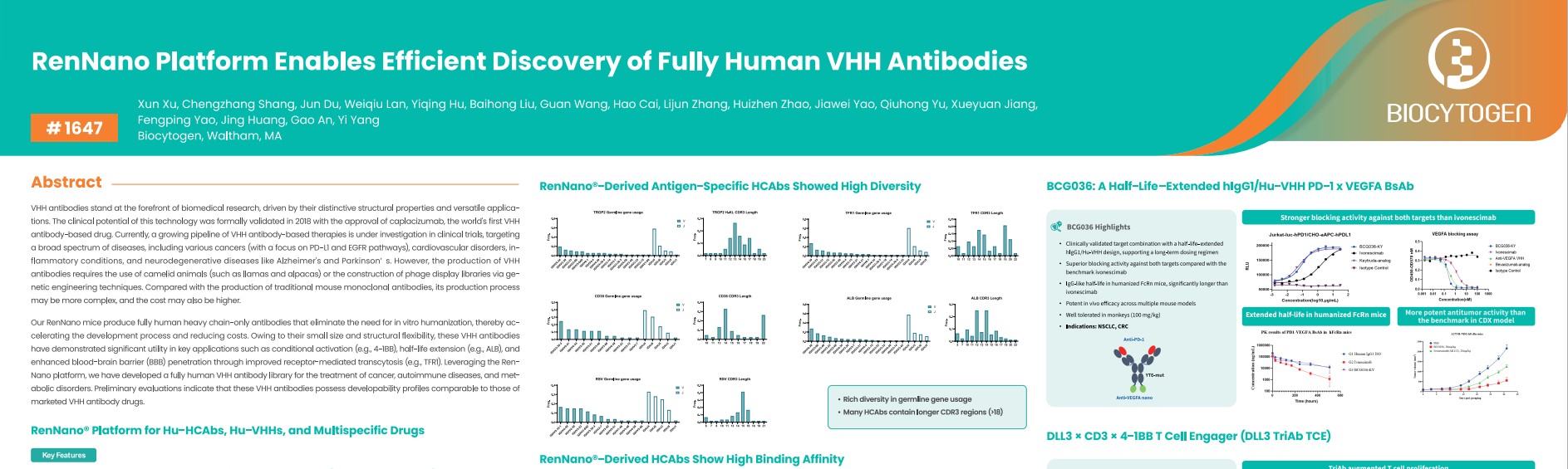
VHH antibodies stand at the forefront of biomedical research, driven by their distinctive structural properties and versatile applications. The clinical potential of this technology was formally validated in 2018 with the approval of caplacizumab, the world's first VHH antibody-based drug. Currently, a growing pipeline of VHH antibody-based therapies is under investigation in clinical trials, targeting a broad spectrum of diseases, including various cancers (with a focus on PD-L1 and EGFR pathways), cardiovascular disorders, inflammatory conditions, and neurodegenerative diseases like Alzheimer's and Parkinson's.
With a molecular weight of merely 12-15 kDa—approximately one-tenth that of conventional IgG antibodies—and a compact structure, VHH antibodies possess unparalleled tissue penetration capabilities. The complementary determining region (CDR) of VHH antibodies, particularly the CDR3 loop, is significantly longer, forming a protruding "finger-like" structure. This unique conformation allows VHH antibodies to penetrate deep into hidden antigen epitopes, such as enzyme active sites or viral conformational epitopes, that are inaccessible to traditional antibodies. However, the production of VHH antibodies requires the use of camelid animals (such as llamas and alpacas) or the construction of phage display libraries via genetic engineering techniques. Compared with the production of traditional mouse monoclonal antibodies, its production process may be more complex, and the cost may also be higher.
Our RenNano mice produce fully human heavy chain-only antibodies that eliminate the need for in vitro humanization, thereby accelerating the development process and reducing costs. Owing to their small size and structural flexibility, these VHH antibodies have demonstrated significant utility in key applications such as conditional activation (e.g., 4-1BB), half-life extension (e.g., ALB), and enhanced blood-brain barrier (BBB) penetration through improved receptor-mediated transcytosis (e.g., TFR1). Leveraging the RenNano platform, we have developed a fully human VHH antibody library for the treatment of cancer, autoimmune diseases, and metabolic disorders. Preliminary evaluations indicate that these VHH antibodies possess developability profiles comparable to those of marketed VHH antibody drugs.