
NA • 322476

Origin: The CT26.WT cell line is derived from BALB/c murine colon. The cell line is a commonly used murine model for colon carcinoma cell line.
Background Information: VEGFA is the primary mediator of angiogenesis. It stimulates endothelial cell proliferation, migration, and survival, thereby promoting the growth of new blood vessels. Its overexpression is closely associated with tumor progression, as it enhances tumor vascularization, increases vascular permeability, and provides nutrients for cancer cell growth. PD-L1 is an immune checkpoint protein expressed on the surface of various cells, including tumor cells and immune cells. It binds to PD-1 on T cells, leading to T cell exhaustion, reduced cytokine production, and impaired anti-tumor immunity. Combining anti-VEGFA therapies with immune checkpoint inhibitors has emerged as a promising strategy to enhance therapeutic outcomes by simultaneously targeting tumor vasculature and immune evasion.
Gene targeting strategy: The exogenous promoter, human PD-L1 coding sequences were inserted to replace part of murine exon 3. The insertion disrupts the endogenous murine Pdl1 gene, resulting in a non-functional transcript. The human VEGFA coding sequence was inserted to replace part of murine exon 1 and all of exons 2-5. The insertion disrupts the endogenous murine Vegfa gene, resulting in a non-functional transcript.
Tumorigenicity: Confirmed in B-hPD-1/hPD-L1 mice(C).
Application: The B-hVEGFA/hPD-L1 CT26.WT tumor models can be used for preclinical evaluation of monoclonal antibody drugs and bispecific antibody drugs targeting human VEGFA and PD-1/PD-L1.
Notes:


Subcutaneous tumor growth of B-hVEGFA/hPD-L1 CT26.WT cells. B-hVEGFA/hPD-L1 CT26.WT (1×10⁵) and wild-type CT26.WT cells (1×10⁵) were subcutaneously implanted into B-hPD-1/hPD-L1 mice(C) (female, 8-week-old, n=8). Tumor volume and body weight were measured twice a week. (A) Average tumor volume. (B) Body weight. Volume was expressed in mm3 using the formula: V=0.5 × long diameter × short diameter2. Results indicate that B-hVEGFA/hPD-L1 CT26.WT were able to establish tumors in vivo and can be used for efficacy studies. Values are expressed as mean ± SEM.

Tumor cells were harvested at the end of the experiment and assayed for mouse and human VEGFA expression by ELISA. As shown, human VEGFA was consistently highly expressed in the B-hVEGFA/hPD-L1 CT26.WT tumor homogenate, with an expression level of over 2000 pg per milligram of total protein. Data are presented as mean ± SEM.
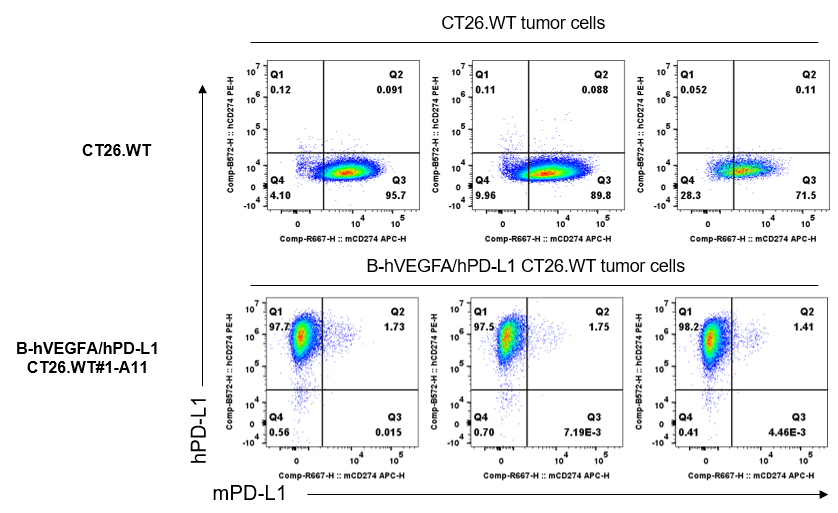
PD-L1 expression evaluated on B-hVEGFA/hPD-L1 CT26.WT by flow cytometry. B-hVEGFA/hPD-L1 CT26.WT cells were subcutaneously transplanted into B-hPD-1/hPD-L1 mice(C) (female, 8-week-old, n=8). Upon conclusion of the experiment, tumor cells were harvested and assessed for PD-L1 expression (anti-hPD-L1 antibody: Biolegend, 329706; anti-mPD-L1 antibody: Biolegend, 124312). As shown, human PD-L1 was highly expressed on the surface of tumor cells. Therefore, B-hVEGFA/hPD-L1 CT26.WT cells can be used for in vivo efficacy studies evaluating novel PD-L1 therapeutics.