Description
- ANGPTL3 humanized mice plus are genetically engineered mouse models in which the murine Angptl3 locus is replaced with the human ANGPTL3 gene, enabling physiological expression of human ANGPTL3 in vivo.
- ANGPTL3 (angiopoietin-like 3) is a secreted regulator of plasma lipid metabolism and plays a key role in triglyceride and cholesterol homeostasis, making it an attractive therapeutic target for dyslipidemia and cardiovascular disease.
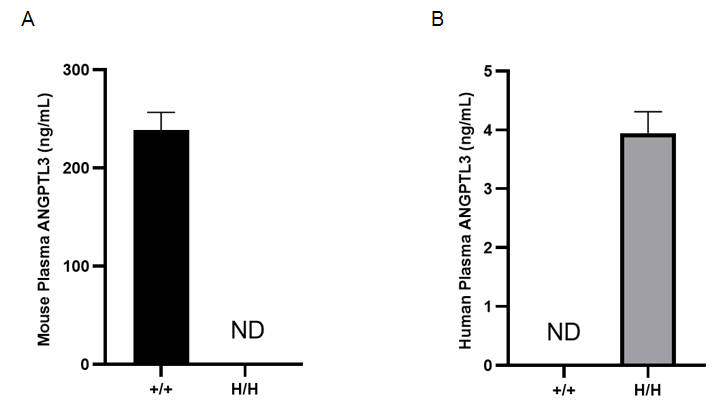
- In phenotypic validation studies, human ANGPTL3 expression is detectable in the plasma of homozygous ANGPTL3 humanized mice plus but not in wild-type controls. Furthermore, administration of human ANGPTL3-targeted nucleic acid drugs significantly reduced ANGPTL3 mRNA levels in liver tissue, demonstrating the utility of this model for assessing gene-targeted therapeutic efficacy.
Key Advantages
- Physiological human ANGPTL3 expression: Endogenous integration of human ANGPTL3 allows for natural regulation and tissue-specific expression.
- Relevant for lipid metabolism research: ANGPTL3 is a validated regulator of triglycerides and cholesterol, with translational implications for cardiovascular disease.
- Translatable preclinical platform: Suitable for the evaluation of human-targeted oligonucleotide and nucleic acid therapeutics.
- Validated therapeutic response: Following targeted nucleic acid drug treatment, the model demonstrates a significant reduction in human ANGPTL3 expression.
- Supports advanced cardiovascular programs: Enables mechanistic and efficacy studies in lipid regulation and cardiovascular risk modulation.
Validation
- Gene expression validation: Species-specific ELISA confirms that human ANGPTL3 is detectable in the plasma of ANGPTL3 humanized mice plus, whereas endogenous murine ANGPTL3 is present only in wild-type mice.
- Therapeutic activity validation: Nucleic acid drugs targeting human ANGPTL3 mRNA significantly reduced hepatic ANGPTL3 expression in vivo, demonstrating pharmacodynamic responsiveness.
Application
- Preclinical evaluation of human ANGPTL3–targeted nucleic acid drugs: Assess in vivo inhibitory efficacy and tissue targeting.
- Translational cardiovascular research: Study ANGPTL3 biology in the context of lipid metabolism and therapeutic modulation.
- Lipid metabolism mechanisms: Investigate pathways regulating triglyceride and cholesterol homeostasis.
ANGPTL3 Protein Expression Analysis in ANGPTL3 Humanized Mice Plus
Strain-specific ANGPTL3 expression analysis was performed in homozygous ANGPTL3 humanized mice plus by ELISA. Plasma samples were collected from wild-type C57BL/6 mice (+/+) and homozygous ANGPTL3 humanized mice plus (H/H) and analyzed using species-specific ANGPTL3 ELISA kits. Mouse ANGPTL3 was detectable in wild-type mice, whereas human ANGPTL3 was exclusively detectable in homozygous ANGPTL3 humanized mice plus (H/H) but not in wild-type mice.
Inhibitory Efficacy of Nucleic Acid Drugs Against Human ANGPTL3 mRNA Expression in ANGPTL3 Humanized Mice Plus

The inhibitory efficiency of nucleic acid drugs against human ANGPTL3 mRNA expression was evaluated in liver tissue of ANGPTL3 humanized mice plus. Mice were randomly divided into two groups (n = 4 per group, 10 weeks old). Human ANGPTL3–targeted nucleic acid drugs (synthesized according to patents) and PBS were administered individually. The nucleic acid drugs were administered as PBS aqueous solutions, and dosages were calculated based on body weight.
Mice were sacrificed on day 14, and liver tissues were collected to detect human ANGPTL3 mRNA expression by qPCR. (A) Schematic diagram of the experimental procedure. (B) Human ANGPTL3 mRNA expression levels in the liver tissue after treatment. The inhibition rate in the treatment group was 83.4%. (C) Human ANGPTL3 protein expression in plasma. Human ANGPTL3 levels in the treatment group (G2) were significantly reduced compared to the control group (G1). These results demonstrate that ANGPTL3 humanized mice plus provide a powerful preclinical model for in vivo evaluation of human ANGPTL3–targeted nucleic acid drugs. Values are expressed as mean ± SEM.
FAQ
Q1: What are ANGPTL3 humanized mice plus?
ANGPTL3 humanized mice plus are genetically engineered mice expressing human ANGPTL3 in place of the mouse gene, providing an in vivo model for testing human ANGPTL3-targeted therapeutics.
Q2: Why are they useful for drug development?
This model enables the assessment of human ANGPTL3 modulation by nucleic acid drugs and supports translational studies in lipid metabolism and cardiovascular disease.
Q3: How is human ANGPTL3 expression validated?
Human ANGPTL3 expression in plasma is confirmed through species-specific assays in homozygous ANGPTL3 humanized mice plus, while wild-type mice show only endogenous murine ANGPTL3.
Q4: What types of therapeutics can be evaluated with this model?
This model is suitable for evaluating human ANGPTL3-targeted nucleic acid drugs, including antisense oligonucleotides and siRNA modalities.
* When publishing results obtained using this animal model, please acknowledge the source as follows: The animal model [B-hANGPTL3 mice plus] (Cat# 112523) was purchased from Biocytogen.