Description
CD3 and CDCP1: A New Choice of T Cell Engager Therapeutic
- Gene Information: Encoded by CD3E, D, G; part of the Ig superfamily. It forms the essential signaling backbone of the T-cell receptor (TCR) complex. CDCP1: CDCP1 is a transmembrane glycoprotein, associated with cell adhesion, migration, and tumor progression. Overexpressed in multiple solid tumors.
- Protein Expression: CD3: Constitutive and universal marker for all mature T cells (CD4+, CD8+). Always present on the cell surface. CDCP1 is expressed at low levels in several normal epithelial tissues but is markedly upregulated in cancers.
- Signaling Pathway: CD3 (Signal 1): Operates via ITAM phosphorylation and ZAP-70. It triggers the initial “on” switch, Ca2+ flux, and immediate cytotoxicity. CDCP1: After phosphorylation by Src family kinases, CDCP1 interacts with signaling molecules including PI3K/AKT pathway, FAK signaling, also linked to receptor tyrosine kinase signaling, including EGFR and MET pathways.
- Therapeutic Inhibition: CDCP1 has emerged as a promising cancer therapeutic target. Current therapeutic approaches includes mAB, ADC, TCE, etc.
CD3E Protein Expression in Spleen
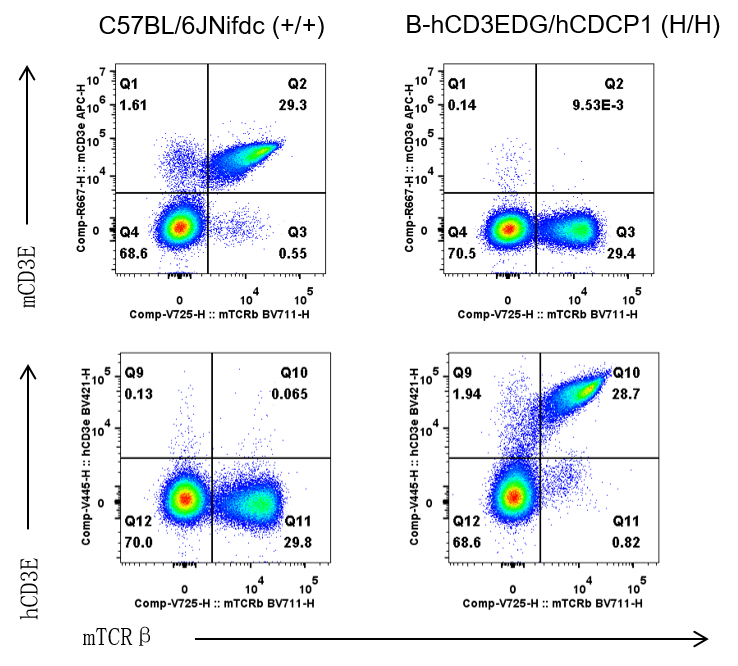
- Mouse CD3E was detected on T cells populations in wild-type C57BL/6JNifdc mice, but not in B-hCD3EDG/hCDCP1 mice.
- Human CD3E was detected on T cells populations in B-hCD3EDG/hCDCP1 mice, but not in wild-type C57BL/6JNifdc mice.
Mouse and human CD3E expression analysis in splenocytes. Splenocytes were collected from wild-type C57BL/6JNifdc mice (female, 6-week-old, n = 1) and homozygous B-hCD3EDG/hCDCP1 mice (female, 6-week-old, n = 1). CD3E expression on T cells was analyzed by flow cytometry using species-specific anti-CD3E antibodies (anti-human CD3E antibody, BD Horizon, 562426; anti-mouse CD3E antibody, Biolegend, 100312 ).
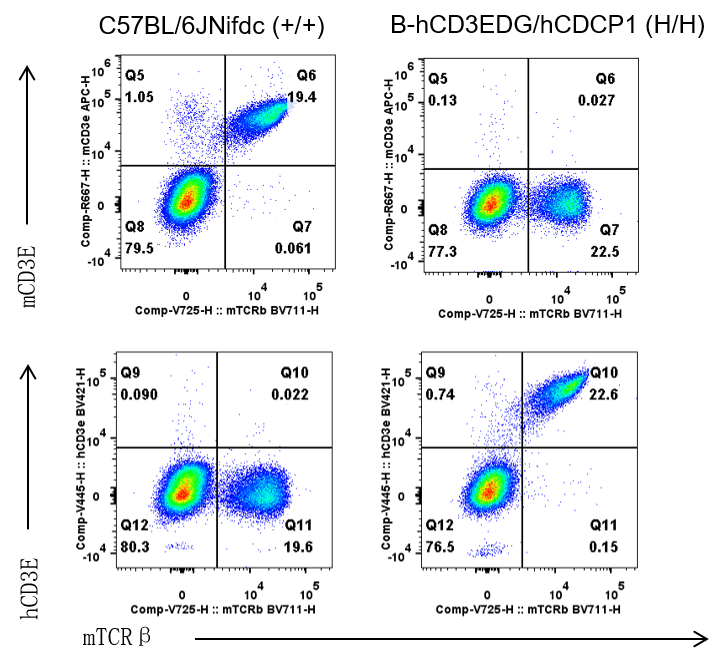
- Mouse CD3E was detected on T cells populations in wild-type C57BL/6JNifdc mice, but not in B-hCD3EDG/hCDCP1 mice.
- Human CD3E was detected on T cells populations in B-hCD3EDG/hCDCP1 mice, but not in wild-type C57BL/6JNifdc mice.
Mouse and human CD3E expression analysis in blood. Blood cells were collected from wild-type C57BL/6JNifdc (female, 6-week-old, n = 1) and homozygous B-hCD3EDG/hCDCP1 mice (female, 6-week-old, n = 1). CD3E expression on T cells was analyzed by flow cytometry using species-specific anti-CD3E antibodies (anti-human CD3E antibody, BD Horizon, 562426; anti-mouse CD3E antibody, Biolegend, 100312 ).
CDCP1 Expression by RT-PCR
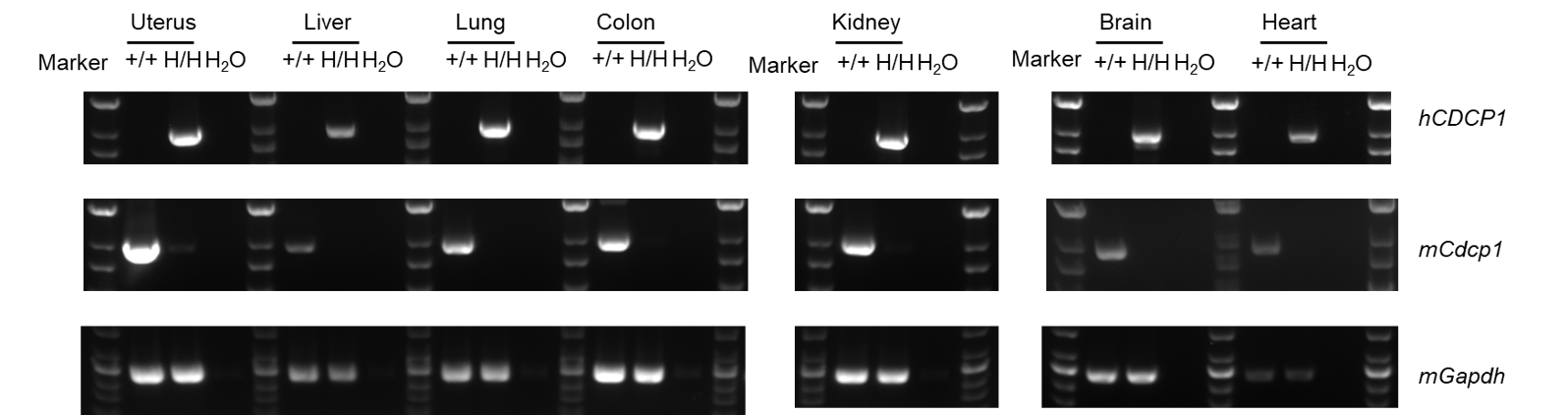
- Human CDCP1 mRNA was exclusively detectable in homozygous B-hCD3EDG/hCDCP1 mice but not in wild-type mice.
- Mouse Cdcp1 mRNA was only detectable in wild-type mice.
Strain specific analysis of CDCP1 mRNA expression in wild-type C57BL/6JNifdc mice and B-hCD3EDG/hCDCP1 mice by RT-PCR. RNA were isolated from wild-type C57BL/6JNifdc mice (+/+) (female, 6-week-old, n=1) and homozygous B-hCD3EDG/hCDCP1 mice (H/H) (female, 6-week-old, n=1), then cDNA libraries were synthesized by reverse transcription, followed by PCR with mouse or human CDCP1 primers.
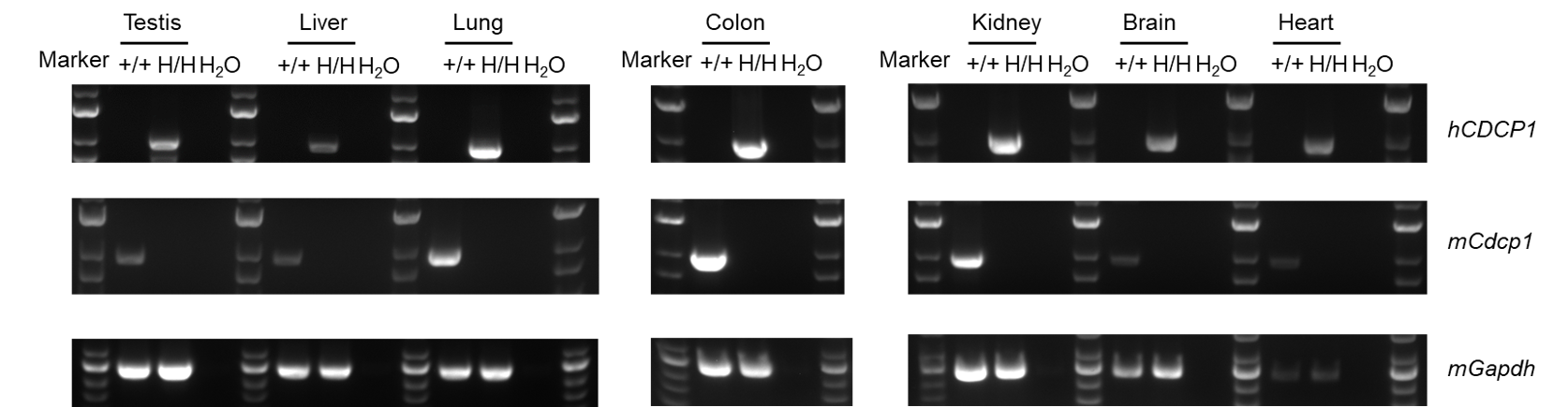
- Human CDCP1 mRNA was exclusively detectable in homozygous B-hCD3EDG/hCDCP1 mice but not in wild-type mice.
- Mouse Cdcp1 mRNA was only detectable in wild-type mice.
Strain specific analysis of CDCP1 mRNA expression in wild-type C57BL/6JNifdc mice and B-hCD3EDG/hCDCP1 mice by RT-PCR. RNA were isolated from wild-type C57BL/6JNifdc mice (+/+) (Male, 6-week-old, n=1) and homozygous B-hCD3EDG/hCDCP1 mice (H/H) (Male, 6-week-old, n=1), then cDNA libraries were synthesized by reverse transcription, followed by PCR with mouse or human CDCP1 primers.
* When publishing results obtained using this animal model, please acknowledge the source as follows: The animal model [B-hCD3EDG/hCDCP1 mice] (Cat# 114593) was purchased from Biocytogen.