

Gene targeting strategy for B-hIL33/hST2 mice. The exons 2-8 of mouse Il33 gene that encode the whole molecule (ATG to STOP codon) were replaced by human counterparts in B-hIL33/hST2 mice. The promoter 5’UTR and 3’UTR region of the mouse gene are retained. The human IL33 expression is driven by endogenous mouse IL33 promoter, while mouse IL33 gene transcription and translation will be disrupted. The exons 2-9 of mouse St2 gene that encode signal peptide, extracellular domain are replaced by human counterparts in B-hIL33/hST2 mice. The genomic region of mouse St2 gene that encodes cytoplasmic portion is retained. The promoter, 5’UTR and 3’UTR region of the mouse gene are also retained. The chimeric ST2 expression is driven by endogenous mouse St2 promoter, while mouse St2 gene transcription and translation will be disrupted.


Function analysis of ST2 in wild-type C57BL/6 mice and homozygous B-hIL33/hST2 mice by ELISA. Splenocytes were collected from wild-type C57BL/6 mice (+/+) and homozygous B-hIL33/hST2 mice (H/H). CD4+ T cells were isolated and cultured on plates pre-coated with anti-mCD3Ɛ Ab and anti-mCD28 antibody in the presence of IL2. They were stimulated with mouse/human IL33, with or without anti-ST2 antibody analog (in-house) for 48 hours. Cell supernatants were subsequently collected for ELISA analysis of mouse IL5 production. Mouse and human IL33 induced mouse IL5 production in both wild-type C57BL/6 mice and homozygous B-hIL33/hST2 mice.

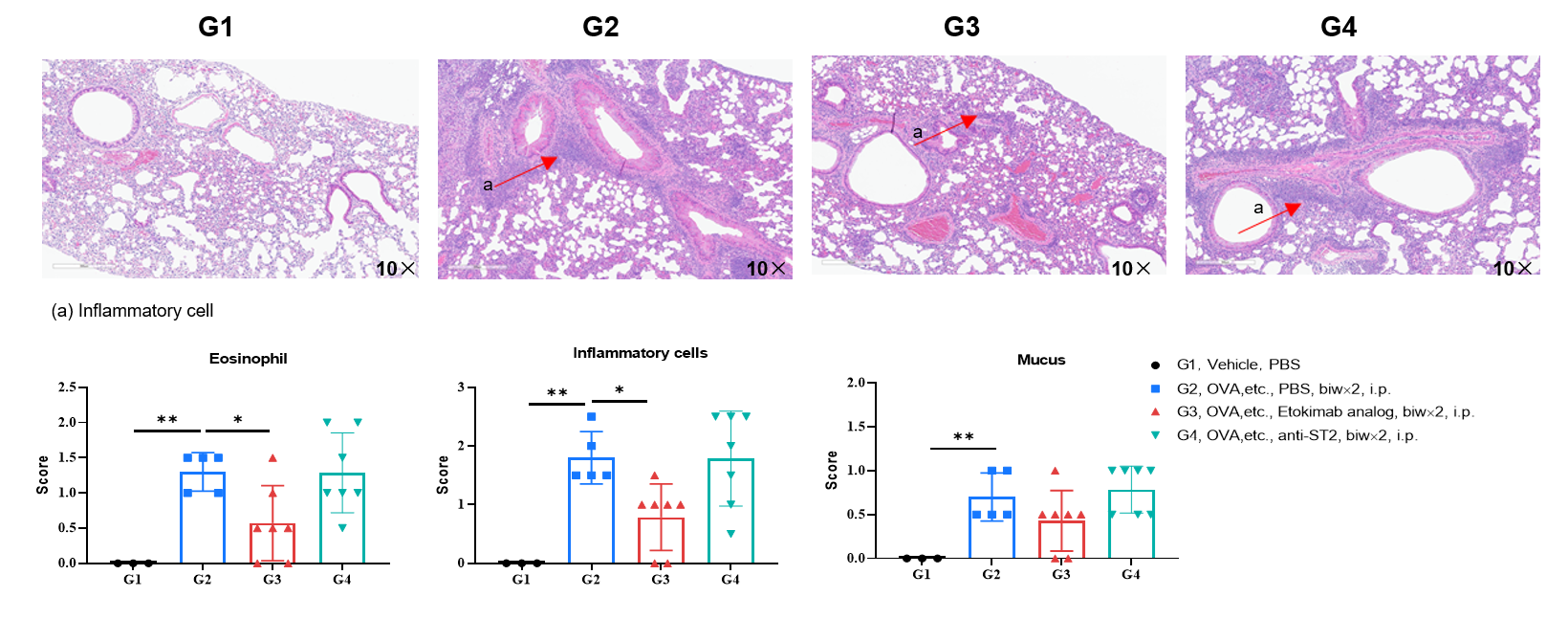
H&E staining of asthma-like model in B-hIL33/hST2 mice. Lung tissues were collected at the study endpoint and analyzed with H&E staining. The results showed that the group of mice treated with anti-human IL33 antibody and anti-human ST2 antibody in inflammatory infiltration and mucus secretion in lung tissue was lower than that in untreated mice, indicating that B-hIL33/hST2 mice provide a powerful preclinical model for in vivo evaluation of anti-human IL33 antibody and anti-human ST2 antibody. Values are expressed as mean ± SEM. Significance was determined by unpaired t-test. *P < 0.05, **P < 0.01, ***P < 0.001.