


Gene targeting strategy for B-hPD-1/hPD-L1/hLAG3 plus/hCD8 mice.
The exon 2 of mouse Pdcd1 gene encodes the IgV domain is replaced by human counterparts in B-hPD-1/hPD-L1/hLAG3 plus/hCD8 mice. The promoter, 5’UTR and 3’UTR region of the mouse gene are also retained. The human PD-1 expression is driven by endogenous mouse Pdcd1 promoter, while mouse Pdcd1 gene transcription and translation will be disrupted.
The exon 3 of mouse Pdl1 gene that encodes the IgV domain was replaced by human PD-L1 exon 3 in B-hPD-1/hPD-L1/hLAG3 plus/hCD8 mice. The promoter, 5’UTR and 3’UTR region of the mouse gene are also retained. The human PD-L1 expression is driven by endogenous mouse Cd274 promoter, while mouse Cd274 gene transcription and translation will be disrupted.
The exons 2-7 of mouse Lag3 gene that encode extracellular domain are replaced by human counterparts in in B-hPD-1/hPD-L1/hLAG3 plus/hCD8 mice. The genomic region of mouse Lag3 gene that encodes transmembrane domain and cytoplasmic portion is retained. The promoter, 5’UTR and 3’UTR region of the mouse gene are also retained. The chimeric LAG3 expression is driven by endogenous mouse Lag3 promoter, while mouse Lag3 gene transcription and translation will be disrupted.
The exons 1-3 and partial exon 4 of mouse Cd8a gene that encode extracellular domain are replaced by human counterparts in B-hPD-1/hPD-L1/hLAG3 plus/hCD8 mice. The genomic region of mouse Cd8a gene that encodes transmembrane domain and cytoplasmic portion is retained. The promoter, 5’UTR and 3’UTR region of the mouse gene are also retained. The chimeric CD8A expression is driven by endogenous mouse Cd8a promoter, while mouse Cd8a gene transcription and translation will be disrupted. The exons 1-3 and partial exon 4 of mouse Cd8b1 gene that encode extracellular domain are replaced by human counterparts in in B-hPD-1/hPD-L1/hLAG3 plus/hCD8 mice. The genomic region of mouse Cd8b gene that encodes transmembrane domain and cytoplasmic portion is retained. The promoter, 5’UTR and 3’UTR region of the mouse gene are also retained. The chimeric CD8B expression is driven by endogenous mouse Cd8b1 promoter, while mouse Cd8b1 gene transcription and translation will be disrupted.

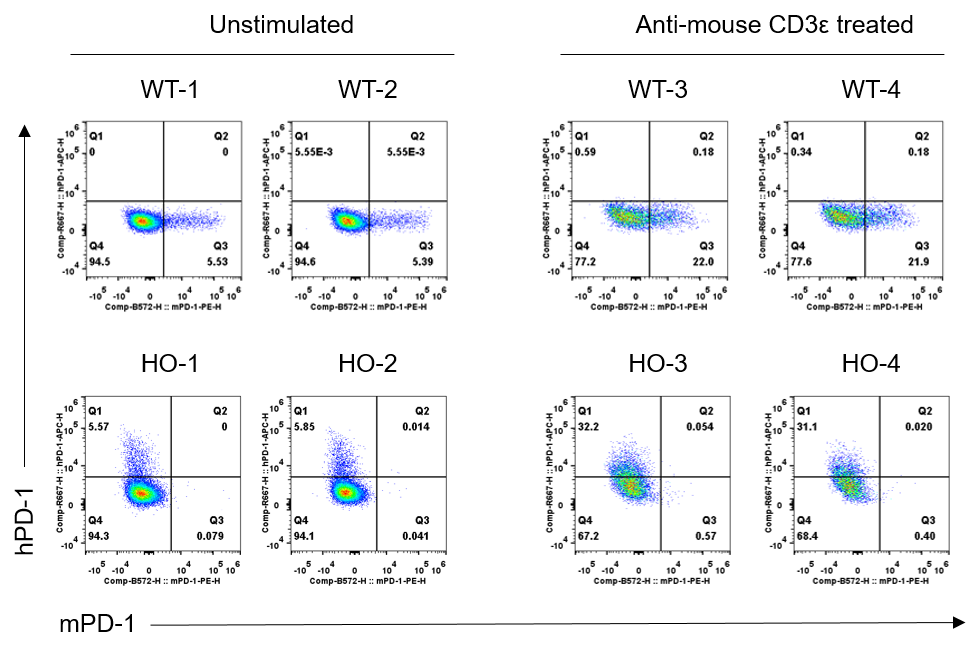
Strain specific PD-1 expression analysis in wild-type (WT) mice and homozygous (HO) B-hPD-1/hPD-L1/hLAG3 plus/hCD8 mice by flow cytometry. Splenocytes were collected from wild-type C57BL/6JNifdc mice and homozygous B-hPD-1/hPD-L1/hLAG3 plus/hCD8 mice after stimulated with or without anti-mouse CD3ε antibody (7.5 μg, i.p.) in vivo for 24 hrs (male, 10-week-old, n=2). Protein expression was analyzed with anti-mouse PD-1 antibody (Biolegend, 109104), anti-human PD-1 antibody (Biolegend, 329908) by flow cytometry. Mouse PD-1 was detectable on T cells in wild-type C57BL/6JNifdc mice. Human PD-1 was only detectable on T cells in homozygous B-hPD-1/hPD-L1/hLAG3 plus/hCD8 mice but not in wild-type C57BL/6JNifdc mice.
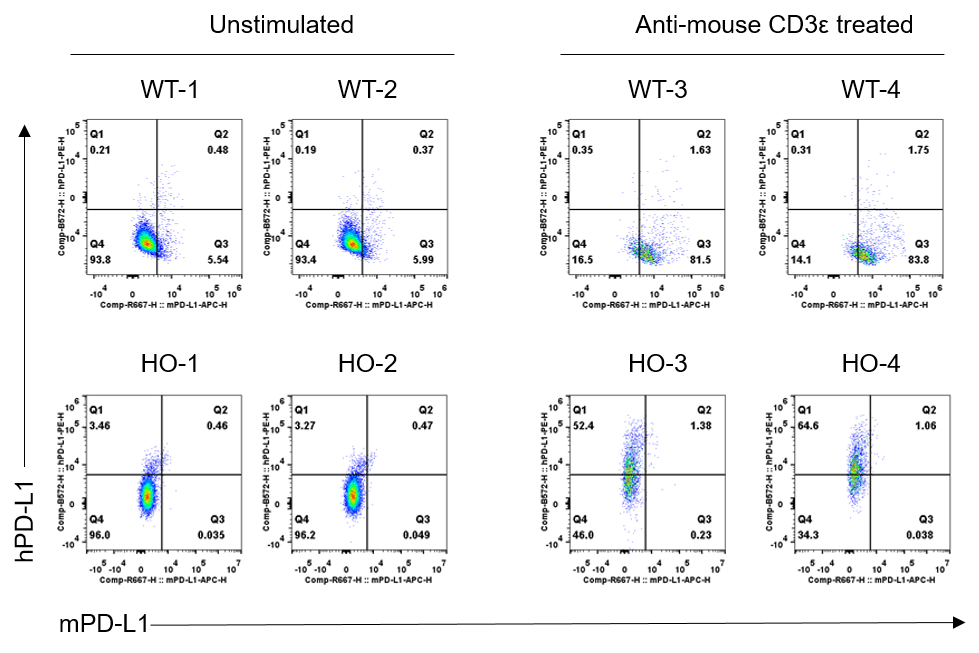
Strain specific PD-L1 expression analysis in wild-type (WT) mice and homozygous (HO) B-hPD-1/hPD-L1/hLAG3 plus/hCD8 mice by flow cytometry. Splenocytes were collected from wild-type C57BL/6JNifdc mice and homozygous B-hPD-1/hPD-L1/hLAG3 plus/hCD8 mice after stimulated with or without anti-mouse CD3ε antibody (7.5 μg, i.p.) in vivo for 24 hrs (male, 10-week-old, n=2). Protein expression was analyzed with anti-mouse PD-L1 antibody (Biolegend, 124312), and anti-human PD-L1 antibody (Biolegend, 329706) by flow cytometry. Mouse PD-L1 was detectable on T cells in wild-type C57BL/6JNifdc mice. Human PD-L1 was only detectable on T cells in homozygous B-hPD-1/hPD-L1/hLAG3 plus/hCD8 mice but not in wild-type C57BL/6JNifdc mice.
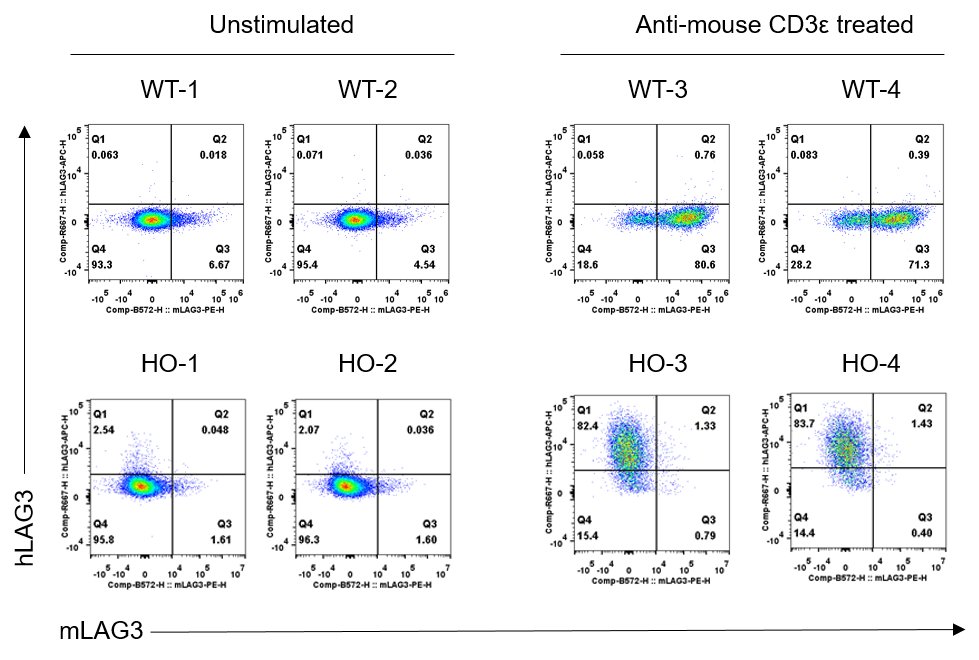
Strain specific LAG3 expression analysis in wild-type (WT) mice and homozygous (HO) B-hPD-1/hPD-L1/hLAG3 plus/hCD8 mice by flow cytometry. Splenocytes were collected from wild-type C57BL/6JNifdc mice and homozygous B-hPD-1/hPD-L1/hLAG3 plus/hCD8 mice after stimulated with or without anti-mouse CD3ε antibody (7.5 μg, i.p.) in vivo for 24 hrs (male, 10-week-old, n=2). Protein expression was analyzed with anti-mouse LAG3 antibody (Biolegend, 125208) and anti-human LAG3 antibody (Biolegend, 369304) by flow cytometry. Mouse LAG3 was detectable on T cells in wild-type C57BL/6JNifdc mice. Human LAG3 was only detectable on T cells in homozygous B-hPD-1/hPD-L1/hLAG3 plus/hCD8 mice but not in wild-type C57BL/6JNifdc mice.
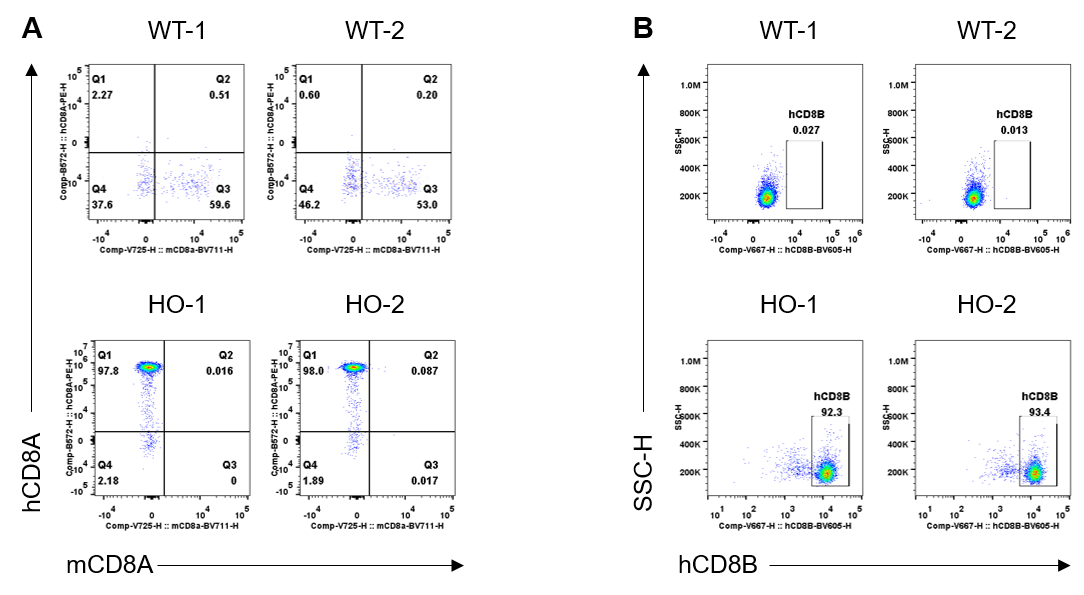
Strain specific CD8A and CD8B expression analysis in wild-type (WT) mice and homozygous (HO) B-hPD-1/hPD-L1/hLAG3 plus/hCD8 mice by flow cytometry. Splenocytes were collected from wild-type C57BL/6JNifdc mice and homozygous B-hPD-1/hPD-L1/hLAG3 plus/hCD8 mice (male, 10-week-old, n=2). Protein expression was analyzed with anti-mouse CD8a antibody (Biolegend, 100759), and anti-human CD8a antibody (Biolegend, 300908), and anti-human CD8B antibody (BD, 742392) by flow cytometry. Mouse CD8a was detectable on the CD4- T cells in wild-type C57BL/6JNifdc mice. Human CD8a (A) and CD8B (B) were only detectable on the CD4- T cells in homozygous B-hPD-1/hPD-L1/hLAG3 plus/hCD8 mice but not in wild-type C57BL/6JNifdc mice.
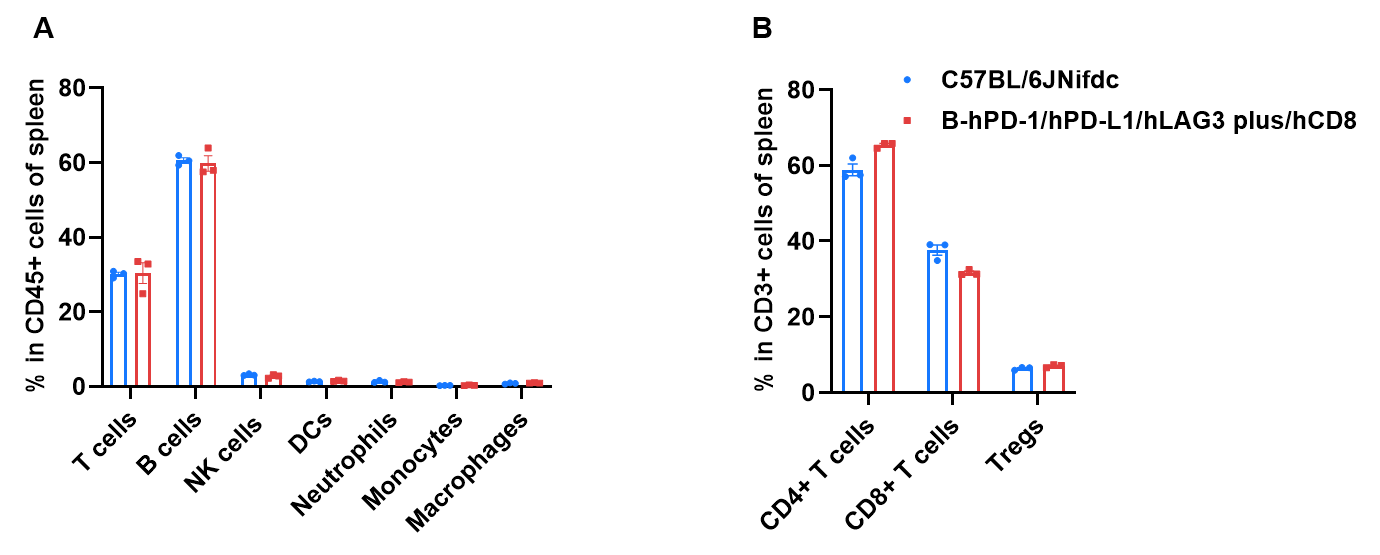
Frequency of leukocyte subpopulations in spleen by flow cytometry. Splenocytes were isolated from wild-type C57BL/6JNifdc mice and homozygous in B-hPD-1/hPD-L1/hLAG3 plus/hCD8 mice (male, 10-week-old, n=3). A. Flow cytometry analysis of the splenocytes was performed to assess the frequency of leukocyte subpopulations. B. Frequency of T cell subpopulations. Frequencies of T cells, B cells, NK cells, dendritic cells, neutrophils, monocytes, macrophages, CD4+ T cells, CD8+ T cells, and Tregs in B-hPD-1/hPD-L1/hLAG3 plus/hCD8 mice were similar to those in C57BL/6JNifdc mice, demonstrating that humanization of PD-1, PD-L1, LAG3, and CD8 does not change the frequency or distribution of these cell types in spleen. The frequency of leukocyte subpopulations in blood and lymph node of B-hPD-1/hPD-L1/hLAG3 plus/hCD8 mice were also comparable to wild-type C57BL/6JNifdc mice (Data not shown).