B-hTAU mice

C57BL/6-Mapttm1(MAPT)Bcgen/Bcgen • 110953

B-hTAU mice

Product nameB-hTAU mice
Catalog number110953
Strain nameC57BL/6-Mapttm1(MAPT)Bcgen/Bcgen
Strain backgroundC57BL/6
NCBI gene ID4137 (Human)
AliasesTAU; FTD1; MSTD; PPND; DDPAC; MAPTL; MTBT1; MTBT2; tau-40; FTDP-17; PPP1R103; Tau-PHF6
ApplicationThis product is used for pharmacodynamics and safety evaluation of Alzheimer's disease (AD).

이 페이지에서

  • Description
  • Phenotypic analysis
  • Efficacy
  • FAQ section

포스터

모두 보기

    출판물

      Description

      TAU humanized mice are genetically engineered mice in which the murine Mapt gene exons encoding the full-length protein and the 3′ UTR are replaced with human MAPT exons under the control of the endogenous mouse promoter, resulting in physiological expression of human Tau. TAU is a microtubule-associated protein predominantly expressed in neurons of the central nervous system, and abnormal TAU aggregation is a core pathological feature of many neurodegenerative diseases, including Alzheimer's disease (AD).

      In this model, human TAU mRNA is detectable only in homozygous TAU humanized mice, and protein expression is confirmed in brain tissue. TAU humanized mice also support in vivo evaluation of human MAPT–targeted nucleic acid drugs, demonstrating a significant reduction in human TAU mRNA and protein levels after treatment.

      Key Advantages

      • Human MAPT gene expression: Endogenous replacement ensures physiological regulation and splicing of human TAU isoforms.
      • Neuroscience relevance: TAU plays a central role in AD and other tauopathies, enabling disease pathway studies.
      • Validated protein expression: Human TAU protein is detected in brain tissues, confirming model integrity.
      • Supports therapeutic evaluation: Effective reduction of human TAU expression following nucleic acid drug treatment demonstrates utility for pharmacodynamic studies.
      • Translational modeling: Suitable for preclinical research in neurodegeneration, including Alzheimer's disease pathogenesis and therapeutic development.

      Application

      • Preclinical evaluation of MAPT-targeting nucleic acid therapeutics: Enables assessment of in vivo knockdown efficacy.
      • Neurodegenerative disease research: Models human TAU expression for studies in Alzheimer's disease and other tauopathies.
      • Mechanistic studies: Investigates TAU biology, splicing, and post-translational regulation in a humanized context.
      • Translational drug discovery: Bridges target engagement and therapeutic response from preclinical to clinical settings.
      Tau mRNA Expression Analysis in TAU Humanized Mice

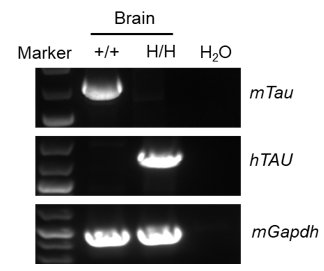
      Strain-specific analysis of TAU mRNA expression was performed in wild-type C57BL/6 mice and TAU humanized mice using RT-PCR. Brain RNA was isolated from wild-type C57BL/6 mice (+/+) and homozygous TAU humanized mice (H/H). cDNA libraries were synthesized by reverse transcription and subjected to PCR using mouse- or human-specific TAU primers. Human TAU mRNA was detectable only in homozygous TAU humanized mice and not in wild-type mice.

      TAU Protein Expression Analysis in TAU Humanized Mice

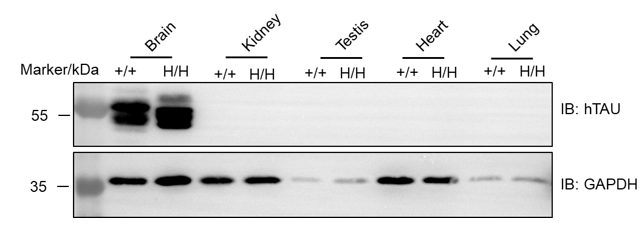
      Western blot analysis of TAU protein expression was performed using tissue lysates collected from wild-type C57BL/6 mice (+/+) and homozygous TAU humanized mice (H/H). A total of 40 μg of protein per sample was loaded and detected using an anti-TAU antibody. TAU protein was detected in brain tissue from both wild-type and homozygous TAU humanized mice.

      Inhibitory Efficacy of Nucleic Acid Drugs Against Human TAU in TAU Humanized Mice

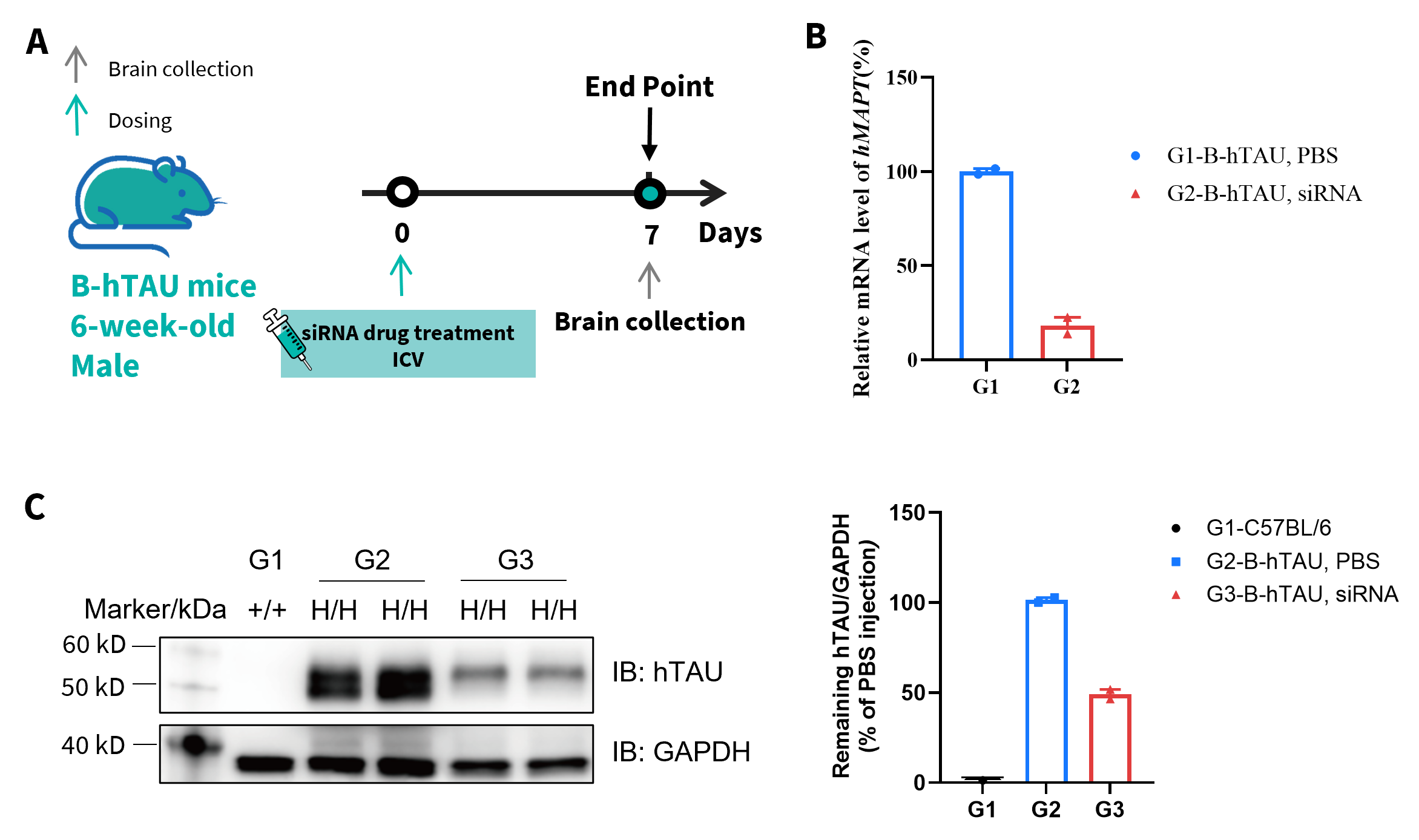
      The inhibitory efficiency of nucleic acid drugs against human TAU was evaluated in TAU humanized mice. Mice were randomly divided into two groups (n = 2 per group, 6 weeks old, male). Human TAU–targeted nucleic acid drugs (provided by the client) and PBS were administered individually. Mice were sacrificed on day 7, and brain tissues were collected for analysis of human TAU mRNA and protein expression by qRT-PCR and western blot, respectively. (A) Schematic diagram of the experimental procedure. (B) Human TAU mRNA expression in brain tissue. Human TAU levels in the treatment group (G2) were significantly reduced compared to the control group (G1). (C) Human TAU protein expression in brain tissue. Compared with the control group (G2), the treatment group (G3) showed a significant decrease in human TAU protein, with an inhibition rate of 51.5%. These results demonstrate that TAU humanized mice provide a powerful preclinical model for in vivo evaluation of human TAU–targeted nucleic acid drugs. Values are expressed as mean ± SEM. Validation data were supplied by the client.

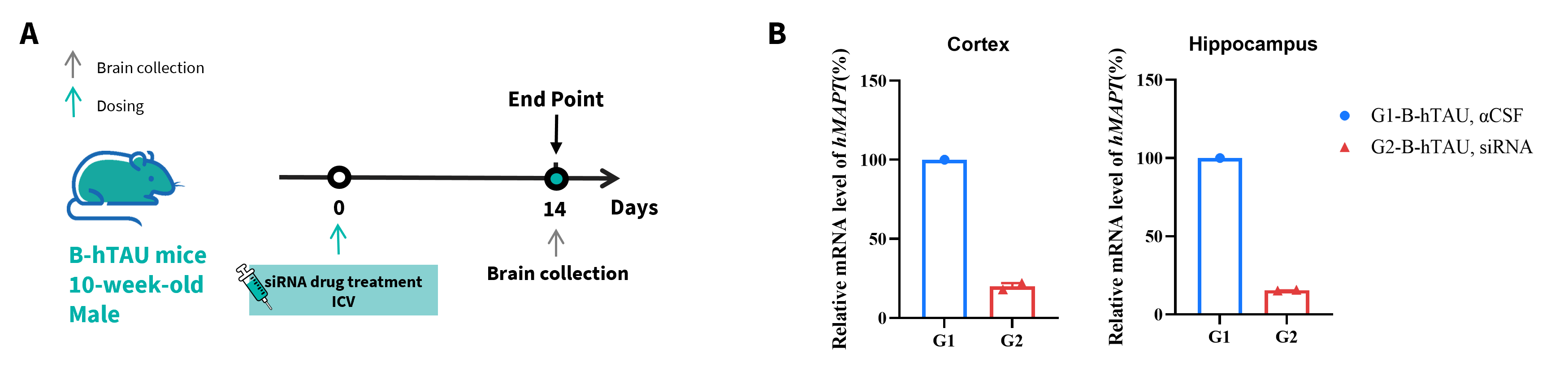
      The inhibitory efficiency of nucleic acid drugs against human TAU was further evaluated in TAU humanized mice. Mice were randomly divided into two groups (G1: n = 1, 10 weeks old, male; G2: n = 2, 10 weeks old, male). Human TAU–targeted nucleic acid drugs (AD-1637701) and αCSF were administered individually. Mice were sacrificed on day 14, and brain tissues were collected to assess human TAU mRNA expression by qRT-PCR. (A) Schematic diagram of the experimental procedure. (B) Human TAU mRNA expression in the frontal cortex and hippocampus. Human TAU levels in the treatment group (G2) were significantly reduced compared with the control group (G1). Values are expressed as mean ± SEM. Validation data were supplied by the client.

      Frequently Asked Questions (FAQs) About TAU Humanized Mice (B-hTAU)

      Q1: What are TAU humanized mice?

      A: TAU humanized mice express the human MAPT gene under the control of the endogenous mouse promoter, replacing the murine Mapt sequence to allow physiological expression of human TAU in brain tissue.

      Q2: Why use TAU humanized mice in research?

      A: These mice are used to model human TAU expression, investigate mechanisms related to tauopathies such as Alzheimer's disease, and evaluate MAPT-targeted therapeutics in a humanized in vivo context.

      Q3: How is human TAU expression validated in this model?

      A: Human TAU mRNA is detected only in homozygous TAU humanized mice, and western blot analysis confirms TAU protein expression in brain lysates, demonstrating successful humanization.

      Q4: Can TAU humanized mice be used to test therapeutic efficacy?

      A: Yes. Treatment with MAPT-targeted nucleic acid drugs in TAU humanized mice reduces human TAU mRNA and protein levels, supporting their use for in vivo therapeutic assessment.

      * When publishing results obtained using this animal model, please acknowledge the source as follows: The animal model [B-hTAU mice] (Cat# 110953) was purchased from Biocytogen.