

B-hTL1A/hOX40/hOX40L mice

C57BL/6-Tnfsf15tm2(TNFSF15)Bcgen Tnfrsf4tm1(TNFRSF4)Bcgen Tnfsf4tm1(TNFSF4)Bcgen/Bcgen • 114354


B-hTL1A/hOX40/hOX40L mice

Product nameB-hTL1A/hOX40/hOX40L mice
Catalog number114354
Strain nameC57BL/6-Tnfsf15tm2(TNFSF15)Bcgen Tnfrsf4tm1(TNFRSF4)Bcgen Tnfsf4tm1(TNFSF4)Bcgen/Bcgen
Strain backgroundC57BL/6
NCBI gene ID9966,7293,7292 (Human)
AliasesTL1; TL1A; VEGI; TNLG1B; VEGI192A; OX40; ACT35; CD134; IMD16; TXGP1L; GP34; CD252; OX4OL; TXGP1; CD134L; OX-40L; TNLG2B

이 페이지에서

  • Description
  • Targeting strategy
  • Phenotypic analysis

포스터

모두 보기

    출판물

      Description
      • TL1A binds to death receptor 3 (DR3) to provide stimulatory signals for downstream signaling pathways, thereby regulating the proliferation, activation, apoptosis of effector cells, and the production of cytokines and chemokines. Soluble decoy receptor 3 (DcR3) may neutralize the effects of soluble TL1A (sTL1A)/DR3. In addition, DcR3 can inhibit apoptosis, reduce inflammation, and prevent tissue damage by neutralizing LIGHT and FasL.
      • CD134, also known as OX40 and TNFRSF4, is a 50 kD type I transmembrane protein, which is a member of the TNF receptor family. CD252 is a 35 kD member of the TNF superfamily and is also known as OX40 ligand, OX40L, and CD134L. The OX40L is expressed on activated B cells and antigen presenting cells. OX40 is expressed on activated T lymphocytes including Th1, Th2, Th17, and Treg cells and the interaction of OX40 with OX40L results in B cell proliferation and antibody secretion, regulation of primary T cell expansion, and T cell survival.
      • The exons 1-4 of mouse Tl1a gene that encode extracellular domain were replaced by human counterparts in B-hTL1A/hOX40/hOX40L mice. The exons 1-5 of mouse Ox40 gene that  encode the extracellular domain were replaced by human OX40 exons 1-5 in B-hTL1A/hOX40/hOX40L mice. The exons 2-3 of mouse Ox40l gene that  encode the extracellular region were replaced by human OX40L exons 2-3 in B-hTL1A/hOX40/hOX40L mice.

      • Human TL1A, OX40, and OX40L protein were only detectable in homozygous B-hTL1A/hOX40/hOX40L mice.
      • This product is used for pharmacodynamics and safety evaluation of  drugs.
      Targeting strategy

      Gene targeting strategy for B-hTL1A/hOX40/hOX40L mice.

      The exons 1-4 of mouse Tl1a gene that encode extracellular domain were replaced by human counterparts in B-hTL1A/hOX40/hOX40L mice.

      The exons 1-5 of mouse Ox40 gene that  encode the extracellular domain were replaced by human OX40 exons 1-5 in B-hTL1A/hOX40/hOX40L mice.

      The exons 2-3 of mouse Ox40l gene that  encode the extracellular region were replaced by human OX40L exons 2-3 in B-hTL1A/hOX40/hOX40L mice.

      Protein expression analysis

      Soluble TL1A expression analysis in B-hTL1A/hOX40/hOX40L mice by ELISA. Bone marrow-derived dendritic cells were isolated from wild-type C57BL/6JNifdc mice (+/+) and homozygous B-hTL1A/hOX40/hOX40L mice (H/H;H/H;H/H), and stimulated with 1 μg/mL LPS  in vitro for 24 h, then the supernatants were collected and the levels of soluble TL1A were measured using the species-specific mouse and human TL1A ELISA kits. Soluble mouse TL1A was detectable in wild-type C57BL/6JNifdc mice. Soluble human TL1A was exclusively detectable in homozygous B-hTL1A/hOX40/hOX40L mice but not in wild-type mice. Values are expressed as mean ± SEM. ND: not detectable.
      Protein expression analysis-spleen

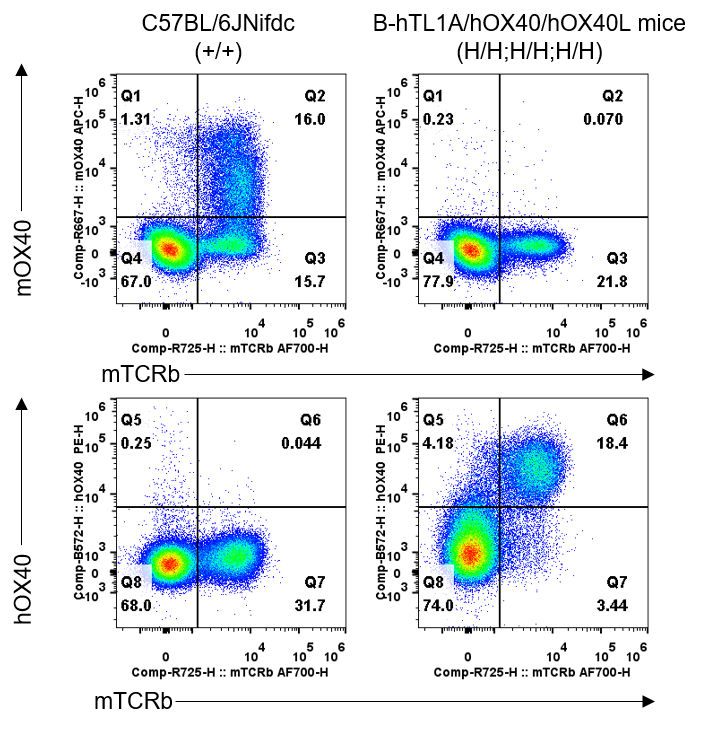
      Strain specific OX40 expression analysis in homozygous B-hTL1A/hOX40/hOX40L mice by flow cytometry. Splenocytes were collected from wild-type C57BL/6JNifdc mice(+/+) and homozygous B-hTL1A/hOX40/hOX40L mice(H/H;H/H;H/H) stimulated with anti-mouse CD3ε antibody in vivo for 24 h, protein expression was analyzed by flow cytometry with species-specific anti-mouse OX40 antibody (Biolegend, 119414) and anti-human OX40 antibody (Biolegend, 350004). Mouse OX40 was detectable on T cells of wild-type C57BL/6JNifdc mice. Human OX40 was detectable on T cells of homozygous B-hTL1A/hOX40/hOX40L mice.
      Protein expression analysis-BMDC

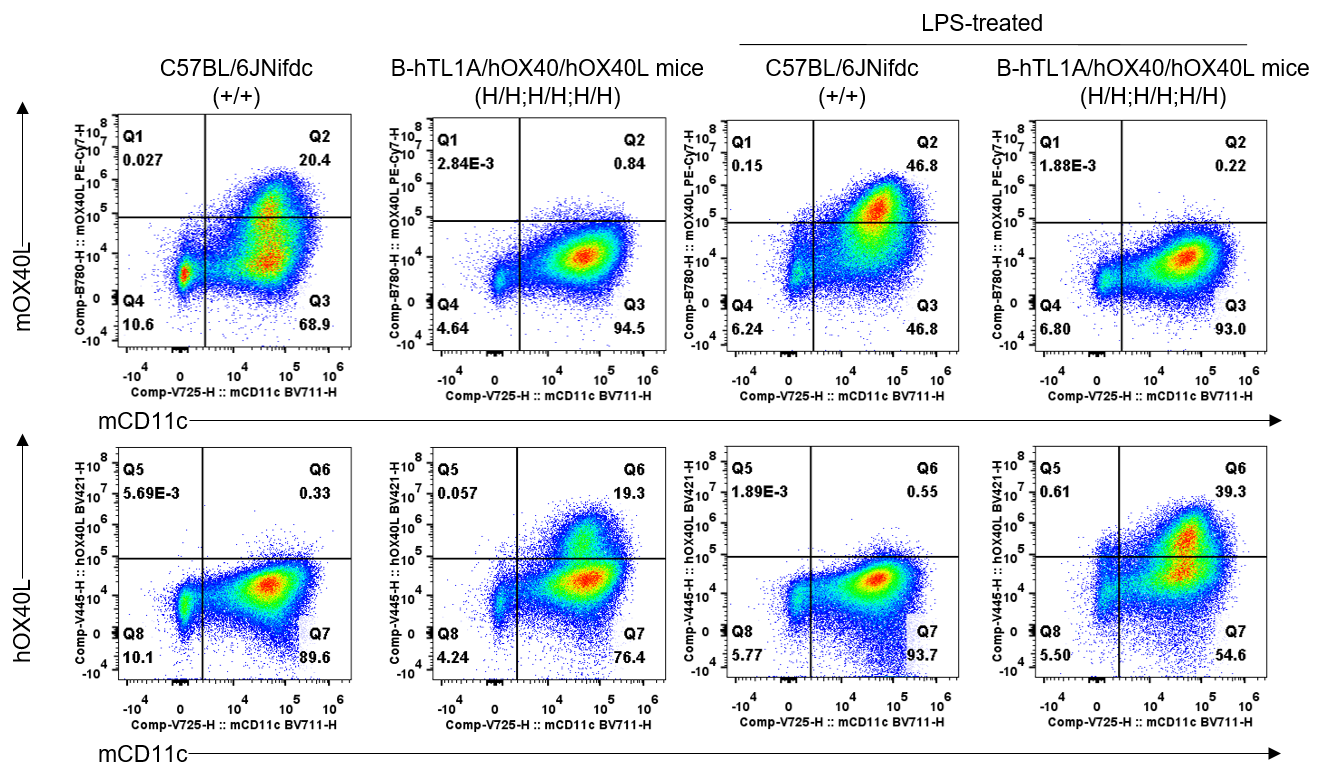
      Strain specific OX40L expression analysis in homozygous B-hTL1A/hOX40/hOX40L mice by flow cytometry. Bone marrow derived dendritic cells (BMDCs) were produced by culturing the bone marrow from wild-type C57BL/6JNifdc mice (+/+) and homozygous B-hTL1A/hOX40/hOX40L mice (H/H;H/H;H/H), which were stimulated with LPS in vitro for 24 h. Protein expression was analyzed with anti-mouse OX40L antibody (Biolegend, 108814) and anti-human OX40L antibody (BD, 563766) by flow cytometry. Mouse OX40L was detectable in wild-type C57BL/6JNifdc mice. Human OX40L was detectable in homozygous B-hTL1A/hOX40/hOX40L mice.

      * When publishing results obtained using this animal model, please acknowledge the source as follows: The animal model [B-hTL1A/hOX40/hOX40L mice] (Cat# 114354) was purchased from Biocytogen.