C57BL/6JNifdc-Car4tm1(CA4)Bcgen/Bcgen • 114425

Background:
CA4, short for Carbonic Anhydrase IV, is a membrane-bound zinc metalloenzyme belonging to the carbonic anhydrase family. Its core function is catalyzing the reversible hydration of carbon dioxide (CO₂ + H₂O ↔ HCO₃⁻ + H⁺), playing pivotal roles in regulating acid-base balance, ion transport, and extracellular pH homeostasis. Specifically expressed on the luminal surface of brain capillary endothelial cells (BCECs) that form the blood-brain barrier (BBB), CA4 is a key molecular target for BBB penetration. CA4 serves as a promising anchor for targeted AAV transduction into BBB via receptor-mediated transcytosis, a natural cellular process that allows the vectors to cross the BBB without disrupting its integrity. Compared to non-targeted AAV, CA4-targeted AAV exhibits significantly enhanced brain accumulation, improved transduction efficiency of neural cells (neurons, astrocytes), and reduced off-target effects in peripheral tissues, making it a valuable strategy for developing effective gene therapies for central nervous system diseases.
Targeting strategy:
The exons 1-8 of mouse Ca4 gene that encode the whole protein domains were replaced by human counterparts in B-hCA4 mice. The promoter, 5’UTR of the mouse gene were retained and the 3’UTR region was replaced with human counterparts.
Validation:
Mouse Car4 mRNA was only detectable in wild-type mice. Human CA4 mRNA was exclusively detectable in homozygous B-hCA4 mice but not in wild-type mice.
Human CA4 was detected in brain, heart, kidney, colon and lung from homozygous B-hCA4 mice.
Application: For example, this product can be used for pharmacodynamics and safety evaluation of drugs targeting CA4. Also, this product can be used to evaluate the pharmacodynamics and safety of treatments of AAV capsids, as well as to assess the potential of AAV capsids penetrate the blood-brain barrier.

Gene targeting strategy for B-hCA4 mice. The exons 1-8 of mouse Ca4 gene that encode the whole protein domains were replaced by human counterparts in B-hCA4 mice. The promoter, 5’UTR of the mouse gene were retained and the 3’UTR region was replaced with human counterparts.

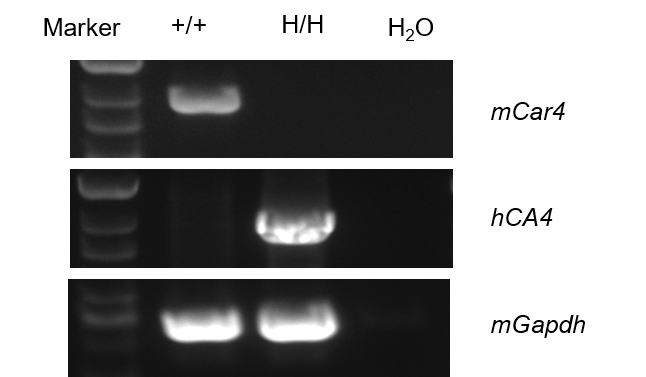
Strain specific analysis of CA4 mRNA expression in wild-type C57BL/6JNifdc mice and homozygous B-hCA4 mice by RT-PCR. Brain RNA were isolated from wild-type C57BL/6JNifdc mice (+/+) and homozygous B-hCA4 mice (H/H) (female, 6-week-old), then cDNA libraries were synthesized by reverse transcription, followed by PCR with mouse or human CA4 primers. Mouse Car4 mRNA was only detectable in wild-type mice. Human CA4 mRNA was exclusively detectable in homozygous B-hCA4 mice but not in wild-type mice.
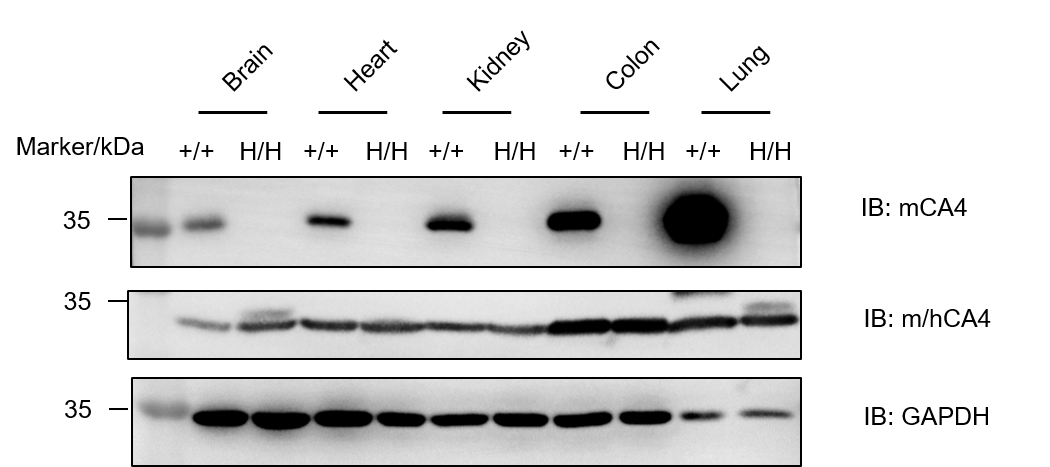
Western blot analysis of CA4 protein expression in homozygous B-hCA4 mice. Various tissue lysates were collected from wild-type C57BL/6JNifdc mice (+/+) and homozygous B-hCA4 mice (H/H), and then analyzed by western blot with anti-CA4 antibody (anti mouse CA4 antibody, R&D, AF2414; anti mouse/human CA4 antibody, Invirtrogen, PA5-47266). 40 μg total proteins were loaded for western blotting analysis. Mouse CA4 was only detected in brain, heart, kidney, colon and lung from wild-type mice. Human CA4 was detected in brain, heart, kidney, colon and lung from homozygous B-hCA4 mice.