

BALB/cAnNCrl-Igf1rtm5(IGF1R)Bcgen/Bcgen • 114790

Background: This receptor binds insulin-like growth factor with a high affinity. It has tyrosine kinase activity. The insulin-like growth factor I receptor plays a critical role in transformation events. Cleavage of the precursor generates alpha and beta subunits. It is highly overexpressed in most malignant tissues where it functions as an anti-apoptotic agent by enhancing cell survival.
Targeting strategy:
Validation:
Application: Humanized B-hIGF1R mice plus can be utilized for target validation, mechanism research, pharmacodynamic studies, and drug safety evaluation in thyroid eye disease, autoimmune diseases, and other relevant disorders. Additionally, they serve as a valuable tool for pharmacokinetic (PK) studies related to the blood-brain barrier (BBB) penetration of IGF1R-targeting large-molecule drugs

Gene targeting strategy for B-hIGF1R mice(C). A chimeric CDS that encodes mouse Igf1r signal peptide and human extracellular domain, human transmembrane and mouse cytoplasmic domain, as well as mouse 3’UTR region were inserted right after mouse Igf1r exon 2 to replace the exon 2 of mouse Igf1r gene. The chimeric IGF1R protein expression will be driven by endogenous mouse Igf1r promoter, while mouse Igf1r gene transcription and translation will be disrupted.

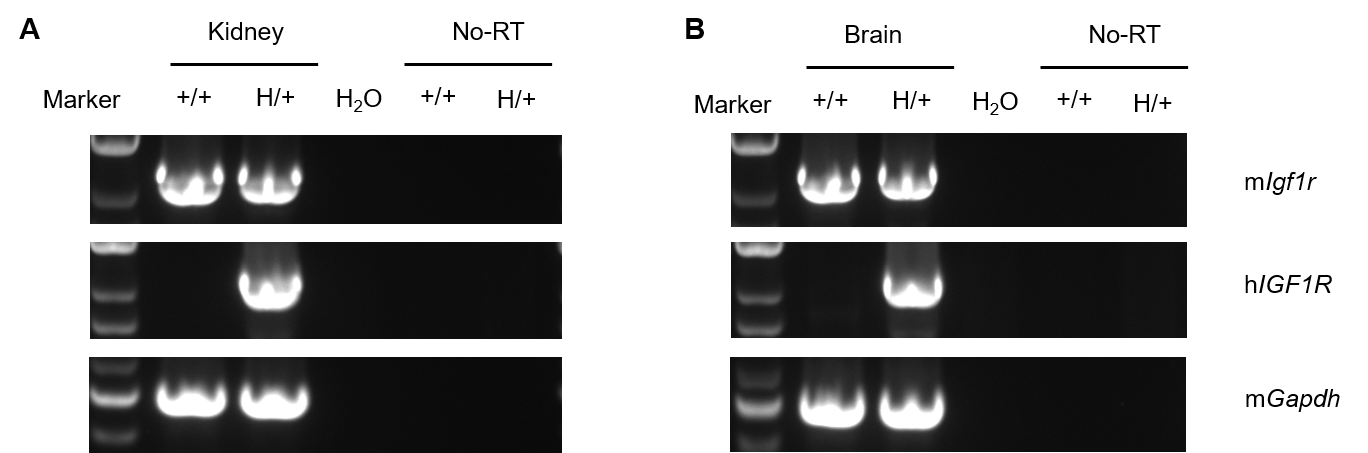
Strain specific analysis of IGF1R mRNA expression in wild-type BALB/c mice and heterozygous B-hIGF1R mice(C) by RT-PCR. Kidney (A) and brain (B) RNA were isolated from wild-type BALB/c mice (+/+) and heterozygous B-hIGF1R mice(C) (H/+), then cDNA libraries were synthesized by reverse transcription, followed by PCR with IGF1R primers. Mouse Igf1r was detectable in wild-type BALB/c mice and heterozygous B-hIGF1R mice(C). Human IGF1R was exclusively detectable in heterozygous B-hIGF1R mice(C) but not in wild-type mice. Human IGF1R sequence was confirmed by Sanger-sequencing. No-RT: no reverse-transcripted.
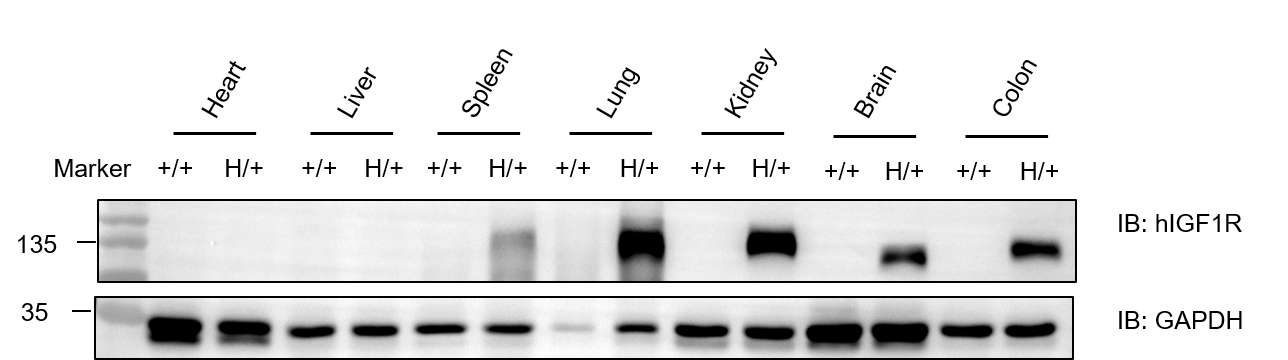
Western blot analysis of IGF1R protein expression in wild-type BALB/c mice and heterozygous B-hIGF1R mice(C) by WB. Various tissues were collected from wild-type BALB/c mice (+/+) and heterozygous B-hIGF1R mice(C) (H/+), and then analyzed by western blot with anti-IGF1R antibody (Abcam, ab263903). 40 μg total protein was loaded for western blotting analysis. Human IGF1R was exclusively detectable in spleen, lung, kidney, brain and colon from heterozygous B-hIGF1R mice(C).