B-hPCSK9 plus, Ldlr KO mice

C57BL/6-Pcsk9tm2(PCSK9)Bcgen Ldlrtm2Bcgen/Bcgen • 113891


B-hPCSK9 plus, Ldlr KO mice

Product nameB-hPCSK9 plus, Ldlr KO mice
Catalog number113891
Strain nameC57BL/6-Pcsk9tm2(PCSK9)Bcgen Ldlrtm2Bcgen/Bcgen
Strain backgroundC57BL/6
NCBI gene ID255738,3949 (Mouse)
AliasesFH3; PC9; FHCL3; NARC1; LDLCQ1; NARC-1; HCHOLA3; FH; FHC; FHCL1; LDLCQ2

이 페이지에서

  • Description
  • Targeting strategy
  • Phenotypic analysis
  • Efficacy

포스터

모두 보기

    출판물

      Description
      • PCSK9 is expressed in the liver, intestine and kidney tissues and escorts specific receptors for lysosomal degradation. It plays a role in cholesterol and fatty acid metabolism. PCSK9 binds to the receptor for LDL, if PCSK9 is blocked, more LDLRs are recycled and are present on the surface of cells to remove LDL particles from the extracellular fluid.
      • LDLR, or Low-Density Lipoprotein Receptor, is a critical cell surface receptor involved in cholesterol metabolism. It facilitates the uptake of LDL particles, which contain high levels of cholesterol, by binding to apolipoproteins B-100 and E.
      • Gene editing strategy: The exons 1-12 of mouse Pcsk9 gene that encode the whole molecule were replaced by human counterparts in B-hPCSK9 mice plus. The promoter, 5’UTR and 3’UTR regions of the mouse gene were replaced by human counterparts. Exons 4-18 of the mouse Ldlr gene were knocked out in B-Ldlr KO mice, resulting in a disruption of the Ldlr gene.
      • B-hPCSK9 plus, Ldlr KO mice were generated by crossing B-hPCSK9 mice plus with B-Ldlr KO mice.
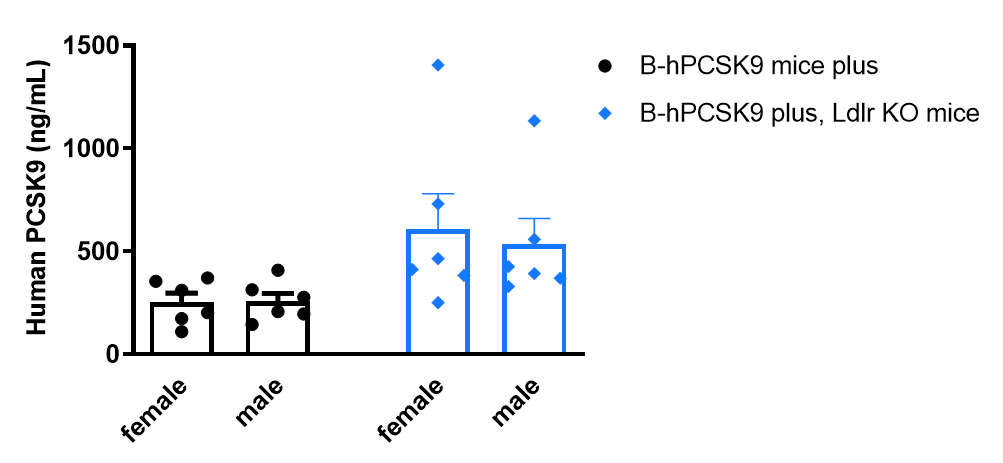
      • Protein expression analysis: The human PCSK9 expression of B-hPCSK9 plus, Ldlr KO mice was higher than that of B-hPCSK9 mice plus.
      • Lipid metabolism analysis: The LDLC levels of male and female mice in C57BL/6JNifdc mice, B-hPCSK9 mice plus and B-hPCSK9 plus, Ldlr KO mice showed no significant difference. The  LDL-C concentration of B-hPCSK9 plus, Ldlr KO mice was higher than that of B-hPCSK9 mice plus.
      • In vivo efficacious: B-hPCSK9 plus, Ldlr KO mice as an effective preclinical model for evaluating human PCSK9-targeted therapies.
      • Application: This product is used for pharmacodynamics and safety evaluation of hypercholesterolemia and other metabolic diseases.
      Targeting Strategy

      Gene targeting strategy for B-hPCSK9 plus, Ldlr KO mice.
      The exons 1-12 of mouse Pcsk9 gene that encode the whole molecule were replaced by human counterparts in B-hPCSK9 mice plus. The promoter, 5’UTR and 3’UTR regions of the mouse gene were replaced by human counterparts.

      Exons 4-18 of the mouse Ldlr gene were knocked out in B-Ldlr KO mice, resulting in a disruption of the Ldlr gene.

      B-hPCSK9 plus, Ldlr KO mice were generated by crossing B-hPCSK9 mice plus with B-Ldlr KO mice.

      Protein Expression Analysis in Serum

      Strain-specific PCSK9 expression analysis in humanized B-hPCSK9 plus, Ldlr KO mice by ELISA. Serum was collected from homozygous B-hPCSK9 mice plus (H/H), and B-hPCSK9 plus, Ldlr KO mice (H/H,+/-) (female and male, n=6, 6-8 weeks old). Expression level of human PCSK9 was analyzed by ELISA (human PCSK9 ELISA kit: Proteintech, KE00278). Human PCSK9 was detectable in homozygous B-hPCSK9 mice plus (H/H), and B-hPCSK9 plus, Ldlr KO mice (H/H,+/-). The human PCSK9 expression of B-hPCSK9 plus, Ldlr KO mice was higher than that of B-hPCSK9 mice plus. Values are expressed as mean ± SEM.

      Analysis of Lipid Metabolism in B-hPCSK9 plus, Ldlr KO mice

      Lipid metabolism analysis in B-hPCSK9 plus, Ldlr KO mice.

      Serum concentrations of LDL-C were analyzed in 4-hour-fasted B-hPCSK9 plus, Ldlr KO mice (H/H,+/-), B-hPCSK9 mice plus (H/H) and wild-type C57BL/6JNifdc mice (+/+) ( n=6, 6-8 weeks old). The LDLC levels of male and female mice in the three strains showed no significant difference. The  LDL-C concentration of B-hPCSK9 plus, Ldlr KO mice was higher than that of B-hPCSK9 mice plus.

      LDL-C, low-density lipoprotein cholesterol.

      Values are expressed as mean ± SEM. Significance was determined by 2-way ANOVA.

      Inhibitory Efficiency of the PCSK9 Targeted Nucleic Acid Drugs

      The inhibitory efficiency of the PCSK9 targeted nucleic acid drugs in B-hPCSK9 plus, Ldlr KO mice. (A) Schematic of the experimental design. B-hPCSK9 plus, Ldlr KO mice (6-8 weeks old, n=3 per group) were administered a single subcutaneous (s.c.) dose of 3 mg/kg Inclisiran or PBS at Day 0. Blood samples were collected on days -3, 14, 21, and 28.

       (B) Time-course of serum LDL-C concentration. A significant reduction in LDL-C levels was observed in Inclisiran-treated groups (G2: female, G4: male) compared to their respective PBS control groups (G1: female, G3: male). These results validate the B-hPCSK9 plus, Ldlr KO mice as an effective preclinical model for evaluating human PCSK9-targeted therapies. Data are presented as mean ± SEM.

      * When publishing results obtained using this animal model, please acknowledge the source as follows: The animal model [B-hPCSK9 plus, Ldlr KO mice] (Cat# 113891) was purchased from Biocytogen.