
B-hCD3EDG/hBCMA mice

C57BL/6-Cd3etm1(CD3E)Bcgen Cd3dtm1(CD3D)BcgenCd3gtm1(CD3G)Bcgen Tnfrsf17tm1(TNFRSF17)Bcgen/Bcgen • 112602

B-hCD3EDG/hBCMA mice

Product nameB-hCD3EDG/hBCMA mice
Catalog number112602
Strain nameC57BL/6-Cd3etm1(CD3E)Bcgen Cd3dtm1(CD3D)BcgenCd3gtm1(CD3G)Bcgen Tnfrsf17tm1(TNFRSF17)Bcgen/Bcgen
Strain backgroundC57BL/6
NCBI gene ID916,915,917,608 (Human)
AliasesT3E; TCRE; IMD18; CD3epsilon; T3D; IMD19; CD3DELTA; CD3-DELTA; T3G; IMD17; CD3GAMMA; CD3-GAMMA; BCM; BCMA; CD269; TNFRSF13A

이 페이지에서

  • Description
  • Phenotypic analysis
  • FAQ section

포스터

모두 보기

    출판물

      Description
      • CD3 consists of four protein chains (CD3E, CD3D, CD3G, and CD3Z), which form the TCR/CD3 complex together with the T cell receptor and mediate T cell antigen recognition, signal transduction, activation, and immune regulation. B cell maturation antigen (BCMA, TNFRSF17) is primarily expressed on plasma cells and is an important therapeutic target in multiple myeloma and other B cell malignancies.
      • In CD3EDG/BCMA humanized mice, chimeric human CD3EDG gene are engineered while endogenous mouse Cd3edg genes are disrupted. Human BCMA replaces the corresponding mouse Bcma sequences, enabling physiological relevant expression of human BCMA in plasma cells.
      • Human CD3E was detectable on T cells of homozygous CD3EDG/BCMA humanized mice, while human BCMA was detected in spleen plasma cells. This model supports in vivo evaluation of T cell-engaging therapeutics and BCMA-targeted biologics.

      Key Advantages

      • Fully humanized CD3EDG and BCMA targets for translational immuno-oncology studies
      • Supports evaluation of BCMA-targeted bispecific antibodies and CAR-T therapies
      • Human CD3E expression enables T cell engager pharmacology studies in vivo
      • Suitable for multiple myeloma and hematologic malignancy research
      • Enables simultaneous assessment of efficacy, immune activation, and safety

      Validation

      • Molecular Validation: Mouse Cd3edg and Bcma mRNA were detectable in splenocytes of wild-type mice, whereas human CD3EDG and BCMA mRNA were detectable in homozygous CD3EDG/BCMA humanized mice. Sequencing confirmed the specificity of the amplified humanized gene products.
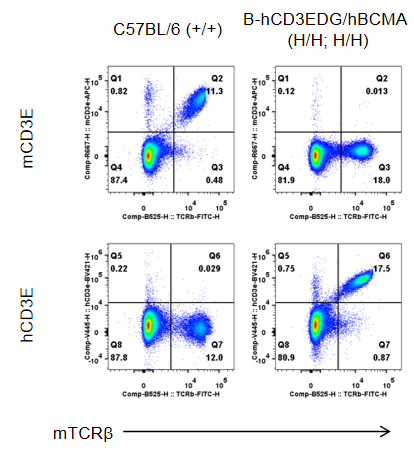
      • Protein Validation: Human CD3E protein was detected on splenic T cells of homozygous CD3EDG/BCMA humanized mice by flow cytometry, while mouse CD3E expression was detected in wild-type mice.
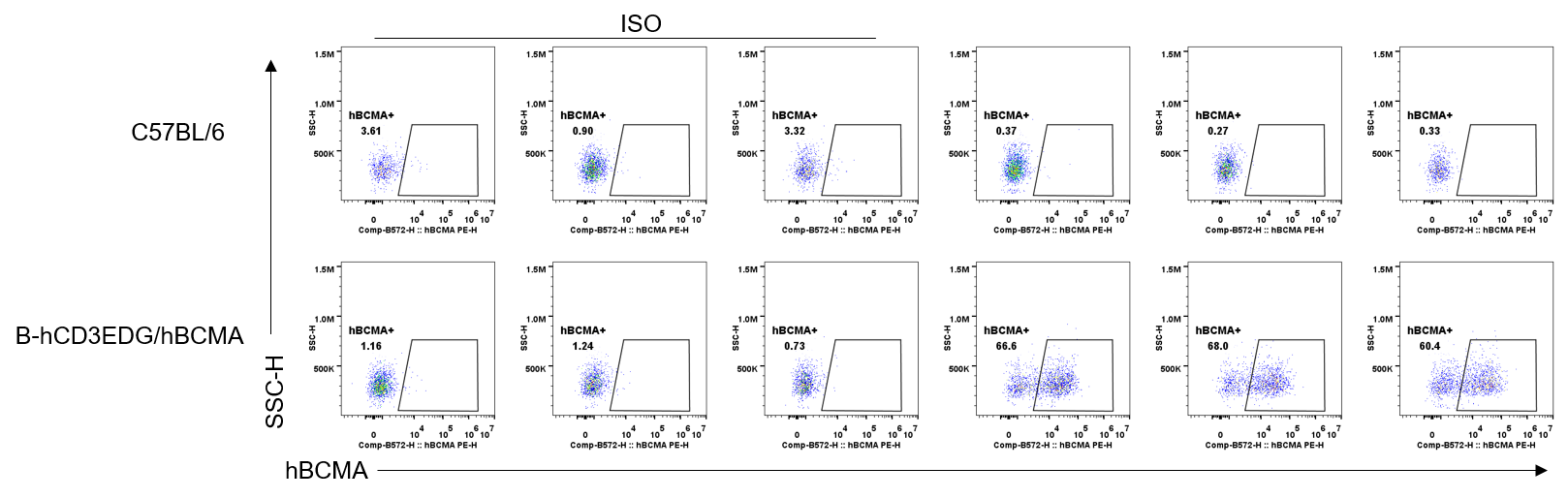
      • Cell-Type Validation: Human BCMA protein was detected in spleen plasma cells of CD3EDG/BCMA humanized mice using human-specific BCMA antibody staining, confirming successful humanization and plasma-cell expression.
      • Translational Value: The co-expression of human CD3E and human BCMA enables in vivo assessment of T cell-dependent cytotoxicity, bispecific antibody activity, and BCMA-targeted immunotherapies.

      Application

      • BCMA-targeted antibody and biologic validation
      • Bispecific T cell engager efficacy evaluation
      • CAR-T and T cell immunotherapy research
      • Multiple myeloma and plasma cell malignancy studies
      • Preclinical pharmacodynamics and safety assessment of human-specific therapeutics
      mRNA Expression Analysis of Human CD3EDG and BCMA in CD3EDG/BCMA Humanized Mice

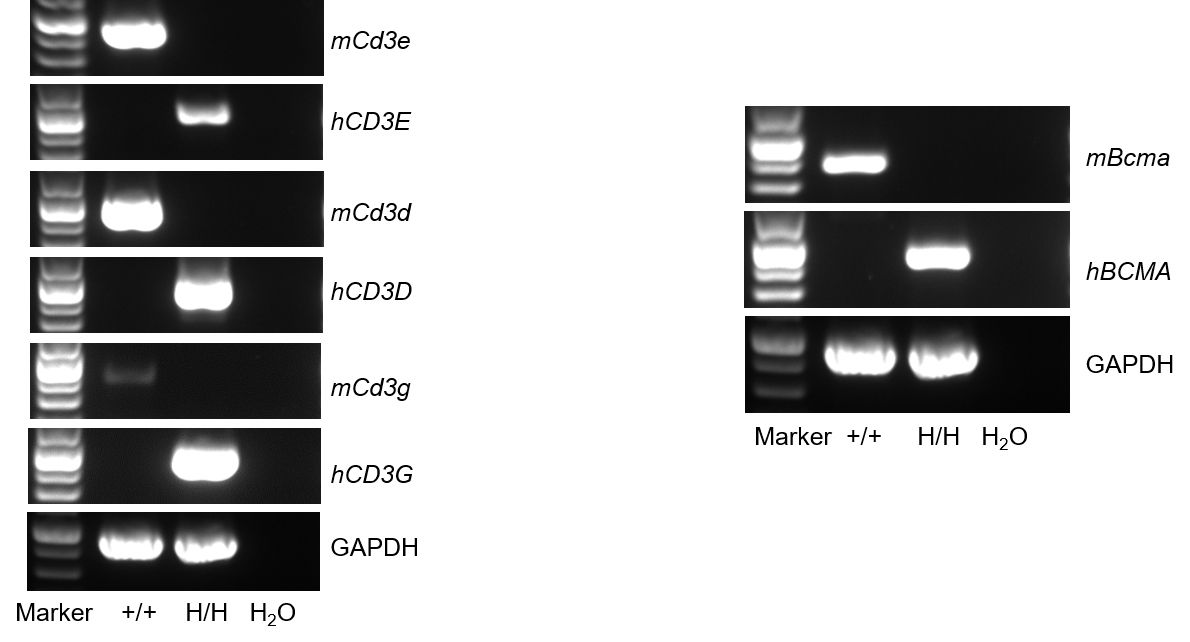
      Strain-specific analysis of human CD3EDG and BCMA gene expression was performed in wild-type mice and CD3EDG/BCMA humanized mice by RT-PCR. Mouse Cd3edg and Bcma mRNA were detectable in splenocytes of wild-type mice (+/+). Human CD3EDG and BCMA mRNA were detectable in homozygous CD3EDG/BCMA humanized mice (H/H; H/H), but not in wild-type mice (+/+). The positive band was confirmed by sequencing.

      Protein Expression Analysis of Human CD3E in CD3EDG/BCMA Humanized Mice

      Strain-specific human CD3E expression analysis was performed in homozygous CD3EDG/BCMA humanized mice by flow cytometry. Splenocytes were collected from wild-type mice (+/+) and homozygous CD3EDG/BCMA humanized mice (H/H; H/H), and analyzed by flow cytometry using species-specific anti-CD3E antibody. Mouse CD3E was detectable in wild-type mice (+/+). Human CD3E was detectable in homozygous CD3EDG/BCMA humanized mice (H/H; H/H), but not in wild-type mice (+/+).

      Protein Expression Analysis of BCMA in Spleen Plasma Cells of CD3EDG/BCMA Humanized Mice

      BCMA expression was analyzed in wild-type C57BL/6 mice and homozygous CD3EDG/BCMA humanized mice by flow cytometry. Spleen plasma cells were collected from wild-type C57BL/6 mice and homozygous CD3EDG/BCMA humanized mice. Protein expression was analyzed using human BCMA antibody (BioLegend, 357504). Human BCMA was detectable in plasma cells of spleen from CD3EDG/BCMA humanized mice but not in wild-type C57BL/6 mice.

      FAQ section

      Q1:What are CD3EDG/hBCMA Humanized Mice?

      CD3EDG/hBCMA Humanized Mice are genetically engineered mice expressing humanized CD3EDG and BCMA targets for translational immuno-oncology and hematologic malignancy research.

      Q2: Why is hBCMA an important therapeutic target?

      BCMA is highly expressed on plasma cells and multiple myeloma cells and plays important roles in B cell maturation, plasma cell survival, and tumor biology, making it a promising target for multiple myeloma and other B cell malignancy therapeutics.

      Q3: Can these mice be used for bispecific antibody evaluation?

      Yes. The model is designed for evaluation of BsADCs, T cell engagers, and other human-specific BCMA-targeted therapeutics.

      Q4: What tissues express humanized hBCMA in this model?

      Humanized CDH17 expression was confirmed in spleen plasma cells .

      Q5: Are these mice suitable for toxicity studies?

      Yes. The model supports both efficacy and toxicity assessment of hBCMA-targeted immunotherapies in vivo.

      * When publishing results obtained using this animal model, please acknowledge the source as follows: The animal model [B-hCD3EDG/hBCMA mice] (Cat# 112602) was purchased from Biocytogen.