Abstract Body:
Introduction:
Activin E, encoded by the INHBE gene, is a growth factor that belongs to the transforming growth factor-β (TGF-β) family. As part of the liver-adipose feedback loop, activin E is released from hepatocytes in response to elevated hepatic triglycerides and serum-free fatty acids. It then signals in adipose cells via ALK7 to suppress lipolysis, reducing the efflux of free fatty acids to the liver and preventing excessive hepatic lipid accumulation. Preclinical studieshave shown that targeting INHBE with RNAi therapy can reduce fat mass andpreserve lean muscle mass compared to currently approved obesity therapies. The drug with the fastest progress at present has initiated a Phase 1/2a clinical trial.
Biocytogen has developed a humanized INHBE mouse model, B-hINHBEmice, which exclusively express human INHBE but not mouse Inhbe. This model provides a valuable tool for preclinical studies of INHBE-related diseases.
Methods:
- To develop humanized B-hINHBE mice, exons 1-2 of the mouse Inhbegene, which encode the entire molecule (from ATG start codon to STOP codon) including the 3’UTR, were replaced with their human counterparts. The promoter and 5’UTR regions of the mouse gene were retained. Human INHBE expression is driven by the endogenous mouse Inhbe promoter, while transcription and translation of the mouse Inhbe gene are disrupted.
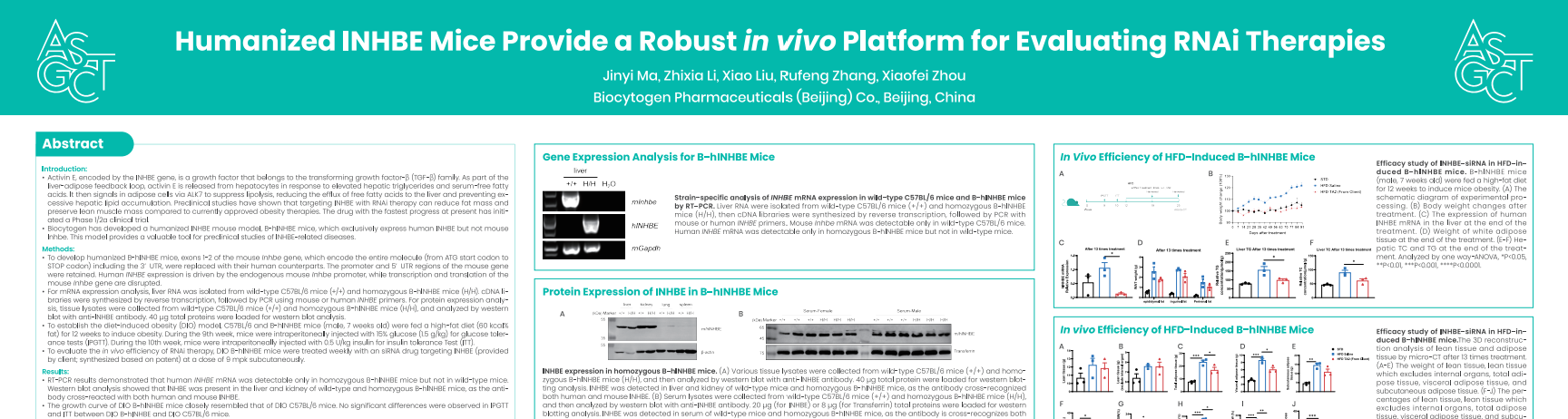
- For mRNA expression analysis, liver RNA was isolated from wild-type C57BL/6 mice (+/+) and homozygous B-hINHBE mice (H/H). cDNA libraries were synthesized by reverse transcription, followed by PCR usingmouse or human INHBE primers. For protein expression analysis, tissue lysates were collected from wild-type C57BL/6 mice (+/+) and homozygous B-hINHBE mice (H/H), and analyzed by western blot with anti-INHBE antibody. 40 μg total proteins were loaded for western blotanalysis.
- To establish the diet-induced obesity (DIO) model, C57BL/6 and B-hINHBE mice (male, 7 weeks old) were fed a high-fat diet (60 kcal% fat) for 12 weeks to induce obesity. During the 9th week, mice were intraperitoneally injected with 15% glucose (1.5 g/kg) for glucose tolerance tests (IPGTT). During the 10th week, mice were intraperitoneally injected with 0.5 U/kg insulin for insulin tolerance Test(ITT).
- To evaluate the in vivo efficiency of RNAi therapy, DIO B-hINHBE mice were treated weekly with an siRNA drug targeting INHBE (provided byclient; synthesized based on patent) at a dose of 9 mpk subcutaneously.
Results:
- RT-PCR results demonstrated that human INHBE mRNA was detectable only in homozygous B-hINHBE mice but not in wild-type mice. Western blot analysis showed that INHBE was present in the liver and kidney of wild-type and homozygous B-hINHBE mice, as the antibody cross-reactedwith both human and mouse INHBE.
- The growth curve of DIO B-hINHBE mice closely resembled that of DIO C57BL/6 mice. No significant differences were observed in IPGTT and ITT between DIO B-hINHBE and DIO C57BL/6 mice.
- In the in vivo efficiency test, siRNA targeting INHBE inhibited body weight gain in DIO B-hINHBE mice compared to the saline-treated group.Treatment with siRNA targeting INHBE also resulted in fat mass loss while preserving lean mass.
Conclusions:
- B-hINHBE mice successfully express human INHBE, which functions normally. Theyserve as a powerful in vivo platform to evaluate RNAi therapy in obesity treatment and muscle preservation.