
B-F8 KO mice

C57BL/6N-F8tm1Bcgen/Bcgen • 110169

B-F8 KO mice

Catalog Number: 110169
Strain Name: C57BL/6N-F8tm1Bcgen/Bcgen
Strain Background: C57BL/6N
NCBI gene ID: 14069 (Mouse)
Aliases: Cf8; Cf-8; FVIII
---
라이선스 옵션 제공 가능
B-F8 KO mice

이 페이지에서

  • Description
  • Targeting strategy
  • Phenotypic analysis
  • Efficacy

포스터

모두 보기

    출판물

      Description

      F8: A Key Coagulation Cofactor in Hemostasis and Its Therapeutic Development

      • Gene Information: Coagulation factor VIII (FVIII, encoded by F8) is a large protein-coding gene located on chromosome Xq28. It encodes a circulating plasma glycoprotein cofactor that is an essential component of the intrinsic coagulation cascade.
      • Protein Expression: FVIII precursor is predominantly produced by liver sinusoidal endothelial cells and vascular endothelial cells, secreted into plasma and circulates in complex with von Willebrand factor (vWF) for stability; it is proteolytically activated to FVIIIa during hemostatic activation upon vascular injury.
      • Signaling Pathway: Activated FVIIIa acts as an essential cofactor for FIXa to assemble the intrinsic tenase complex, which drives robust FX activation, accelerates prothrombin conversion to thrombin and mediates stable fibrin clot formation via the intrinsic coagulation cascade.
      • Therapeutic Inhibition: Recombinant FVIII replacement, gene therapies and bispecific antibodies restore or bypass FVIII function to correct defective hemostasis, representing the mainstay treatments for hemophilia A caused by F8 gene mutations.
      Targeting strategy

      The exons 16~20 of mouse F8 gene  were knocked out in B-F8 KO mice.

      Tail transection bleeding assay
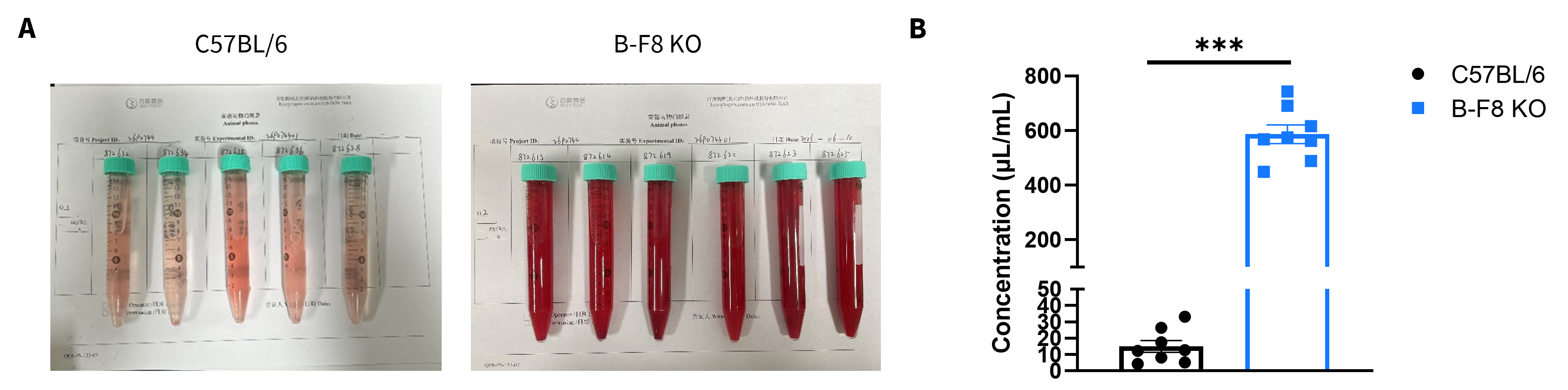
      • Homozygous B-F8 KO mice exhibit a severe bleeding tendency with significantly increased blood loss upon tail transection compared with wild-type C57BL/6 mice.

      Tail transection bleeding assay in homozygous B-F8 KO mice. Wild-type C57BL/6 mice (+/+, 9-week-old, n=8) and homozygous B-F8 KO mice (-/-, 9-week-old, n=8) were assessed using a 2 mm distal tail transection analysis. A. The result shows representative blood collection tubes reflecting apparent differences in blood loss between C57BL/6 mice and homozygous B-F8 KO mice. B. Quantitative hemoglobin concentration analysis revealed markedly elevated blood volume in B-F8 KO mice relative to C57BL/6 mice. Values are expressed as mean ± SEM. Analyzed by 2 way-ANOVA, *P<0.05, **P<0.01, ***P<0.001.
      Functional Analysis
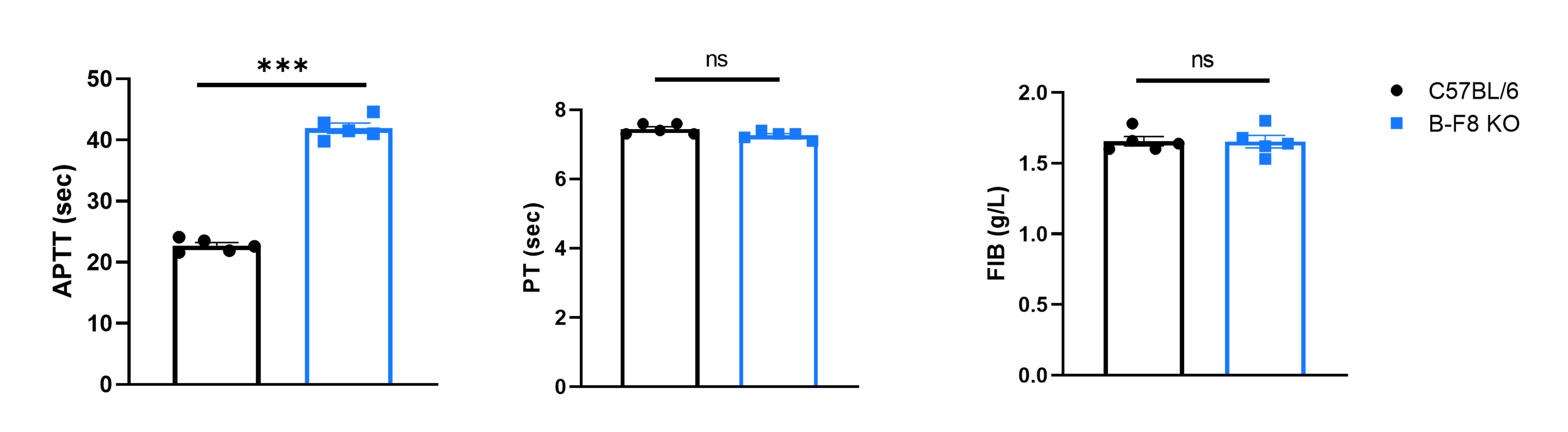
      • The APTT was significantly prolonged in B-F8 KO mice relative to wild-type mice.

      Functional analysis of coagulation in homozygous B-F8 KO mice. Plasma was collected from wild-type C57BL/6 mice (female, 9-week-old, n=5) and homozygous B-F8 KO mice (female, 9-week-old, n=5). Activated partial thromboplastin time (APTT, sec), plasma prothrombin time (PT, sec) and fibrinogen (FIB, g/L) were measured to assess baseline coagulation. Values are expressed as mean ± SEM. Analyzed by 2 way-ANOVA, *P<0.05, **P<0.01, ***P<0.001.

      In vivo efficacy
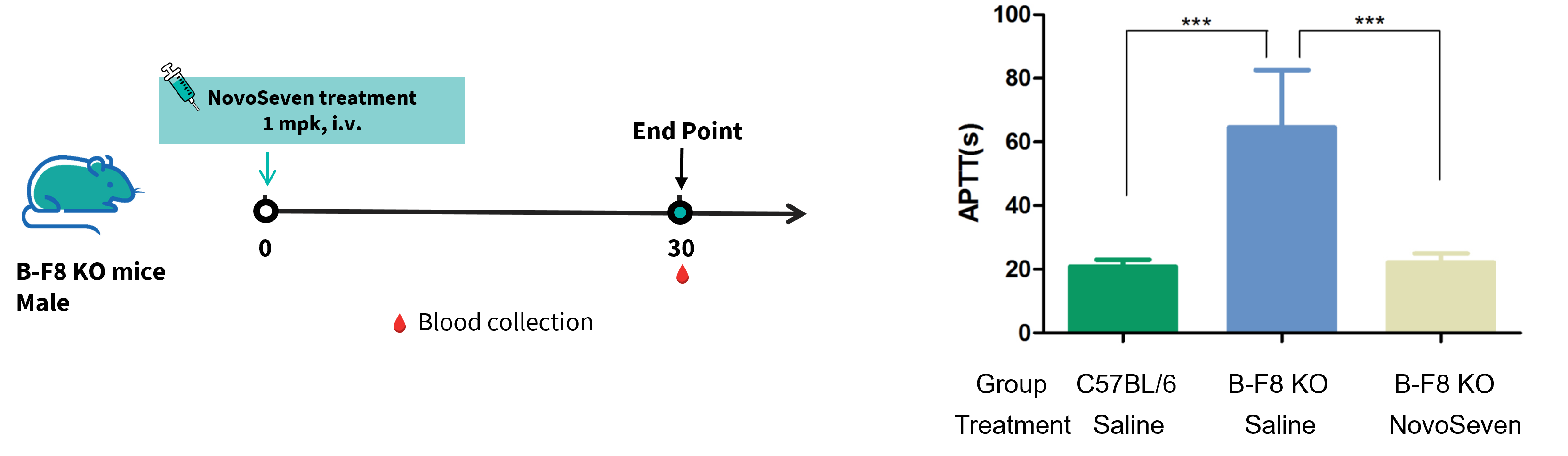
      • APTT in homozygous B-F8 KO mice was much higher than that in wild-type C57BL/6 mice, and APTT returned to normal values after injection of NovoSeven (recombinant human coagulation factor VIIa).

      APTT of recombinant human coagulation factor VIIa in B-F8 KO mice. The experimental animals were randomly divided into groups and given saline or 1 mg/kg NovoSeven by tail vein injection, 30 minutes after injection of the drug, blood was collected from the abdominal aorta to detect the blood coagulation index: activated partial thromboplastin time APTT. The results showed that B-F8 KO mice can be used as a powerful tool for the validation of anticoagulant efficacy. Values are expressed as mean ± SEM. Analyzed by 2 way-ANOVA, *P<0.05, **P<0.01, ***P<0.001, ****P<0.0001.

      * When publishing results obtained using this animal model, please acknowledge the source as follows: The animal model [B-F8 KO mice] (Cat# 110169) was purchased from Biocytogen.