Description
F9: A Key Coagulation Cofactor in Hemostasis and Its Therapeutic Development
- Gene Information: Coagulation factor IX (FIX, encoded by F9) is a protein-coding gene on chromosome Xq27.1, encoding a vitamin K-dependent serine protease zymogen essential for the intrinsic coagulation cascade.
- Protein Expression: FIX is predominantly produced by liver hepatocytes. After gamma-carboxylation, it circulates as an inactive zymogen and is activated to FIXa by FXIa or FVIIa-tissue factor complex upon vascular injury.
- Signaling Pathway: Activated FIXa assembles the intrinsic tenase complex with FVIIIa, calcium and phospholipids, driving efficient FX activation, thrombin generation and stable fibrin clot formation.
- Therapeutic Inhibition: Recombinant FIX replacement (standard/extended half-life), AAV gene therapies and next-generation strategies restore FIX activity, serving as standard treatments for hemophilia B caused by F9 mutations.
Targeting strategy
The exons 1~3 of mouse F9 gene were knocked out in B-F9 KO mice.
In vivo efficacy
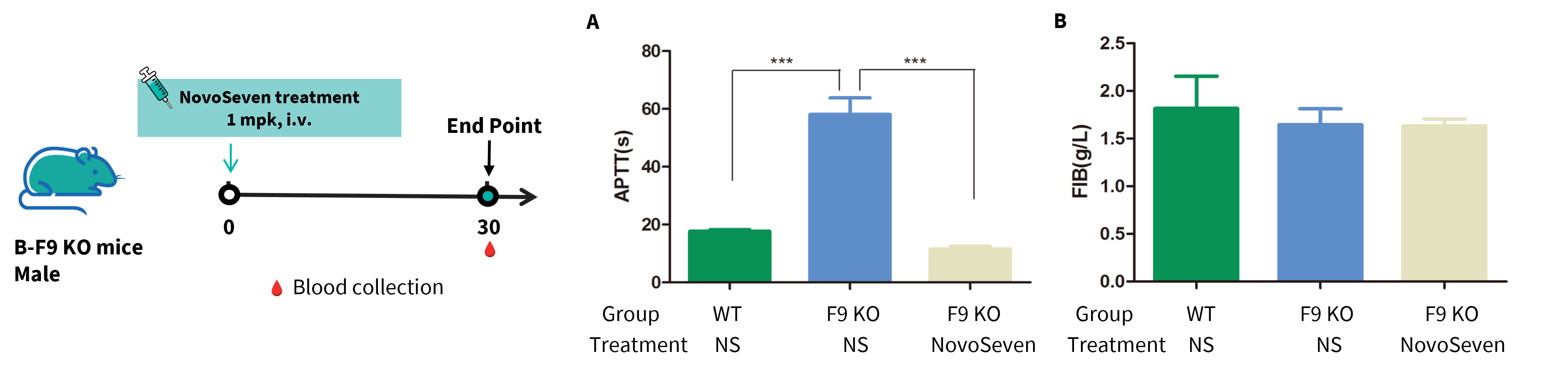
- APTT in homozygous B-F9 KO mice was much higher than that in wild-type C57BL/6 mice, and APTT returned to normal values after injection of NovoSeven (recombinant human coagulation factor VIIa).
- There was no significant difference in FIB values between B-F9 KO mice and WT mice.
APTT of recombinant human coagulation factor VIIa in B-F9 KO mice. The experimental animals were randomly divided into groups and given saline or 1 mg/kg NovoSeven by tail vein injection, 30 minutes after injection of the drug, blood was collected from the abdominal aorta to detect the blood coagulation index: activated partial thromboplastin time APTT. The results showed that B-F9 KO mice can be used as a powerful tool for the validation of anticoagulant efficacy. Values are expressed as mean ± SEM. Analyzed by 2 way-ANOVA, *P<0.05, **P<0.01, ***P<0.001, ****P<0.0001.
* When publishing results obtained using this animal model, please acknowledge the source as follows: The animal model [B-F9 KO mice] (Cat# 110170) was purchased from Biocytogen.