이 페이지에서

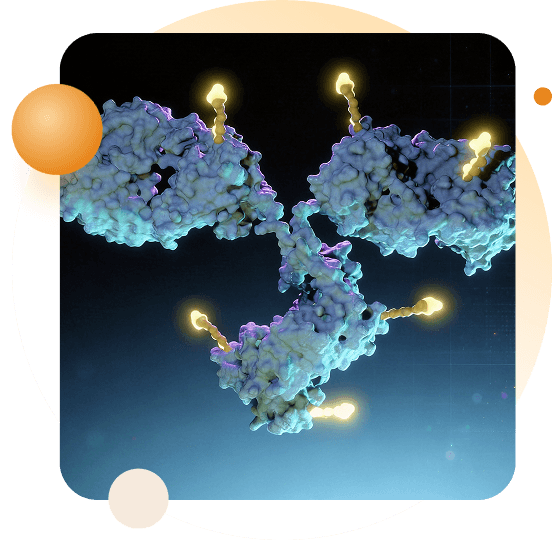
Built on the RenLite® platform, BCG030 utilizes common light chain technology to eliminate heavy/light chain mispairing, ensure seamless assembly, simplify manufacturing, and provide a developable antibody backbone for the DLL3 × SEZ6 bispecific ADC drug development.
BCG030 is conjugated with Biocytogen’s proprietary BLD1102 linker–payload system containing BCPT02, a topoisomerase I (TOP1) inhibitor payload designed to drive potent ADC-mediated cytotoxicity in solid tumor drug development.
BCG030 is being evaluated as a DLL3/SEZ6-directed bispecific ADC drug development asset for solid tumors. Potential development areas include small cell lung cancer (SCLC), neuroendocrine tumors (NETs).

The preclinical data package supporting BCG030, generated from Biocytogen internal studies, includes enhanced binding and internalization in SCLC cell lines, antitumor efficacy across CDX and PDX models, and favorable stability and tolerability in preliminary non-human primate assessments. Together, these findings support the continued development of BCG030 as a differentiated DLL3 × SEZ6 bispecific ADC for SCLC and NETs.

Figure 1. Antigen binding analysis of the DLL3 × SEZ6 bispecific antibody in NCI-H524 SCLC cells. BCG030 showed enhanced binding activity compared with (left) single-target benchmark analogs and (right) parental monovalent antibodies, supporting effective dual-target engagement in DLL3/SEZ6-expressing tumor cells.
In addition, affinity characterization showed that BCG030 binds DLL3 with high affinity and SEZ6 with moderate affinity, with cross-reactivity to the corresponding human and cynomolgus monkey targets, supporting translational evaluation.

Figure 2. Internalization analysis of the DLL3 × SEZ6 bispecific antibody in NCI-H69 SCLC cells. BCG030 demonstrated stronger internalization activity than (left) benchmark analogs and (right) parental monovalent antibodies under the evaluated assay conditions, supporting efficient cellular uptake through dual DLL3 and SEZ6 engagement.
In addition, BCG030 showed high internalization activity across multiple SCLC cell lines; additional supporting data are available upon request.
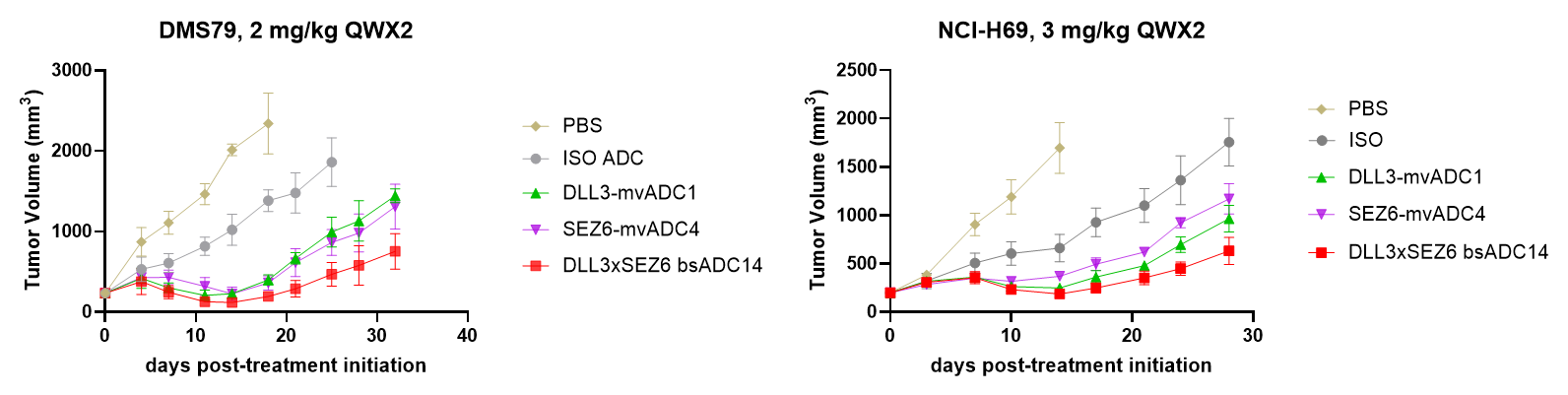
Figure 3. Antitumor efficacy analysis of BCG030 in DMS79 and NCI-H69 SCLC CDX models. BCG030 and the corresponding parental monovalent antibodies were conjugated to BLD1102 at approximately DAR 8. Across both models, the DLL3 × SEZ6 bispecific ADC demonstrated greater tumor growth inhibition than the parental monovalent ADCs, supporting the contribution of the bispecific format to antitumor activity in SCLC.
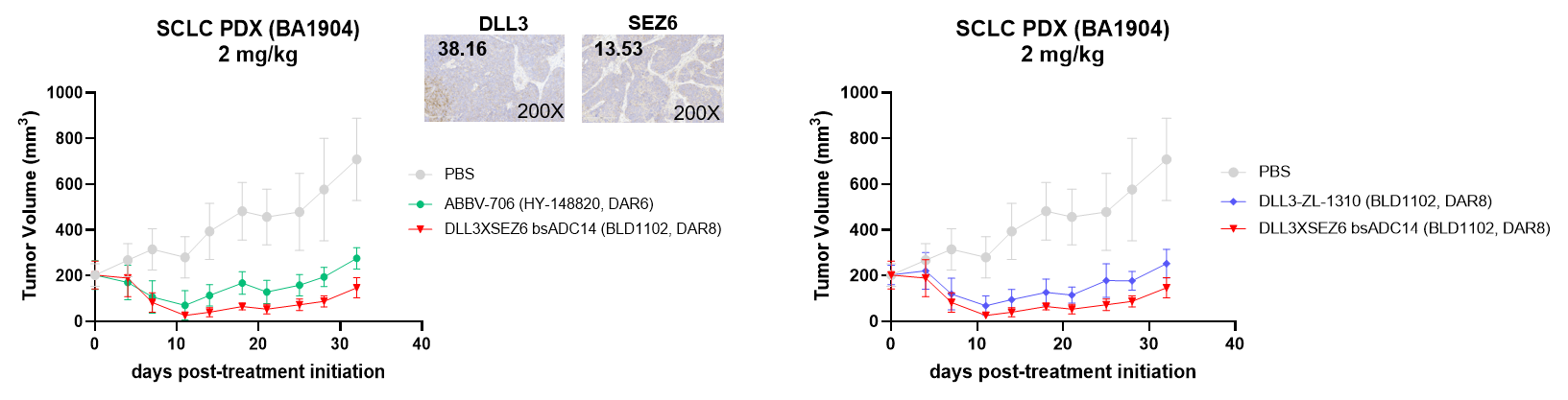
Figure 4. Antitumor efficacy analysis of BCG030 in the BP0818 SCLC PDX model. At 2 mg/kg, BCG030 conjugated to BLD1102 at DAR 8 demonstrated greater tumor growth inhibition than SEZ6 ADC (ABBV-706) and DLL3 ADC (ZL-1310) under the tested conditions. These findings support differentiated antitumor activity of the DLL3 × SEZ6 bispecific ADC relative to single-target benchmark ADCs in this SCLC PDX model.

Biocytogen welcomes partnership discussions to further evaluate this DLL3 × SEZ6 bispecific ADC asset.

BCG030 combines two clinically validated, tumor-selective targets in a potentially first-in-class DLL3 × SEZ6 bispecific ADC format. By engaging DLL3-positive, SEZ6-positive, and dual-positive tumor populations, BCG030 is designed to enhance internalization, overcome antigen heterogeneity, and broaden patient coverage.
BCG030 is conjugated with Biocytogen's proprietary BLD1102 linker–payload system containing BCPT02, a topoisomerase I (TOP1) inhibitor payload. BCPT02 combines high cytotoxic potency with strong bystander killing to eliminate both target-positive and neighboring tumor cells. The BLD1102 linker is engineered for superior hydrophilicity, controlled payload release, and high circulation stability, supporting ADC developability and sustained therapeutic performance.
BCG030 is built on the RenLite® fully human common light chain antibody platform. The common light chain design reduces heavy- and light-chain pairing complexity, supports correct bispecific antibody assembly, simplifies downstream manufacturing, and provides a developable antibody backbone for ADC conjugation, addressing a key CMC challenge in bispecific ADC engineering.
BCG030 is being developed primarily for small cell lung cancer (SCLC) and neuroendocrine tumors (NETs), where DLL3 and SEZ6 expression supports a strong biological rationale for dual-target ADC development. Its bispecific design may also support evaluation in other DLL3- and/or SEZ6-expressing neuroendocrine malignancies.