이 페이지에서

Built on the RenNano® platform, BCG047 utilizes a fully human heavy-chain-only antibody backbone with a compact format. This platform supports the discovery of differentiated FOLR1-binding domains without subsequent humanization and provides a modular antibody framework for ADC conjugation, developability optimization, and further half-life engineering.
BCG047 is conjugated with Biocytogen’s proprietary BLD1102 linker–payload system containing BCPT02, a topoisomerase I (TOP1) inhibitor payload designed to drive potent ADC-mediated cytotoxicity in solid tumor drug development.
BCG047 is being developed as a FOLR1 heavy-chain-only ADC for FOLR1-expressing solid tumors, with potential indications including non-small cell lung cancer (NSCLC), ovarian cancer, and endometrial cancer, particularly in tumors with low or heterogeneous FOLR1 expression.

The supporting preclinical data package for BCG047, generated from Biocytogen internal studies, includes strong FOLR1 binding and internalization across tumor cells with different expression levels, an acceptable PK profile, favorable physicochemical properties, and antitumor efficacy in PDX and CDX models, including a FOLR1-low-expression setting. Together, these data support the development of BCG047 as a differentiated FOLR1 heavy-chain-only ADC for FOLR1-expressing solid tumors.
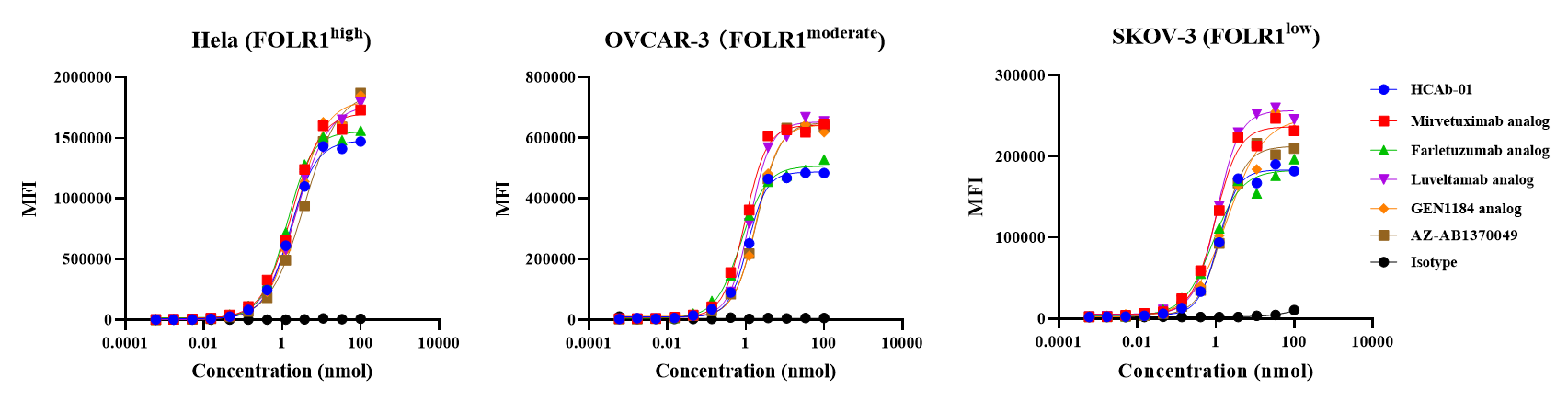
Figure 1. Antigen binding analysis of BCG047 FOLR1 heavy-chain-only antibody across FOLR1-expressing tumor cell lines. The FOLR1 antibody backbone demonstrated strong binding avidity in HeLa cervical cancer cells, OVCAR-3 and SKOV-3 ovarian cancer cells with varying FOLR1 expression levels, showing binding activity comparable to five FOLR1-targeting benchmark analogs. These data support consistent tumor cell recognition across different FOLR1 expression contexts.
In addition, the FOLR1 antibody backbone (HCAb-01) showed human and cynomolgus monkey cross-reactivity with high target specificity, supporting translational development and species-relevant preclinical evaluation.
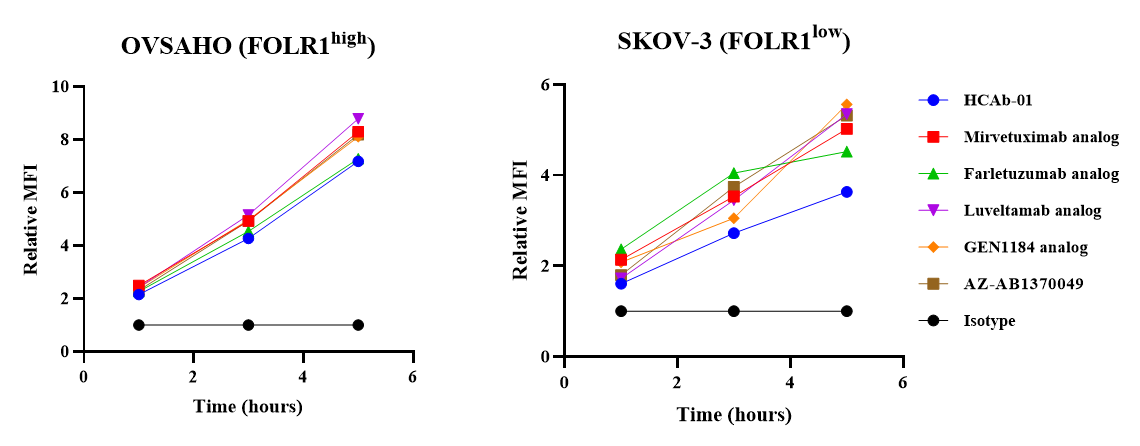
Figure 2. Internalization analysis of BCG047 FOLR1 heavy-chain-only antibody in ovarian cancer cells. At a working concentration of 17.5 nM, the FOLR1 antibody backbone (HCAb-01) demonstrated efficient internalization in OVSAHO and SKOV-3 cells, with activity comparable to five FOLR1-targeting benchmark analogs. These results support effective cellular uptake of the BCG047 antibody backbone and its suitability for intracellular payload delivery in a FOLR1 ADC format.
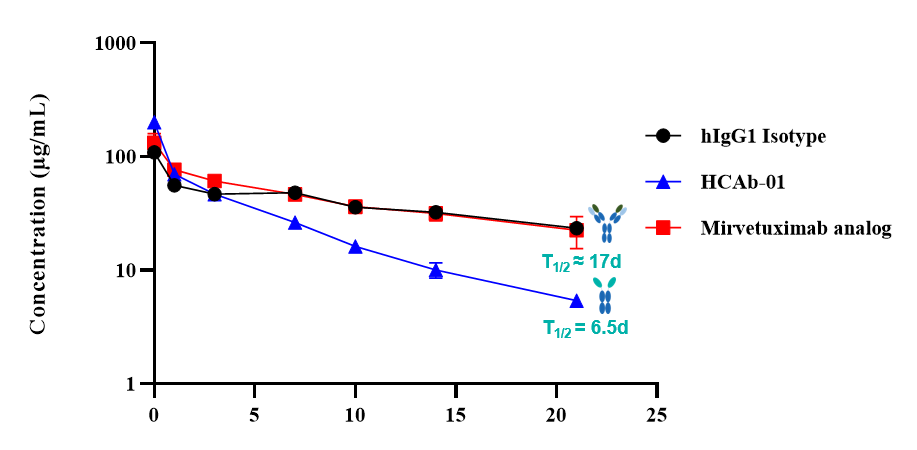
Figure 3. Pharmacokinetic analysis of the BCG047 FOLR1 heavy-chain-only antibody in C57BL/6 mice. Each group included six mice, with each animal receiving a single intravenous dose at 6 mg/kg. The FOLR1 antibody backbone (HCAb-01) exhibited an acceptable PK profile (T1/2 = 6.5d), supporting continued FOLR1 ADC development.
In addition, HCAb-01 showed favorable physicochemical properties and maintained consistent binding activity following stress treatments, supporting molecular stability and developability.
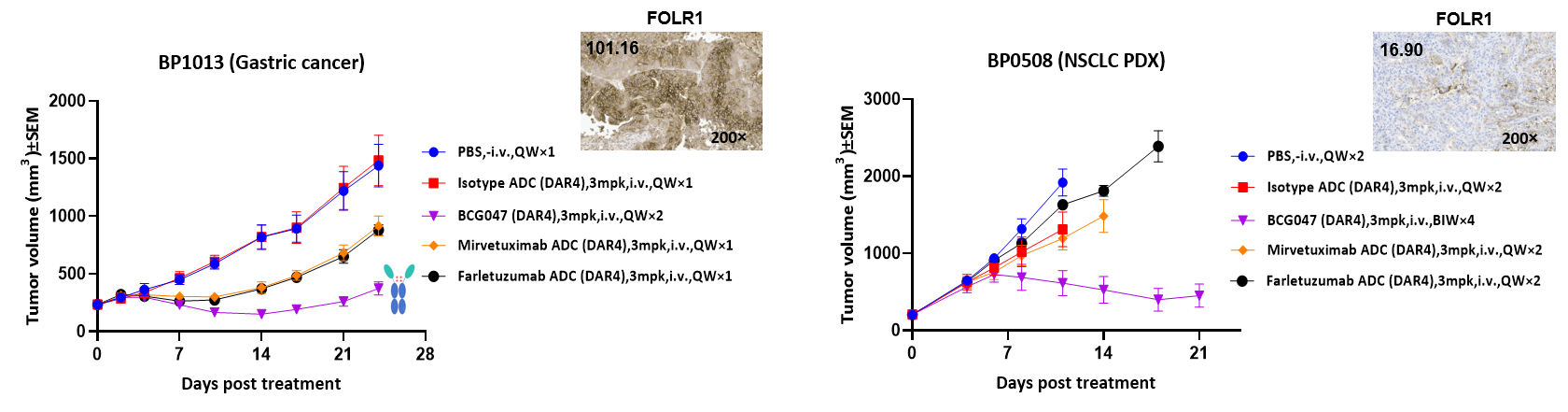
Figure 4. Antitumor efficacy analysis of the BCG047 FOLR1 heavy-chain-only ADC in FOLR1-expressing PDX models. BCG047 (DAR 4) was evaluated against two matched-DAR benchmark analogs in the gastric cancer and NSCLC PDX models, which represent distinct FOLR1 expression levels. BCG047 demonstrated potent tumor growth inhibition across both models, showing a particularly marked advantage over the benchmarks in the FOLR1-low setting.
In addition, robust activity in a FOLR1-moderate CDX model confirms its broad therapeutic potential across variable target expression levels.

Biocytogen welcomes partnership discussions to further evaluate this FOLR1 Heavy-Chain-Only ADC asset.

Folate receptor alpha (FOLR1) is a clinically validated tumor-associated antigen (TAA) that is heavily overexpressed in epithelial malignancies, such as ovarian, lung, and breast cancers. Because it exhibits very limited distribution in normal, healthy tissues, it provides a highly attractive target for precision solid tumor therapeutics with significant commercial potential.
First-generation FOLR1 therapies, such as Elahere (mirvetuximab), typically require a high threshold of FOLR1 expression (>75%) to be effective. Furthermore, traditional ADCs utilize a bulky conventional IgG1 antibody format that struggles to physically penetrate dense solid tumors, severely limiting their efficacy in low-FOLR1 tumor microenvironments.
BCG047 stands out by shrinking the delivery vehicle itself. Unlike conventional ADCs that use bulky IgG1 formats, BCG047 is built on a compact, fully human heavy-chain-only antibody (HCAb) structure derived from the RenNano® platform. This streamlined physical footprint unlocks deep tissue penetration, allowing the therapy to reach the hypoxic tumor core that standard ADCs cannot access. Furthermore, BCG047 targets a novel epitope, helping overcome competitive binding challenges in the crowded FOLR1 landscape.
BCG047 is conjugated with Biocytogen’s proprietary BLD1102 linker–payload system containing BCPT02, a topoisomerase I (TOP1) inhibitor payload. The BLD1102 linker–payload design is engineered to support potent ADC-mediated cytotoxicity, controlled payload release, hydrophilicity, circulation stability, and overall ADC developability.