
이 페이지에서

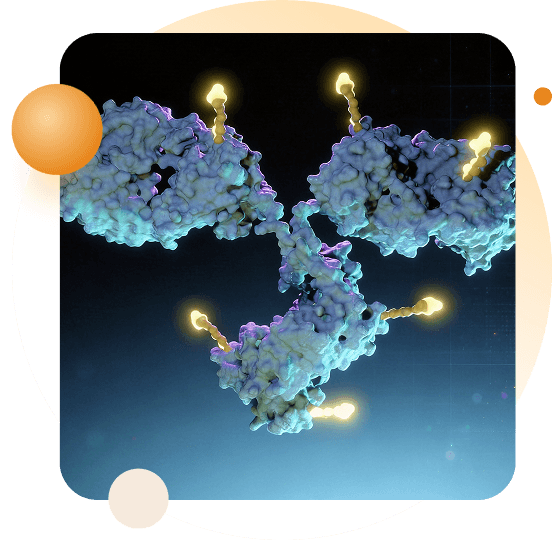
Built on the RenLite® platform, BCG044 utilizes common light chain technology to eliminate heavy/light chain mispairing, ensure seamless assembly, simplify manufacturing, and provide a developable antibody backbone for the HER3 × EpCAM bispecific ADC drug development.
BCG044 is conjugated with Biocytogen’s proprietary BLD1102 linker–payload system containing BCPT02, a topoisomerase I (TOP1) inhibitor payload designed to drive potent ADC-mediated cytotoxicity in solid tumor drug development.
BCG044 is being developed as a novel HER3 × EpCAM bispecific ADC drug development asset for colorectal cancer (CRC) and other HER3/EpCAM co-expressing solid tumors, including gastric, pancreatic, breast, and non-small cell lung cancer (NSCLC). Notably, BCG044 exhibits potential for novel drug development in gastrointestinal (GI) tumors, within an uncrowded competitive landscape.

The supporting preclinical data package for BCG044, generated from Biocytogen internal preclinical studies, includes HER3 × EpCAM co-expression analysis, expression-dependent binding avidity, enhanced internalization, strong antitumor activity in PDX models, and improved tolerability. Together, these data support the development of BCG044 as a differentiated HER3 × EpCAM bispecific ADC with a potentially improved safety window for colorectal cancer (CRC) and other solid tumors.
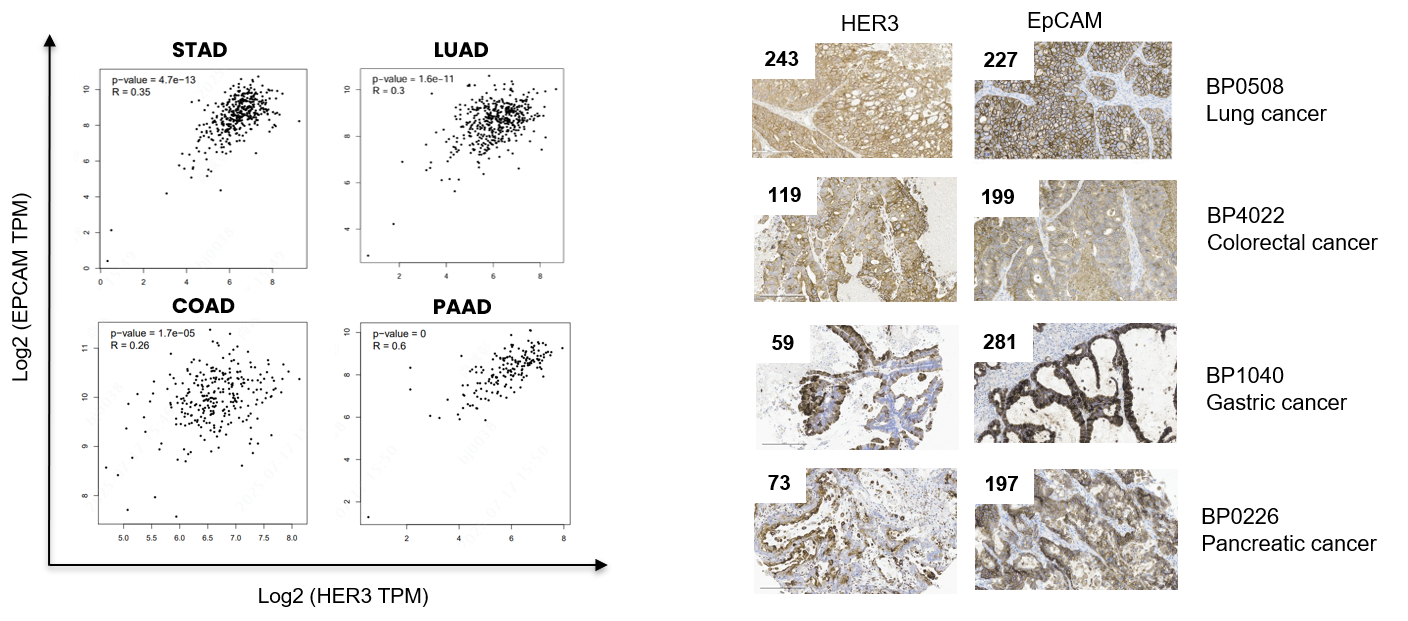
Figure 1. Co-expression analysis of HER3 and EpCAM across solid tumors. Based on GEPIA2 database analysis, HER3 and EpCAM were co-expressed in various tumor types, particularly stomach adenocarcinoma (STAD), lung adenocarcinoma (LUAD), colon adenocarcinoma (COAD), and pancreatic adenocarcinoma (PAAD). Representative immunohistochemistry (IHC) staining of the internal PDX models further confirmed the co-expression of HER3 and EpCAM at the protein level in corresponding tumors, with histochemical scores (H-scores) labeled for each tumor model. These data support the rationale for developing BCG044 as a HER3 × EpCAM bispecific ADC for selected solid tumors.

Figure 2. Internalization analysis of BCG044 in tumor cell lines with different HER3 and EpCAM expression levels. BCG044 was evaluated in NCI-H520 lung cancer cells with low HER3 / high EpCAM expression and NUGC-4 gastric cancer cells with high HER3/EpCAM expression. Compared with the parental antibodies, and clinical-stage EpCAM ADC benchmark analogs CX-2051 and CX-2043, BCG044 demonstrated enhanced or comparable internalization across the evaluated models, supporting efficient cellular uptake through dual HER3 and EpCAM engagement.
In addition, BCG044 bispecific antibody showed binding avidity dependent on HER3 and EpCAM expression across multiple tumor cell lines. Its reduced avidity compared with the EpCAM parental antibody and superior binding versus Patritumab and CX-2051 benchmark analogs support a balanced and differentiated bispecific binding profile.
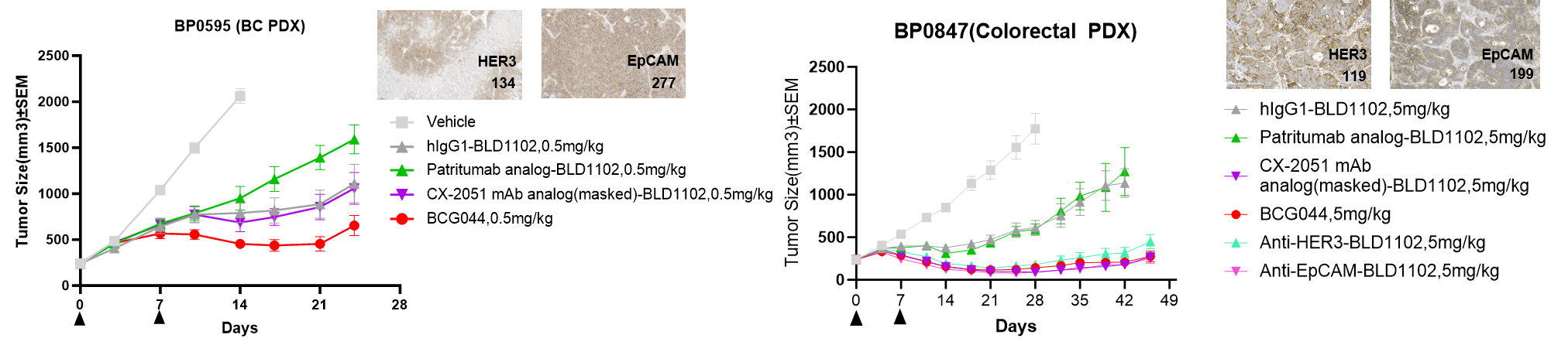
Figure 3. Antitumor efficacy analysis of BCG044 in breast and colorectal cancer PDX models. In the BP0595 breast cancer PDX model with moderate HER3 expression, BCG044 exhibited superior antitumor efficacy than the HER3 benchmark ADC (Patritumab analog) and EpCAM benchmark PDC (CX-2051 mAb-analog (masked)). In the BP0847 colorectal cancer PDX model, BCG044 showed greater antitumor activity than the HER3 benchmark ADC and was comparable to the EpCAM benchmark PDC. These data support the strong in vivo activity of BCG044 across PDX models with different HER3 and EpCAM expression profiles.
(Note: All ADCs with a DAR of approximately 8.)

Figure 4. Tolerability of surrogate BCG044 in EpCAM-humanized mice. A single intravenous dose of surrogate BCG044 at 60 mg/kg was administered to EpCAM-humanized mice (N=4; 2 males & 2 females). Surrogate BCG044 demonstrated better tolerability than both parental and benchmark EpCAM-BLD1102 ADCs, as evidenced by stable post-dose body weights.
In addition, hematology analysis showed no significant reductions in neutrophils and white blood cells with surrogate BCG044, further supporting a larger safety window than benchmark and parental EpCAM ADCs.
(Note: The HER3 arm of BCG044 in this experiment utilized a clone that cross-reacts with mice.)

Biocytogen welcomes partnership discussions to further evaluate this HER3 × EpCAM bispecific ADC asset.

BCG044 overcomes single-target hurdles through synergy-driven tumor selectivity. By requiring both HER3 and EpCAM to bind effectively, the bispecific ADC avoids interacting with healthy single-antigen tissues, successfully bypassing EpCAM-associated toxicity. Simultaneously, this dual-engagement triggers rapid cellular internalization, solving the delivery issues that have historically plagued HER3-only assets.
HER3 and EpCAM are frequently co-expressed across multiple solid tumors, including colorectal, gastric, pancreatic, and lung cancers. HER3 also functions as an oncogenic signaling partner and has been associated with resistance to EGFR-directed therapies. Combining HER3 with EpCAM therefore broadens the biological rationale for tumor targeting and reduces reliance on EpCAM expression alone.
RenLite® provides a fully human common light chain antibody backbone for HER3 × EpCAM bispecific ADC engineering. This design helps reduce heavy/light chain mispairing, supports correct bispecific antibody assembly, and simplifies downstream ADC development.
BCG044 is conjugated with Biocytogen’s proprietary BLD1102 linker–payload system containing BCPT02, a topoisomerase I (TOP1) inhibitor payload. The BLD1102 linker–payload design is engineered to support potent ADC-mediated cytotoxicity, controlled payload release, hydrophilicity, circulation stability, and overall ADC developability.
Colorectal cancer (CRC) is a primary development focus for BCG044, supported by the clinical validation of EpCAM-targeted therapy. Preclinical efficacy was also demonstrated in both colorectal and breast cancer models, with additional potential indications including gastric cancer, pancreatic cancer, and non-small cell lung cancer (NSCLC). BCG044 may be particularly well positioned for gastrointestinal (GI) tumor development, where the HER3 × EpCAM bispecific ADC landscape remains relatively limited.