
이 페이지에서

Built on the RenLite® platform, BCG028 utilizes common light chain technology to eliminate heavy/light chain mispairing, ensure seamless assembly, simplify manufacturing, and provide a developable backbone for the biparatopic OX40 antibody drug development.

The preclinical data package supporting BCG028, generated from Biocytogen’s internal studies, demonstrates a novel OX40-targeting profile, with cross-species binding, afucosylated Fc-enhanced ADCC, limited receptor agonism, and effective suppression of activated T-cell responses. BCG028 also showed superior efficacy in GvHD models, prolonged systemic exposure in non-human primates, and favorable physicochemical properties, supporting its continued development for inflammatory diseases.
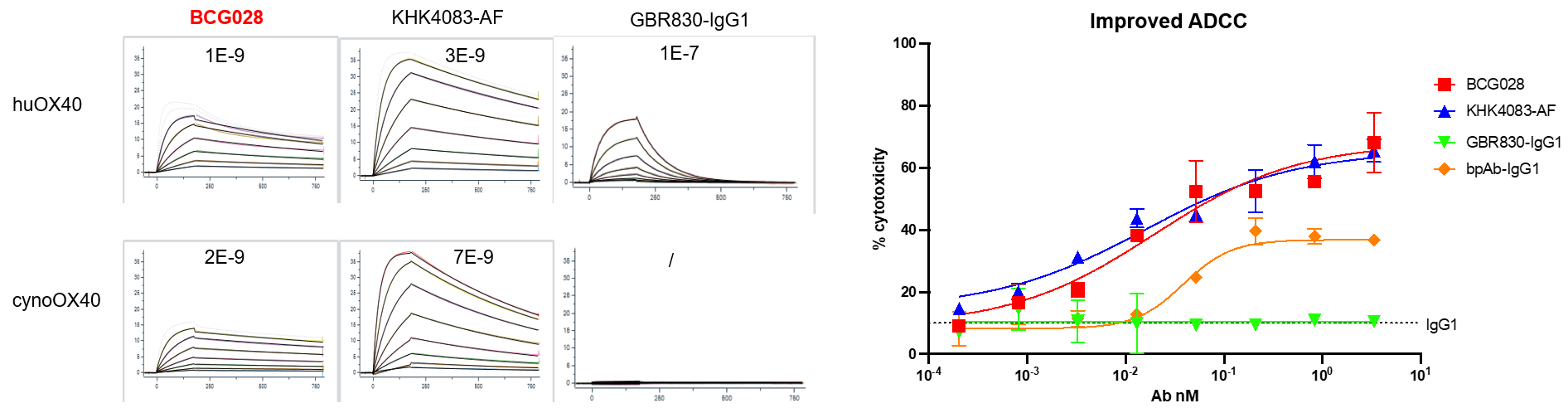
Figure 1. Binding affinity and Antibody-Dependent Cellular Cytotoxicity (ADCC) characterization of BCG028. BCG028 demonstrated comparable binding affinities to human and cynomolgus monkey OX40 relative to KHK4083-AF, supporting cross-species target engagement and translational evaluation. In an ADCC assay, the afucosylated Fc format of BCG028 showed enhanced cytotoxic activity against OX40-expressing target cells, supporting efficient Fcγ receptor-mediated depletion of activated OX40-positive immune cells.
In addition, BCG028 incorporates a YTE Fc modification designed to extend systemic exposure. In FcRn humanized mice, the YTE-containing format showed a prolonged half-life, supporting the potential for less frequent dosing.
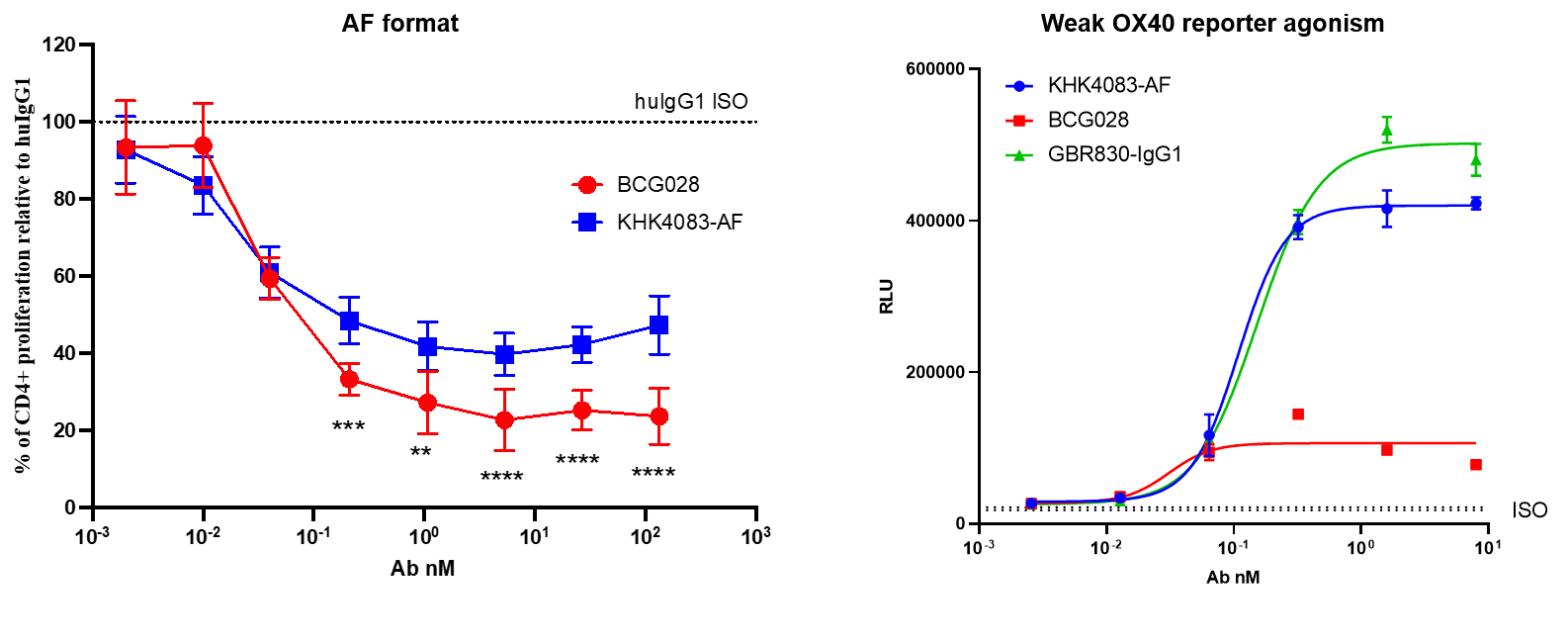
Figure 2. Functional characterization of BCG028 in SEB-mediated T-cell proliferation and OX40 agonism assays. In the afucosylated (AF) format, BCG028 produced greater inhibition of SEB-driven T-cell proliferation than KHK4083-AF, supporting enhanced suppression of activated OX40-positive T cells. Reporter assays showed only weak OX40 agonistic activity, indicating that BCG028 primarily functions through depletion and ligand blockade rather than strong receptor activation. A similar inhibitory effect on SEB-mediated T-cell proliferation was observed with the IgG1 format, and weak OX40 agonism was also confirmed in primary T cells.
(Note: Data are presented as mean ± SD from four donors, with duplicate measurements at each dose point.)
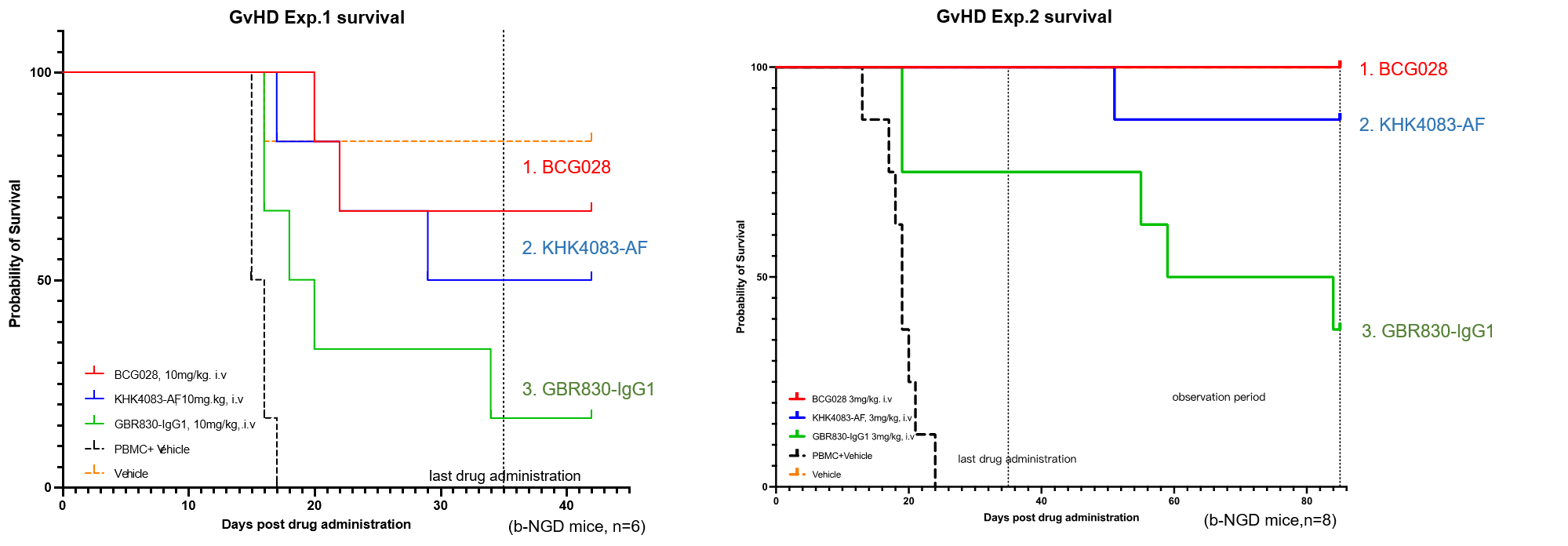
Figure 3. In vivo efficacy of BCG028 in humanized graft-versus-host disease (GvHD) models. Across the two studies, conducted with six and eight animals per group, respectively, BCG028 provided stronger disease control and longer survival than KHK4083-AF and GBR830-IgG1, supporting its differentiated ability to suppress pathogenic OX40-positive T-cell responses in vivo.
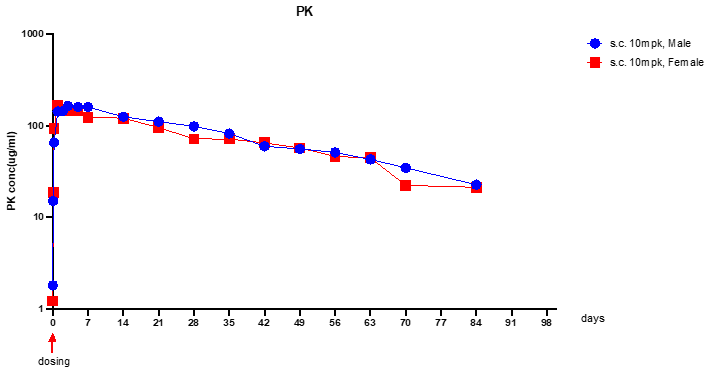
Figure 4. Preliminary pharmacokinetic (PK) analysis of BCG028 in non-human primates (NHP). Following subcutaneous administration, BCG028 demonstrated sustained systemic exposure, with a mean terminal half-life of 26.2 days based on noncompartmental analysis using WinNonlin 8.0. This half-life is among the longest reported for widely used atopic dermatitis (AD) biologics and may translate into a human half-life exceeding 60 days, although clinical confirmation is required. The PK study was extended through Day 126 to further characterize terminal exposure.
In addition, BCG028 demonstrated favorable physicochemical properties, including excellent thermal stability and solubility, supporting its developability and manufacturing potential.

Biocytogen welcomes partnership discussions to further evaluate this OX40 antagonist antibody asset.

BCG028 is a biparatopic OX40 antagonist designed to bind two distinct epitopes, achieving enhanced receptor occupancy and more complete OX40L blockade than single-epitope antibodies. An afucosylated (AF) Fc enhances ADCC-mediated depletion of OX40-high activated T cells, while YTE-based half-life extension prolongs serum exposure to support low-frequency subcutaneous dosing. BCG028 also exhibits minimal OX40 agonistic activity, supporting a predominantly antagonist profile with reduced risk of unintended T cell activation.
OX40 is a costimulatory receptor upregulated on activated T cells, and OX40–OX40L signaling drives the expansion and survival of pathogenic T cells in type 2 inflammatory diseases including atopic dermatitis (AD). Unlike IL-4Rα-targeted therapies that block downstream cytokine signaling, OX40 antagonism intervenes at the level of T cell activation, offering a complementary therapeutic mechanism. AD affects an estimated 320 million adults worldwide, with approximately 30% experiencing moderate to severe disease inadequately controlled by topical treatments, supporting the need for novel systemic therapies targeting upstream immune pathways.
BCG028 incorporates two complementary Fc modifications. AF enhances FcγRIIIa binding and ADCC activity, supporting the depletion of OX40-high activated T cells that drive disease pathology. YTE-mediated half-life extension achieved a mean terminal half-life of 26.2 days following subcutaneous administration in non-human primates, among the longest reported for widely used atopic dermatitis biologics. This extended exposure supports the potential for low-frequency subcutaneous dosing.
RenLite® provides a fully human common light chain antibody backbone for biparatopic OX40 antagonist antibody engineering. This design helps reduce heavy/light chain mispairing, supports correct biparatopic antibody assembly, simplifies manufacturing, and improves downstream developability.