

Gene targeting strategy for B-hCD30/hCD30L mice.
The exons 1-9 of mouse Cd30 gene that encode the extracellular domain were replaced by human CD30 exons 1-11 in B-hCD30/hCD30L mice. The genomic region of mouse Cd30 gene that encodes transmembrane domain and cytoplasmic portion was retained. The promoter and 5’UTR region of the mouse gene were also retained. The 3’UTR region of the mouse gene are replaced by human counterparts. The CD30 expression was driven by endogenous mouse Cd30 promoter, while mouse Cd30 gene transcription and translation will be disrupted.
The exons 1-4 of mouse Cd30l gene that encode extracellular domain were replaced by human counterparts in B-hCD30/hCD30L mice. The genomic region of mouse Cd30l gene that encodes transmembrane domain and cytoplasmic portion was retained. The promoter and 5’UTR region of the mouse gene were also retained. The 3’UTR region of the mouse gene are replaced by human counterparts. The CD30L expression was driven by endogenous mouse Cd30l promoter, while mouse Cd30l gene transcription and translation will be disrupted.

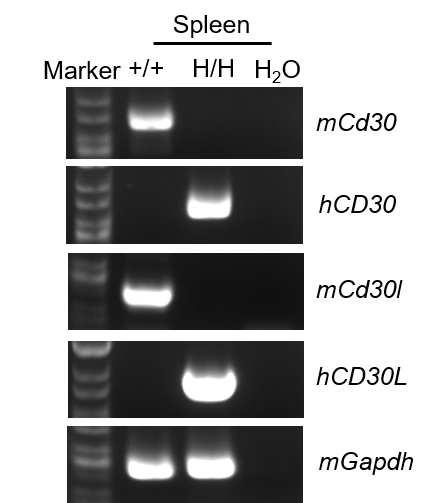
Species specific analysis of CD30 and CD30L gene expression in wild-type C57BL/6JNifdc mice and homozygous B-hCD30/hCD30L mice by RT-PCR. Spleen was collected from wild-type C57BL/6JNifdc mice (+/+) and homozygous B-hCD30/hCD30L mice (H/H;H/H). Mouse Cd30 and Cd30l mRNA were detectable in wild-type C57BL/6JNifdc mice. Human CD30 and CD30L mRNA were detectable only in homozygous B-hCD30/hCD30L mice, but not in wild-type C57BL/6JNifdc mice.
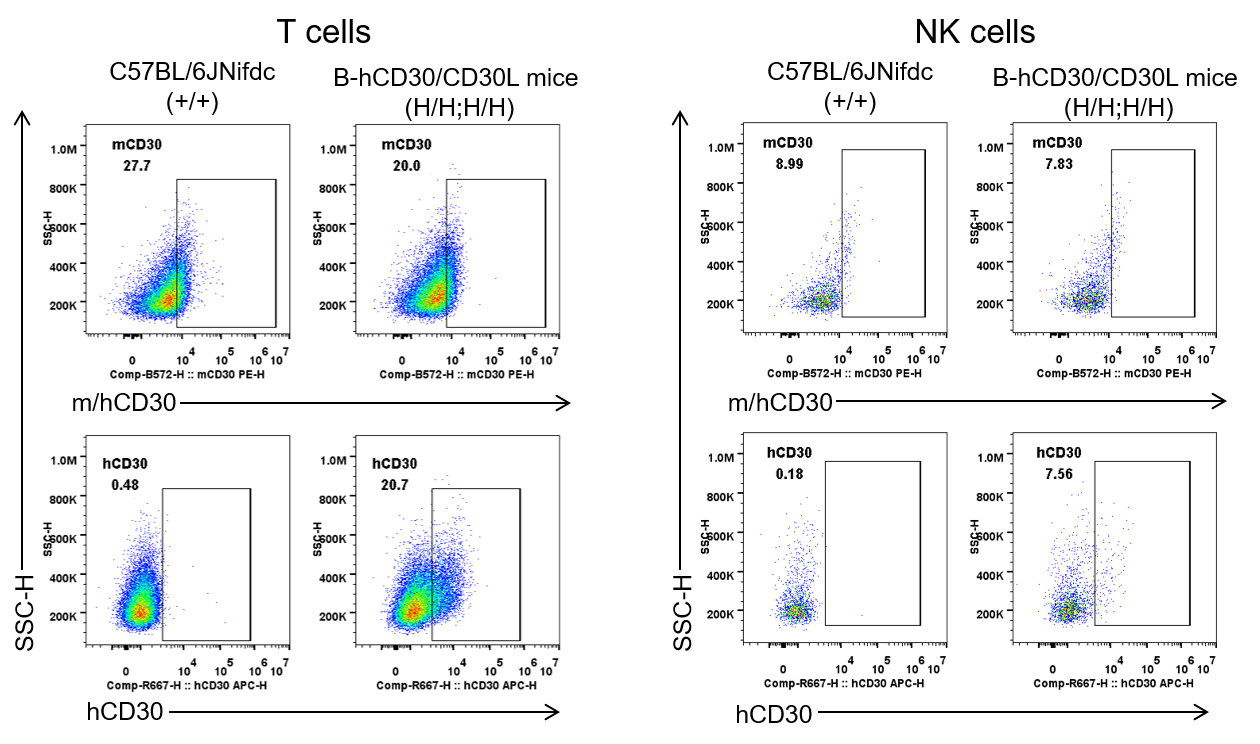
Strain specific CD30 expression analysis in wild-type C57BL/6JNifdc mice and homozygous B-hCD30/hCD30L mice by flow cytometry. Splenocytes were collected from wild-type C57BL/6JNifdc mice (+/+) and homozygous B-hCD30/hCD30L mice (H/H;H/H). Splenocytes were incubated in a medium containing Cell Activation Cocktail (without Brefeldin A) in vitro for 20 h, protein expression was analyzed with anti-mouse CD30 antibody (Biolegend, 102306) and anti-human CD30 antibody (Biolegend, 333909) by flow cytometry. Mouse/human CD30 was detectable in wild-type C57BL/6JNifdc mice and homozygous B-hCD30/hCD30L mice, as the anti-mouse CD30 antibody was cross-reactive between mouse and human. Human CD30 was detectable in homozygous B-hCD30/hCD30L mice.
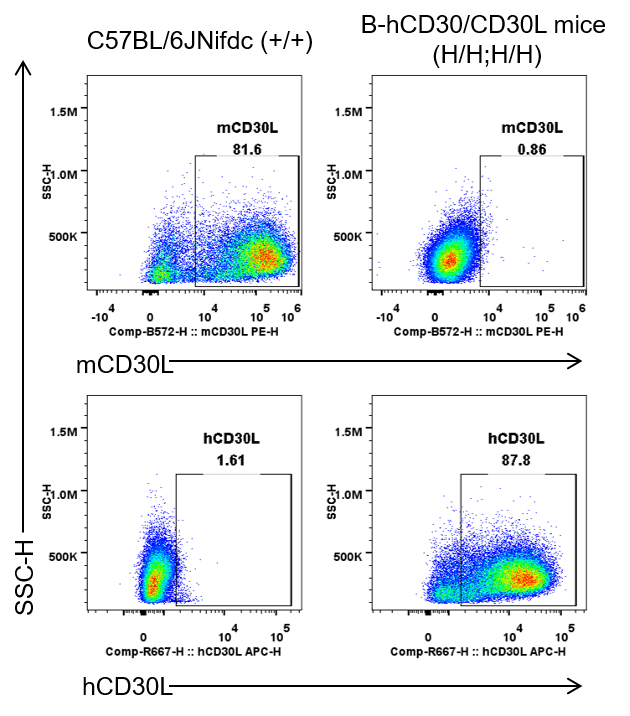
Strain specific CD30L expression analysis in wild-type C57BL/6JNifdc mice and homozygous B-hCD30/hCD30L mice by flow cytometry. Splenocytes were collected from wild-type C57BL/6JNifdc mice (+/+) and homozygous B-hCD30/hCD30L mice (H/H;H/H). Splenocytes were incubated in a medium containing Cell Activation Cocktail (without Brefeldin A) in vitro for 20 h, protein expression was analyzed with anti-mouse CD30L antibody (Biolegend, 106405) and anti-human CD30L antibody (RD, FAB1028A) by flow cytometry. Mouse CD30L was detectable in wild-type C57BL/6JNifdc mice. Human CD30L was detectable in homozygous B-hCD30/hCD30L mice.

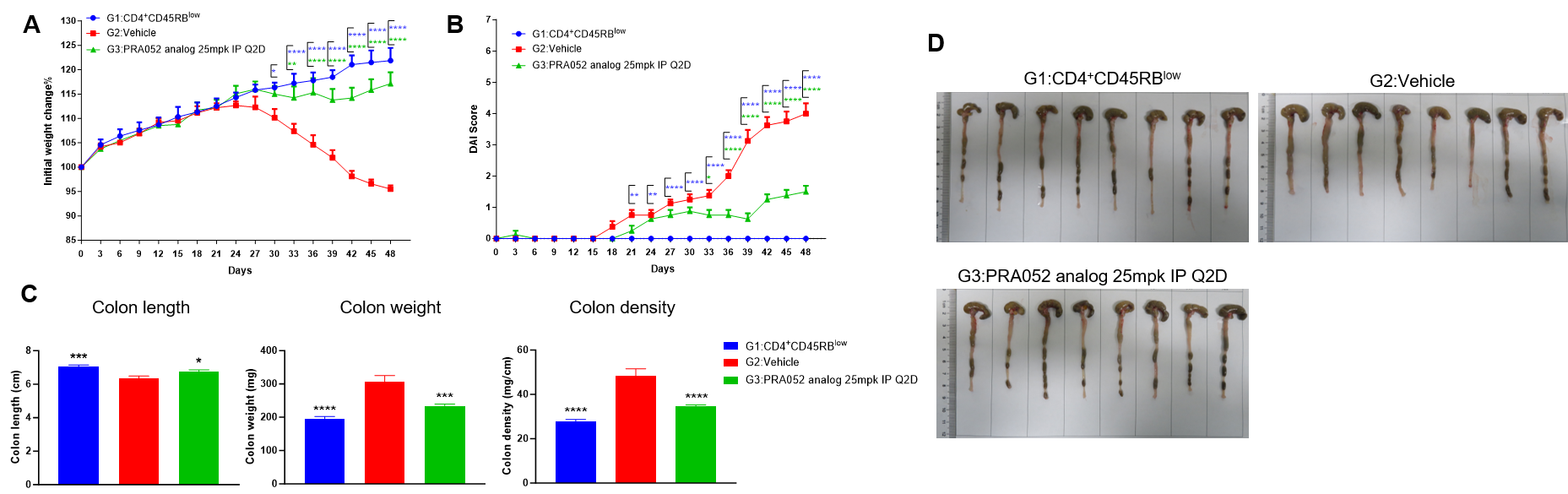
CD4+CD45RBlow T and CD4+CD45RBhigh T cells were isolated from the spleens of B-hCD30/hCD30L mice. B-Rag2 KO mice in G1 were injected with CD4+CD45RBlow T cells, while B-Rag2 KO mice in G2 and G3 were injected with CD4+CD45RBhigh T cells. Animals in G3 were given administration of 25 mg/kg of anti-human CD30L antibody PRA052 analog (in house) every two days. (A) Body weight change. (B) DAI score. (C) Colon index. (D) Colon photo. Administration of anti-human CD30L antibody effectively improved T cells transfer induced colitis. Two-way ANOVA or one-way ANOVA was used for multiple comparisons, with each group compared to Vehicle. Values are expressed as mean ± SEM. *p<0.05, **p<0.01, ***p<0.001, ****p<0.0001.
Note: This experiment was conducted by WuXi AppTec, T cell transfer induced chronic colitis in B-Rag2 KO mice (Donor: B-hCD30/hCD30L mice).