Description
- CD3E/D/G encode type I transmembrane Ig-superfamily subunits that assemble with the TCRαβ heterodimer and ζ chains to form the TCR–CD3 complex. Their extracellular Ig-like domains support complex assembly, while cytoplasmic tails (notably CD3E and CD3G) contain signaling motifs that recruit kinases and adaptor proteins after antigen recognition. CD3 is expressed on essentially all mature T cells (and thymocytes), and mediates T-cell activation, selection, and effector function; dysregulation contributes to immune deficiency, autoimmunity and transplant rejection. Therapeutically, anti-CD3 antibodies and CD3-engaging bispecifics are used to modulate or redirect T cells.
- CD28 is a disulfide-linked homodimeric, type I transmembrane costimulatory receptor with an Ig-like extracellular domain and a cytoplasmic tail that signals via PI3K/AKT and other pathways. It is constitutively expressed on most CD4 T cells and variably on CD8 T cells, providing the “signal 2” required for full activation, IL-2 production, survival and memory formation. Its principal ligands are CD80 (B7-1) and CD86 (B7-2) on antigen-presenting cells. Clinically, CD28 signaling is targeted indirectly by CTLA-4-Ig fusion proteins that block CD80/CD86, and directly by selected agonists/antagonists and bispecific designs.
- B7-H3 (CD276) is a type I transmembrane Ig-superfamily protein (commonly 2-Ig/4-Ig isoforms) with broad, inducible expression on APCs and stromal/endothelial cells, and marked overexpression in many solid tumors. Its definitive receptor(s) remain incompletely defined; functionally it is linked to immune regulation and tumor immune evasion, as well as non-immune roles in adhesion, migration and metabolism. B7-H3 is a major oncology target with multiple modalities in development, including monoclonal antibodies, ADCs, radioligands, bispecifics and CAR-T/NK therapies.
- The chimeric CD3E, CD3D, CD3G, CD28 and B7-H3 were inserted to replace the counterpart genes in B-hCD3EDG/hCD28/hB7-H3 mice.
- Human PD-1, CD28 and B7-H3 were exclusively detectable in homozygous B-hCD3EDG/hCD28/hB7-H3 mice. Humanization of PD-1, CD28 and B7-H3 does not change the overall frequency or distribution of immune cell types in spleen, blood and lymph nodes.
- Application: This mouse model empowers the in vivo efficacy and safety evaluation of CD3/CD28/B7-H3-targeting therapeutic agents.
Protein expression analysis
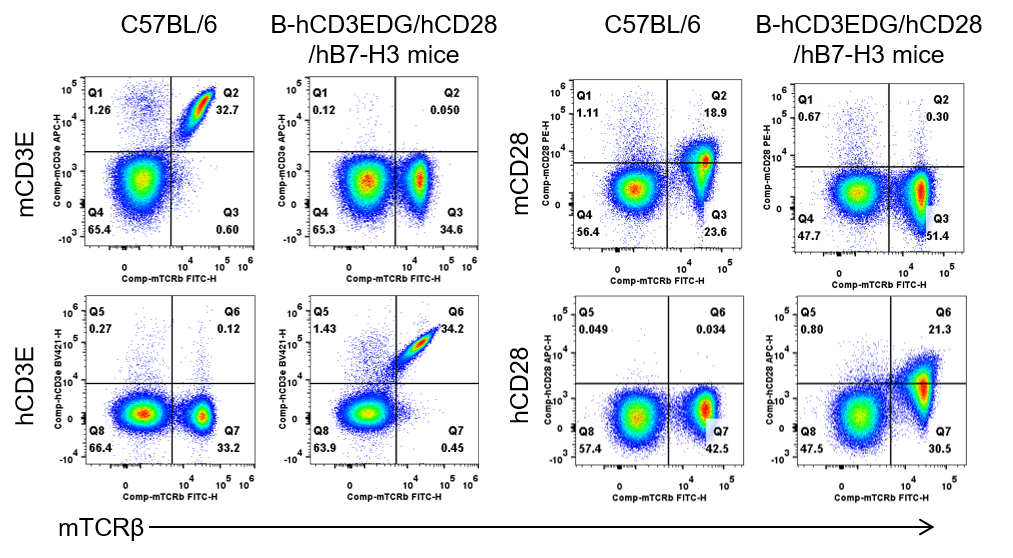
Strain specific CD3E and CD28 expression analysis in wild-type C57BL/6 mice and homozygous humanized B-hCD3EDG/hCD28/hB7-H3 mice by flow cytometry. Splenocytes were collected from wild-type C57BL/6 mice and homozygous B-hCD3EDG/hCD28/hB7-H3 mice (female, 6-week-old, n=3), and analyzed by flow cytometry with species-specific anti-mouse CD3E antibody (Biolegend, 100312), anti-human CD3E antibody (BD, 562426), anti-mouse CD28 antibody (Biolegend, 102105) and anti-human CD28 antibody (Biolegend, 302912). Mouse PD-1 and CD28 were only detectable in wild-type C57BL/6 mice. Human PD-1 and CD28 were exclusively detectable in homozygous B-hCD3EDG/hCD28/hB7-H3 mice.
Protein Expression Analysis
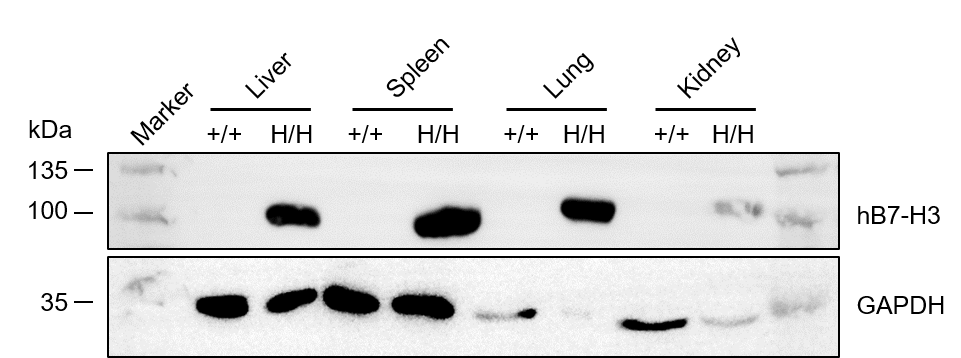
Strain specific B7-H3 expression analysis in wild-type C57BL/6 mice and homozygous humanized B-hCD3EDG/hCD28/hB7-H3 mice by western blotting. Tissues of liver, spleen, lung and kidney were collected from wild-type C57BL/6 mice and homozygous B-hCD3EDG/hCD28/hB7-H3 mice (female, 6-week-old, n=1), and analyzed by western blotting with species-specific anti-human B7-H3 antibody (abcam, ab219648). Human B7-H3 was exclusively detectable in homozygous B-hCD3EDG/hCD28/hB7-H3 mice, but not in wild-type C57BL/6 mice.
Frequency of Leukocyte Subpopulations in Spleen
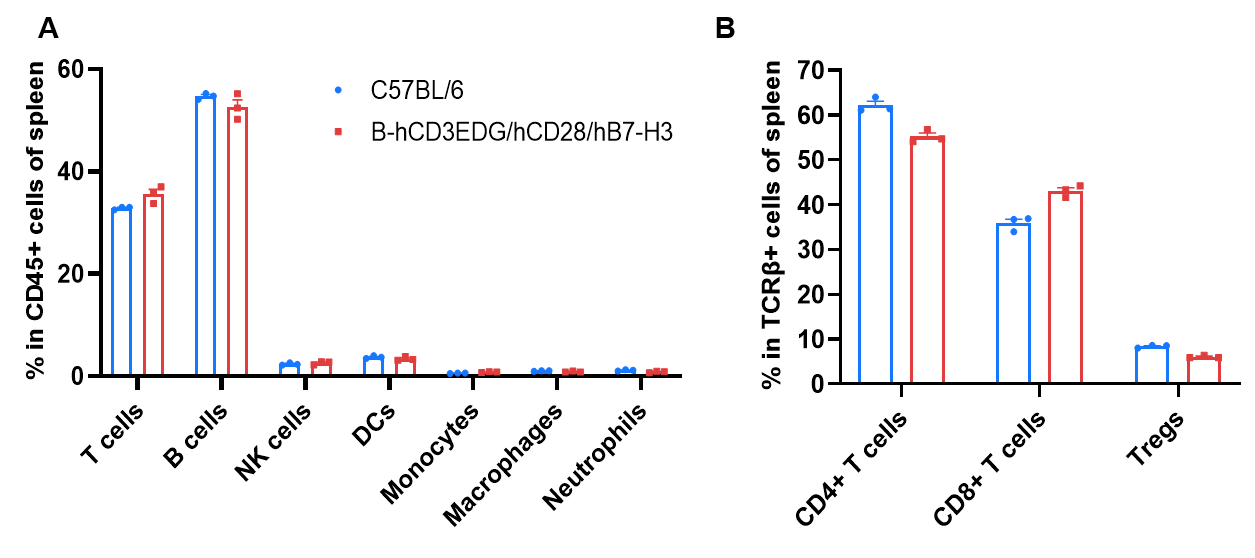
Frequency of leukocyte subpopulations in spleen by flow cytometry. Splenocytes were isolated from wild-type C57BL/6 mice and homozygous B-hCD3EDG/hCD28/hB7-H3 mice (female, 6-week-old, n=3). A. Flow cytometry analysis of the splenocytes was performed to assess the frequency of leukocyte subpopulations. B. Frequency of T cell subpopulations. Frequencies of T cells, B cells, NK cells, DCs, monocytes, macrophages, neutrophils, CD4+ T cells, CD8+ T cells and Tregs in B-hCD3EDG/hCD28/hB7-H3 mice were similar to those in C57BL/6 mice, demonstrating that humanization of CD3EDG, CD28 and B7-H3 does not change the frequency or distribution of these cell types in spleen. The frequency of leukocyte subpopulations in blood and lymph nodes of B-hCD3EDG/hCD28/hB7-H3 mice were also comparable to wild-type C57BL/6 mice (Data not shown).
* When publishing results obtained using this animal model, please acknowledge the source as follows: The animal model [B-hCD3EDG/hCD28/hB7-H3 mice] (Cat# 112725) was purchased from Biocytogen.