



B-hIL23A/hIL12B/hIL7R mice

C57BL/6-Il23atm1(IL23A)Bcgen Il12btm1(IL12B)Bcgen Il7rtm1(IL7R)Bcgen/Bcgen • 114153

B-hIL23A/hIL12B/hIL7R mice

Product nameB-hIL23A/hIL12B/hIL7R mice
Catalog number114153
Strain nameC57BL/6-Il23atm1(IL23A)Bcgen Il12btm1(IL12B)Bcgen Il7rtm1(IL7R)Bcgen/Bcgen
Strain backgroundC57BL/6
NCBI gene ID51561,3593,3575 (Human)
AliasesP19; SGRF; IL-23; IL-23A; IL23P19; CLMF; NKSF; CLMF2; IMD28; IMD29; NKSF2; IL-12B; ILRA; CD127; IL7RA; CDW127; IMD104; sIL-7R; lnc-IL7R; IL7Ralpha; IL-7Ralpha; IL-7R-alpha

이 페이지에서

  • Description
  • Targeting strategy
  • Phenotypic analysis

포스터

모두 보기

    출판물

      Description
      • IL-23 is a heterodimeric cytokine composed of p40 and p19 subunits, primarily produced by macrophages and dendritic cells. IL-23 binds to its receptor IL-23R, which regulates the release of downstream pro-inflammatory cytokines.
      • The IL-7 receptor alpha chain (IL-7Ra) and the common gamma chain (γc) serve as the components of the IL-7 receptor, undergoing dimerization upon binding with the IL-7 ligand. IL-7 and its receptor IL-7R are crucial for the normal development, differentiation, and survival of T cells and B cells. Abnormal IL-7/IL-7R signaling is believed to be associated with the pathogenesis of various autoimmune or inflammatory diseases.
      • The genome of the mouse Il23a gene encoding the full-length protein was replaced with human IL23A counterpart in B-hIL23A/hIL12B/hIL7R mice. The genome of the mouse Il12b gene encoding the full-length protein was replaced with human IL12B counterpart in B-hIL23A/hIL12B/hIL7R mice. The genome of the mouse Il7r gene encoding the extracellular domain was replaced with human IL7R counterpart in B-hIL23A/hIL12B/hIL7R mice.
      • Human IL23 and IL7R protein were exclusively detectable in homozygous B-hIL23A/hIL12B/hIL7R mice.
      • This product is used for the evaluation of the pharmacodynamics and safety of anti-human IL23/IL7R antibodies in autoimmune diseases such as inflammatory bowel disease.
      Targeting strategy

      Gene targeting strategy for B-hIL23A/hIL12B/hIL7R mice.

      The exons 1-4 of mouse Il23a gene that encode the whole molecule (ATG to STOP codon) were replaced by human counterparts in B-hIL23A/hIL12B/hIL7R mice. The promoter, 5’UTR and 3’UTR region of the mouse gene were retained. The human IL23A expression was driven by endogenous mouse Il23a promoter, while mouse Il23a gene transcription and translation would be disrupted.

      The exons 2-8 of mouse Il12b gene that encode the whole molecule (ATG to STOP codon), including 3’UTR were replaced by human counterparts in B-hIL23A/hIL12B/hIL7R mice. The promoter and 5’UTR region of the mouse gene were retained. The human IL12B expression was driven by endogenous mouse Il12b promoter, while mouse Il12b gene transcription and translation would be disrupted.

      The exons 1-6 of mouse Il7r gene that encode the extracellular region were replaced by human IL7R exons 1-6 in B-hIL23A/hIL12B/hIL7R mice.

      Protein expression analysis

      Mouse IL-23 and human IL-23 expression analysis in B-hIL23A/hIL12B/hIL7R mice by ELISA.

      Bone marrow derived dendritic cells were produced by culturing the bone marrow from wild-type C57BL/6JNifdc mice (+/+), and homozygous B-hIL23A/hIL12B/hIL7R mice (H/H;H/H;H/H), which were stimulated with 1 μg/mL LPS in vitro. After stimulation, the supernatants were collected and the levels of mouse and human IL23 were analyzed by ELISA. Mouse IL23 was only detectable in wild-type C57BL/6JNifdc mice. Human IL23 was exclusively detectable in homozygous B-hIL23A/hIL12B/hIL7R mice. Values are expressed as mean ± SEM. ND: not detectable.
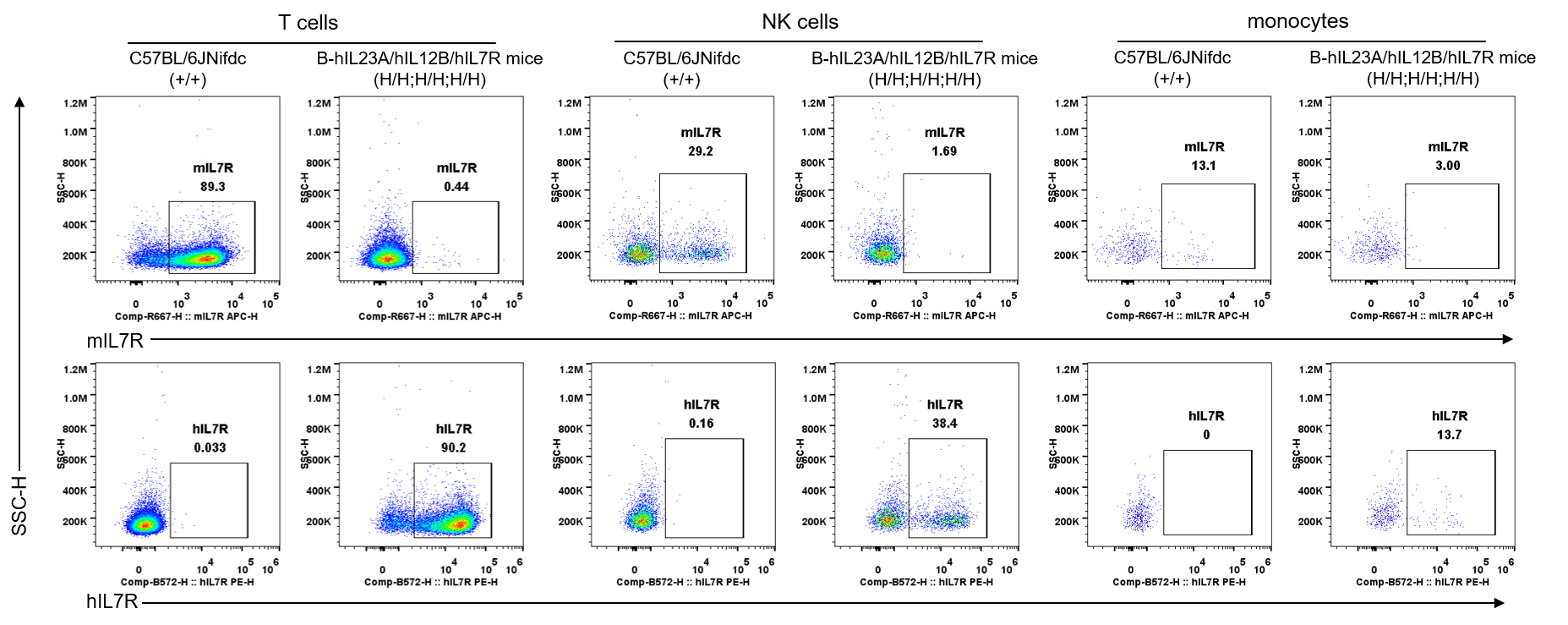
      Strain specific IL7R expression analysis in homozygous B-hIL23A/hIL12B/hIL7R mice by flow cytometry. Splenocytes were collected from wild-type C57BL/6JNifdc mice (+/+) and homozygous B-hIL23A/hIL12B/hIL7R mice (H/H;H/H;H/H), protein expression was analyzed by flow cytometry with species-specific anti-mouse IL7R antibody (Biolegend, 135011) and anti-human IL7R antibody (Biolegend, 351303). Mouse IL7R was detectable in wild-type C57BL/6JNifdc mice. Human IL7R was detectable in homozygous B-hIL23A/hIL12B/hIL7R mice.

      * When publishing results obtained using this animal model, please acknowledge the source as follows: The animal model [B-hIL23A/hIL12B/hIL7R mice] (Cat# 114153) was purchased from Biocytogen.