
C57BL/6-Lsrtm1(LSR)Bcgen/Bcgen • 112957

Gene targeting strategy for B-hLSR mice. The exons 1~5 of mouse Lsr gene that encode the extracellular domain were replaced by human LSR exons 1~5 in B-hLSR mice.

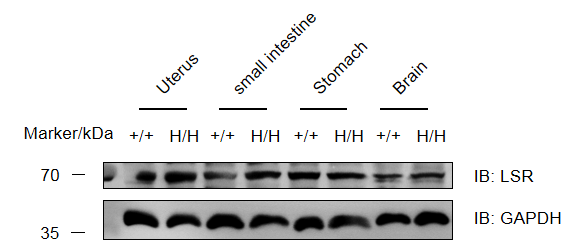
Western blot analysis of LSR protein expression in homozygous B-hLSR mice. Various tissue lysates were collected from wild-type C57BL/6 (+/+) mice and homozygous B-hLSR mice (H/H), and then analyzed by western blot with anti-LSR antibody. 40 μg total proteins were loaded for western blotting analysis.

Strain specific analysis of LSR mRNA expression in wild-type C57BL/6 mice and B-hLSR mice by RT-PCR. Small intestine RNA was isolated from wild-type C57BL/6 mice (+/+) and homozygous B-hLSR mice (H/H), then cDNA libraries were synthesized by reverse transcription, followed by PCR with mouse or human LSR primers. Mouse Lsr mRNA was detectable only in wild-type mice. Human LSR mRNA was detectable only in homozygous B-hLSR mice but not in wild-type mice. LSR was detectable in uterus, small intestine, stomach and brain of both wild-type mice and homozygous B-hLSR mice, as anti-LSR antibody was cross-reactive between human and mouse.
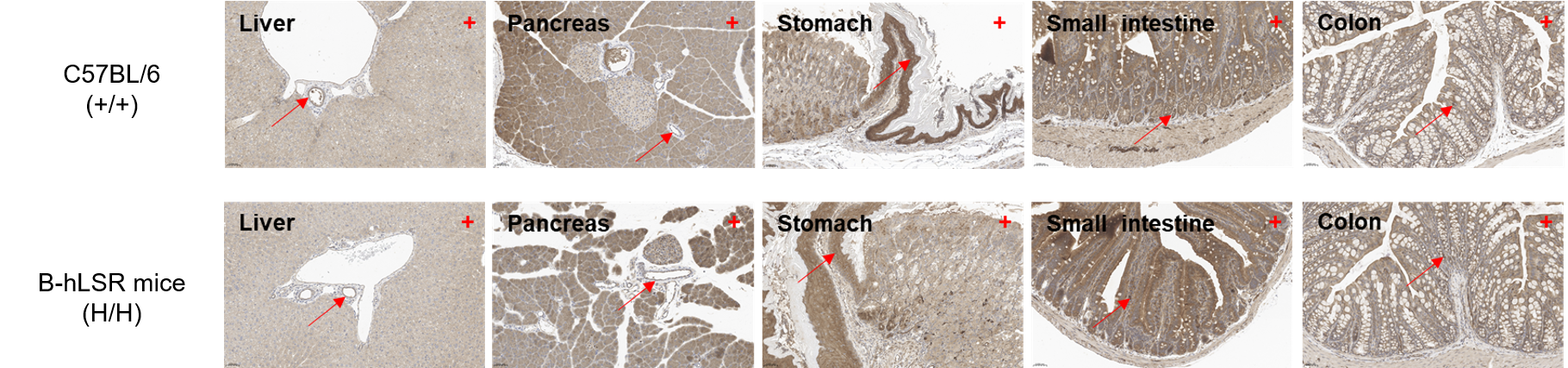
Immunohistochemical (IHC) analysis of LSR protein expression in wild-type mice and B-hLSR mice. Major tissues were collected from wild-type mice and homozygous B-hLSR mice (n=2, Female, 7 weeks) and analyzed by IHC with anti-LSR antibody (MyBioSource, MBS2005012). LSR was both detected in the liver, pancreas, stomach, small intestine and colon of wild-type mice and homozygous B-hLSR mice. And the antibody was cross-reactive between human and mouse.