
C57BL/6-Pdcd1tm3(PDCD1)Bcgen Cd274tm1(CD274)Bcgen Vegfatm1(VEGFA)Bcgen Fcgrttm1(FCGRT)Bcgen/Bcgen • 113955

B-hPD-1 plus/hPD-L1/hVEGFA/hFcRn mice were obtained by mating B-hPD-1 plus/hPD-L1 mice (112550), B-hVEGFA mice (110822) and B-hFcRn mice (110001). For validation data of this mouse model, you can refer to the validation data from the related gene humanized mouse models.

PD-1
A chimeric CDS that encodes human PDCD1 extracellular domain, mouse Pdcd1 transmembrane and cytoplasmic domain, followed by WPRE-pA is inserted right after mouse Pdcd1 ATG to replace the exon 1 of mouse Pdcd1 gene.
The chimeric PDCD1 protein expression will be driven by endogenous mouse Pdcd1 promoter, while mouse Pdcd1 gene transcription and translation will be disrupted.
PD-L1
The exon 3 of mouse Cd274 gene that encodes the IgV domain was replaced by human CD274 exon 3. Sequences of other regions still belonged to mice.
VEGFA
The exons 1-8 of mouse Vegfa gene that encode the full-length protein were replaced by human VEGFA exons 1-8 in B-hPD-1 plus/hPD-L1/hVEGFA/hFcRn mice.
FcRn
The human full-length FCGRT cDNA was inserted into the Fcgrt exon 2 of wild-type mice.

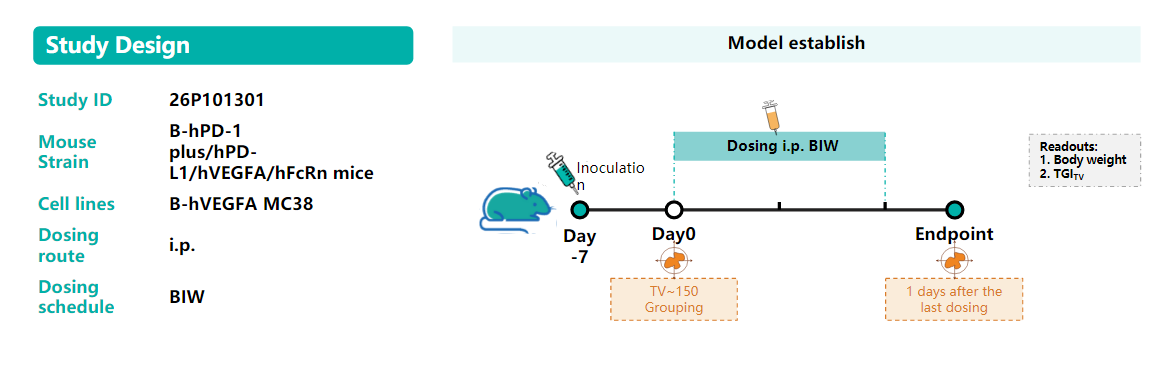
Establishment of a B-hVEGFA MC38 model and in vivo efficacy study of Ivonescimab antibody. B-hVEGFA MC38 cells were implanted subcutaneously into homozygous B-hPD-1 plus/hPD-L1/hVEGFA/hFcRn mice (female, 10-weeks-old, n=6). When the average tumor volume reached approximately 150 mm³, mice were randomized and subsequently administered with anti-PD-1 & anti-VEGFA antibody via intraperitoneal injection.
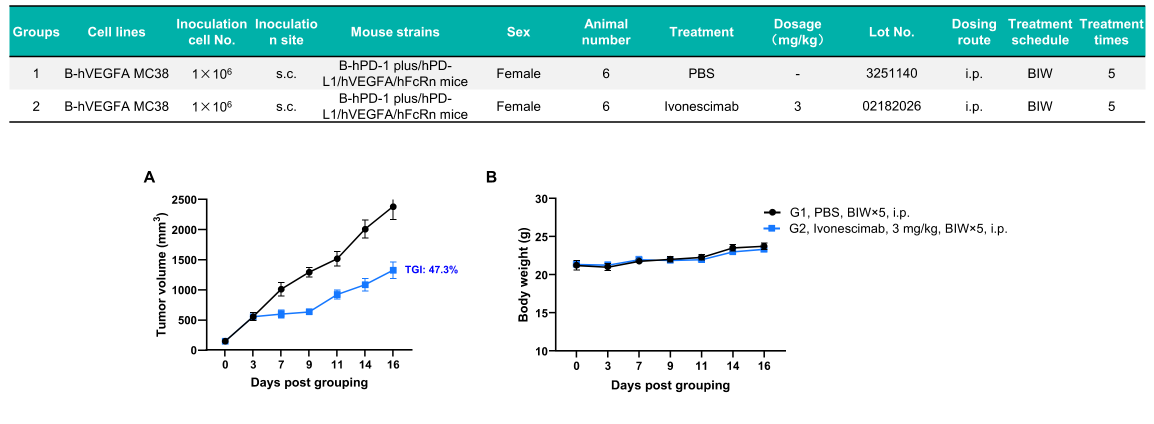
Antitumor activity of Ivonescimab (also known as AK112) in B-hPD-1 plus/hPD-L1/hVEGFA/hFcRn mice. (A) Tumor growth curves. (B) Body weight changes during treatment. As shown in panel A, Ivonescimab was efficacious in controlling tumor growth in B-hPD-1 plus/hPD-L1/hVEGFA/hFcRn mice. Values are expressed as mean ± SEM. The overage of this tumor model is 61%.