Description
Background:
- B-cell lymphoma factor 11A (BCL11A) is a transcription repressor critically involved in the regulation of γ- to β-globin switching, the maintenance of normal hematopoietic stem cell function, erythroid differentiation, and lymphopoiesis. It encodes a C2H2 zinc finger-type transcription factor. BCL11A exhibits high expression levels in the brain and across most hematopoietic lineages. This gene is essential for developmental processes, including skin morphogenesis, epidermal barrier function, and lipid metabolism, with particularly pivotal roles in the formation of the nervous and hematopoietic systems.
- In hematology, BCL11A serves as a direct transcriptional repressor of the γ-globin genes, playing a master regulatory role in the developmental switch from fetal hemoglobin (HbF) to adult hemoglobin. This establishes BCL11A as a highly promising therapeutic target for β-hemoglobinopathies. Current research demonstrates that inhibition of BCL11A activity can robustly reactivate HbF production, presenting a potent therapeutic strategy for treating β-thalassemia and sickle cell disease.
Targeting strategy:
- The exons 1-5 of mouse Bcl11a gene that encode the whole molecule (ATG to STOP codon), including 5’UTR and 3’UTR were replaced by human counterparts in B-hBCL11A mice. The human BCL11A expression is driven by human BCL11A promoter, while mouse Bcl11a gene transcription and translation will be disrupted.
Verification:
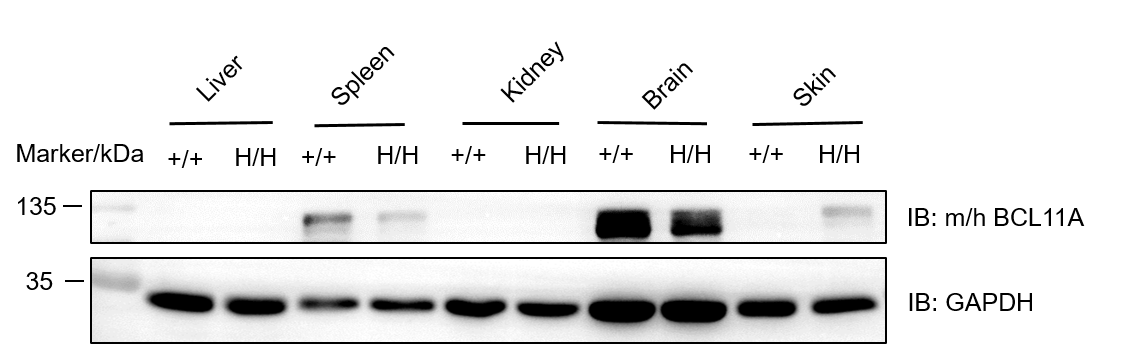
- The protein of BCL11A was detectable in spleen, brain, skin of homozygous B-hBCL11A mice and wild-type C57BL/6JNifdc mice, as the antibody is cross-recognize both human and mouse.
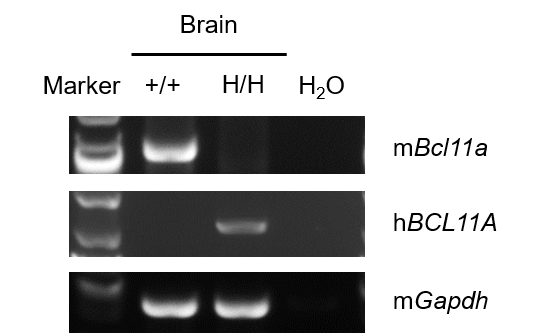
- Human BCL11A mRNA was detectable only in homozygous B-hBCL11A mice but not in wild-type mice. Mouse Bcl11a mRNA was only detectable in wild-type mice.
Application:
- This product is used for evaluating the efficacy and safety of thalassemia and sickle cell anemia.
Targeting strategy
Gene targeting strategy for B-hBCL11A mice. The exons 1-5 of mouse Bcl11a gene that encode the whole molecule (ATG to STOP codon), including 5’UTR and 3’UTR were replaced by human counterparts in B-hBCL11A mice. The human BCL11A expression is driven by human BCL11A promoter, while mouse Bcl11a gene transcription and translation will be disrupted.
Protein expression analysis
Western blot analysis of BCL11A protein expression in homozygous B-hBCL11A mice. Various tissue lysates were collected from wild-type C57BL/6JNifdc mice (+/+) and homozygous B-hBCL11A mice (H/H), and then analyzed by western blot with anti-BCL11A antibody (Abcam, ab19487). 40 μg total proteins were loaded for western blotting analysis. Human BCL11A protein was detectable in spleen, brain, skin of homozygous B-hBCL11A mice and wild-type C57BL/6JNifdc mice, as the antibody is cross-recognize both human and mouse.
mRNA expression analysis
Strain specific analysis of BCL11A mRNA expression in wild-type C57BL/6JNifdc mice and homozygous B-hBCL11A mice by RT-PCR. Brain RNA were isolated from wild-type C57BL/6JNifdc mice (+/+) and homozygous B-hBCL11A mice (H/H), then cDNA libraries were synthesized by reverse transcription, followed by PCR with mouse or human BCL11A primers. Human BCL11A mRNA was detectable only in homozygous B-hBCL11A mice but not in wild-type mice. Mouse Bcl11a mRNA was only detectable in wild-type mice.
* When publishing results obtained using this animal model, please acknowledge the source as follows: The animal model [B-hBCL11A mice] (Cat# 113320) was purchased from Biocytogen.