
C57BL/6-Dmpktm3(DMPK*(CTG)58)Bcgen/Bcgen • 114046

Background: The dystrophia myotonica protein kinase (DMPK) is a serine/threonine kinase primarily expressed in skeletal muscle, cardiac muscle, and the central nervous system. It plays critical roles in regulating muscle contraction and contributing to normal muscle function and tissue integrity.
Myotonic dystrophy type 1 (DM1), the most common adult-onset muscular dystrophy, is caused by abnormal expansion of CTG trinucleotide repeats in the 3'-untranslated region (3'-UTR) of the DMPK gene. When the number of CTG repeats exceeds ~50, the expanded transcripts form toxic RNA foci that sequester RNA-binding proteins (e.g., MBNL1) and disrupt alternative splicing of target genes. This leads to a cascade of pathological changes, including myotonia, muscle weakness, cardiac conduction defects, and cognitive impairment.
Targeting strategy: 3’UTR region containing 58 copies CTG was inserted into human DMPK 3’UTR in B-hDMPK*(CTG)58 mice. The exons 1~15 of mouse Dmpk gene that encode the full-length protein were replaced by human DMPK exons 1~15 in B-hDMPK*(CTG)58 mice. The promoter and 5’UTR of the mouse gene were replaced by human counterparts.
Validation data:
Human DMPK protein was detectable in homozygous B-hDMPK*(CTG)58 mice and wild-type C57BL/6JNifdc mice, as the antibody was cross-reactive between human and mouse.
Mouse Dmpk mRNA was only detectable in wild-type C57BL/6JNifdc mice. Human DMPK mRNA was exclusively detectable in homozygous B-hDMPK*(CTG)58 mice.
The mRNA expression of human DMPK in homozygous B-hDMPK*(CTG)58 mice was lower than that in homozygous B-hDMPK mice, demonstrating that introduction of 58 copies CTG in human DMPK reduced its mRNA expression levels.

Gene targeting strategy for B-hDMPK*(CTG)58 mice. 3’UTR region containing 58 copies CTG was inserted into human DMPK 3’UTR in B-hDMPK*(CTG)58 mice. The exons 1~15 of mouse Dmpk gene that encode the full-length protein were replaced by human DMPK exons 1~15 in B-hDMPK*(CTG)58 mice. The promoter and 5’UTR of the mouse gene were replaced by human counterparts.

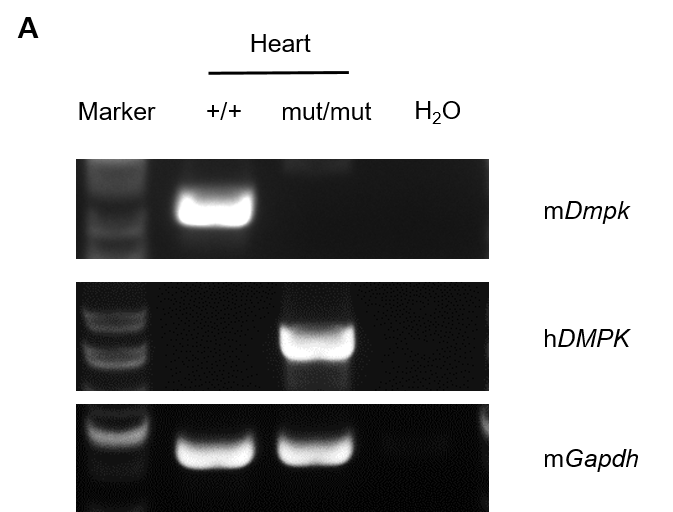
Strain specific analysis of DMPK mRNA expression in wild-type C57BL/6JNifdc mice and B-hDMPK*(CTG)58 mice by RT-PCR. Heart RNA were isolated from wild-type C57BL/6JNifdc mice (+/+) and homozygous B-hDMPK*(CTG)58 mice (mut/mut), then cDNA libraries were synthesized by reverse transcription, followed by PCR with mouse or human DMPK primers. (A) Mouse Dmpk mRNA was only detectable in wild-type C57BL/6JNifdc mice. Human DMPK mRNA was exclusively detectable in homozygous B-hDMPK*(CTG)58 mice. (B) CTG repeats in B-hDMPK*(CTG)58 mice were confirmed by Sanger sequencing.

mRNA expression analysis of DMPK in homozygous B-hDMPK*(CTG)58 mice. Gastrcnemius and Tibialis anterior tissue lysates were collected from homozygous B-hDMPK mice and homozygous B-hDMPK*(CTG)58 mice (male, 8-week-old, n=3), then cDNA libraries were synthesized by reverse transcription, followed by qPCR with human DMPK primers. The mRNA expression of human DMPK in homozygous B-hDMPK*(CTG)58 mice was lower than that in homozygous B-hDMPK mice, demonstrating that introduction of 58 copies CTG in human DMPK reduced its mRNA expression levels. Values are expressed as mean ± SEM. Significance was determined by unpaired t-test. *P < 0.05, **P < 0.01, ***P < 0.001.
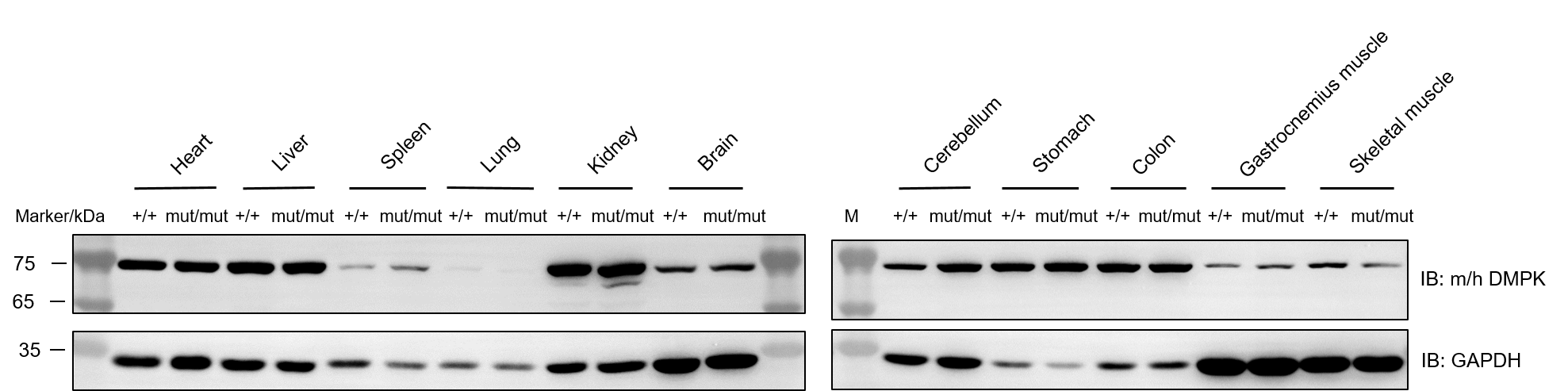
Western blot analysis of DMPK protein expression in homozygous B-hDMPK*(CTG)58 mice. Various tissue lysates were collected from wild-type C57BL/6JNifdc mice (+/+) and homozygous B-hDMPK*(CTG)58 mice (mut/mut) (male, 7-week-old, n=1), and then analyzed by western blot with anti-DMPK antibody (Abcam, ab102804). 40 μg total proteins were loaded for western blotting analysis. GAPDH was detected as internal control. Human DMPK protein was detectable in homozygous B-hDMPK*(CTG)58 mice and wild-type C57BL/6JNifdc mice, as the antibody was cross-reactive between human and mouse. M, marker.
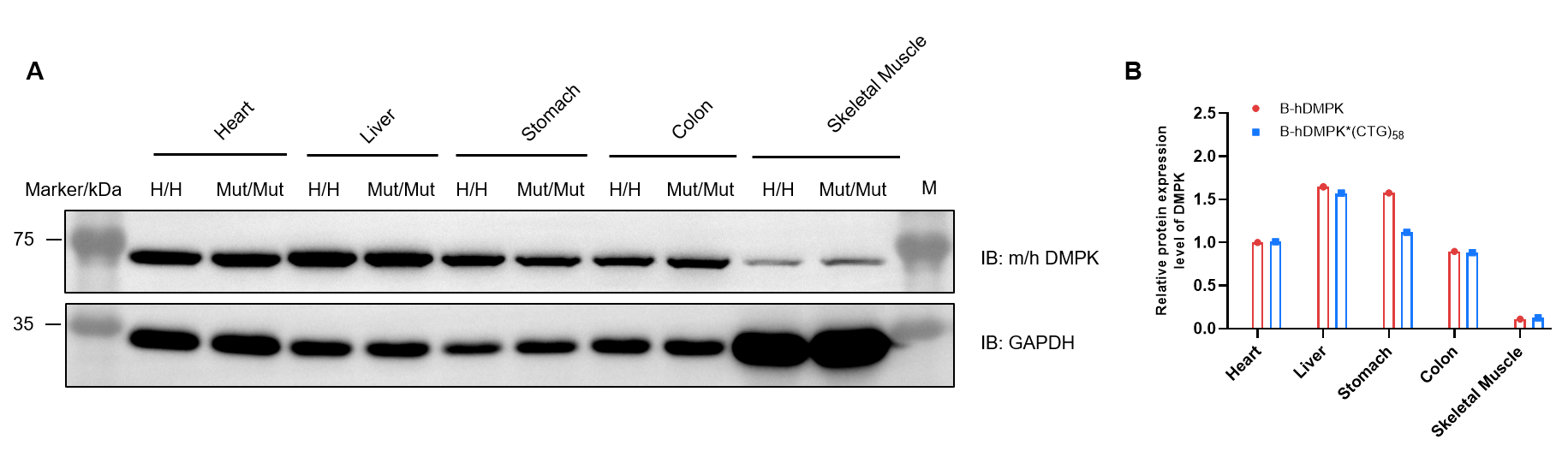
Western blot analysis of DMPK protein expression in homozygous B-hDMPK*(CTG)58 mice. Various tissue lysates were collected from homozygous B-hDMPK mice (H/H) and homozygous B-hDMPK*(CTG)58 mice (mut/mut) (male, 8-week-old, n=1), and then analyzed by western blot with anti-DMPK antibody (Abcam, ab102804). 40 μg total proteins were loaded for western blotting analysis. GAPDH was detected as internal control. (A) Human DMPK protein was detectable in homozygous B-hDMPK*(CTG)58 mice and homozygous B-hDMPK mice. (B) Quantitative analysis of band intensities showed no significant difference in protein expression levels of DMPK between B-hDMPK*(CTG)58 mice and B-hDMPK mice. M, marker.