Description
PD-1 and CD1A: Key molecules in lipid antigen presentation and immune checkpoint regulation
- Gene Information: CD1A encodes a non-classical MHC class I-like molecule that presents lipid antigens to T cells. PDCD1 encodes PD-1, an inhibitory immune checkpoint receptor that negatively regulates T cell responses.
- Protein Expression: CD1A is mainly expressed by antigen-presenting cells, especially Langerhans cells and dendritic cells. PD-1 is primarily expressed on activated T cells and other immune cells during immune activation.
- Signaling Pathway: CD1A presents lipid antigens to CD1A-restricted T cells, promoting T cell activation and cytokine production. PD-1 binds PD-L1 or PD-L2 and suppresses TCR-mediated signaling, thereby limiting T cell activation and effector function.
- Therapeutic Inhibition: CD1A is associated with lipid antigen-driven inflammatory immune responses and may serve as a target for immune modulation. PD-1/PD-L1 blockade restores T cell activity and is a major therapeutic strategy in cancer immunotherapy.
Targeting strategy
PD-1
- A chimeric CDS that encodes human PD-1 signal peptide and extracellular domain, mouse PD-1 transmembrane and cytoplasmic domain, followed by WPRE-polyA is inserted right after mouse 5’UTR to replace the mouse PD-1 gene.
- The chimeric PD-1 protein expression will be driven by endogenous mouse PD-1 promoter, while mouse PD-1 gene transcription and translation will be disrupted in B-hPD-1 mice plus.
CD1A
- The full genomic sequence of the human CD1A gene, including the promoter, 5’UTR, 3’UTR, and the downstream intronic sequence following the 3’UTR, is inserted into the mouse Hipp11 (H11) locus in B-hCD1A mice.
B-hPD-1 plus/hCD1A Mice
- Derived from the crossbreeding of B-hPD-1 mice plus and B-hCD1A mice.
PD-1 Protein Expression in Spleen
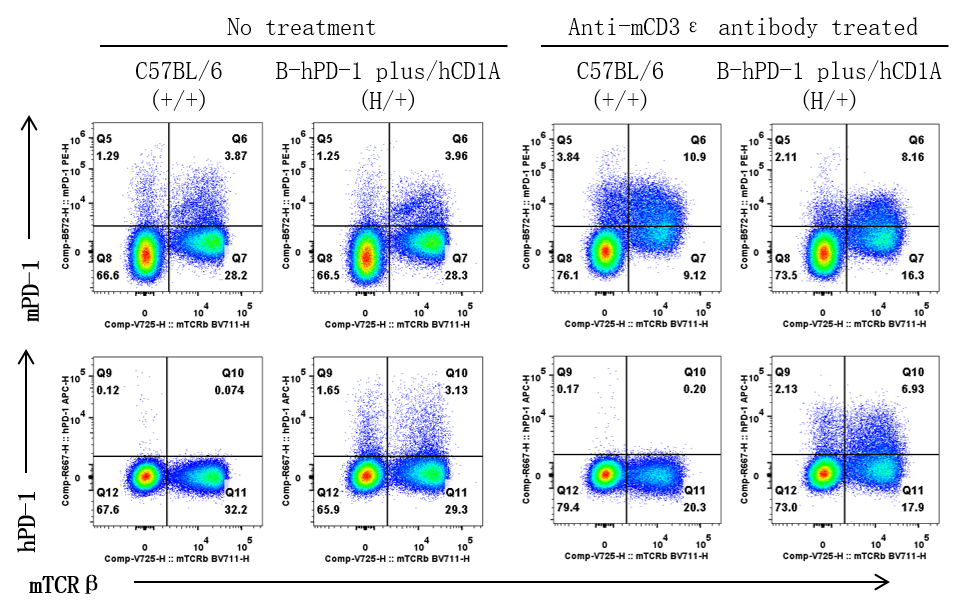
- Mouse PD-1 was detectable in wild-type mice and heterozygous B-hPD-1 plus/hCD1A mice.
- Human PD-1 was exclusively detectable in heterozygous B-hPD-1 plus/hCD1A mice but not in wild-type mice.
Mouse and human PD-1 expression analysis in splenocytes. Splenocytes were collected from wild-type C57BL/6 mice (+/+) and heterozygous B-hPD-1 plus/hCD1A mice (H/+) (female, 6-week-old, n=2) stimulated with or without anti-mCD3ε antibody in vivo. Protein expression was analyzed with anti-human PD-1 antibody (BioLegend, 329908) and anti-mouse PD-1 antibody (BioLegend, 109104).
CD1A Protein Expression in Skin
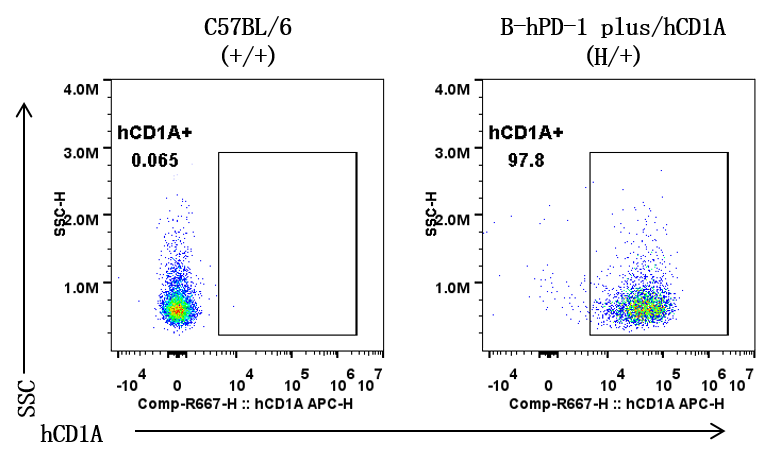
- Human CD1A was exclusively detectable in langerhans cells from heterozygous B-hPD-1 plus/hCD1A mice, but not in wild-type C57BL/6 mice.
Mouse and human CD1A expression analysis in langerhans cells. Skin cells were collected from wild-type C57BL/6 mice (+/+) and heterozygous B-hPD-1 plus/hCD1A mice (H/+) (female, 9-week-old, n=1). Protein expression was analyzed with anti-human CD1A antibody (Biolegend, 336307) by flow cytometry.
* When publishing results obtained using this animal model, please acknowledge the source as follows: The animal model [B-hPD-1 plus/hCD1A mice] (Cat# 115050) was purchased from Biocytogen.