Description
TL1A: A key inflammation cytokine in chronic intestinal inflammation and fibrosis-related diseases
- Gene Information: TNF Superfamily Member 15 (TNFSF15, also known as TL1A) is a protein-coding gene located on chromosome 9q32. This cytokine is a ligand for receptor TNFRSF25 (also known as DR3) and TNFRSF6B (also known as DcR3).
- Protein Expression: TL1A is expressed in various immune cells (such as monocytes, macrophages, dendritic cells, and T cells) as well as in non-immune cells (such as synovial fibroblasts and endothelial cells). TL1A is a type II transmembrane protein that exists in either membrane-bound (mTL1A) or soluble (sTL1A) forms.
- Signaling Pathway: TL1A competes with Death Receptor 3 (DR3) for binding, providing stimulus signals for downstream signaling pathways, thereby regulating the proliferation, activation, apoptosis of effector cells, and the production of cytokines and chemokines.
- Therapeutic Inhibition: Blocking the interaction between TL1A and DR3 can reduce the severity of autoimmune diseases, such as the IBD model.
Targeting strategy
TL1A
- The targeting strategy for humanized TL1A in B-hTL1A mice plus is currently kept confidential.
Soluble TL1A Protein Expression Analysis
- Soluble human TL1A was exclusively detectable in homozygous B-hTL1A mice and B-hTL1A mice plus but not wild-type C57BL/6N mice.
Soluble TL1A expression analysis in B-hTL1A mice plus by ELISA. Bone marrow derived dendritic cells (BMDCs) were produced by culturing the bone marrow from wild-type C57BL/6N mice (+/+) , homozygous B-hTL1A mice (H/H), and homozygous B-hTL1A mice plus (H/H), which were stimulated with LPS in vitro. After stimulation, the supernatants were collected and the levels of soluble TL1A were measured using a species-specific human TL1A ELISA kit. Soluble human TL1A was exclusively detectable in homozygous B-hTL1A mice and B-hTL1A mice plus but not wild-type C57BL/6N mice. Values are expressed as mean ± SEM. ND: not detectable.
- Soluble human TL1A was exclusively detectable in homozygous B-hTL1A mice and B-hTL1A mice plus. The expression of human TL1A protein in the B-hTL1A mice plus is higher than that in the B-hTL1A mice.
- LPS stimulation could increase the expression of human TL1A protein.
Soluble TL1A expression analysis in B-hTL1A mice and B-hTL1A mice plus by ELISA. Serum was collected from homozygous B-hTL1A mice and B-hTL1A mice plus stimulated with LPS in vivo, and analyzed by ELISA with species-specific human TL1A ELISA kit. Soluble human TL1A was detectable in homozygous B-hTL1A mice and homozygous B-hTL1A mice plus. LPS stimulation could increase the expression of human TL1A protein. The expression of human TL1A protein in the B-hTL1A mice plus is higher than that in the B-hTL1A mice. Values are expressed as mean ± SEM.
Chronic Model of TNBS-Induced Colitis
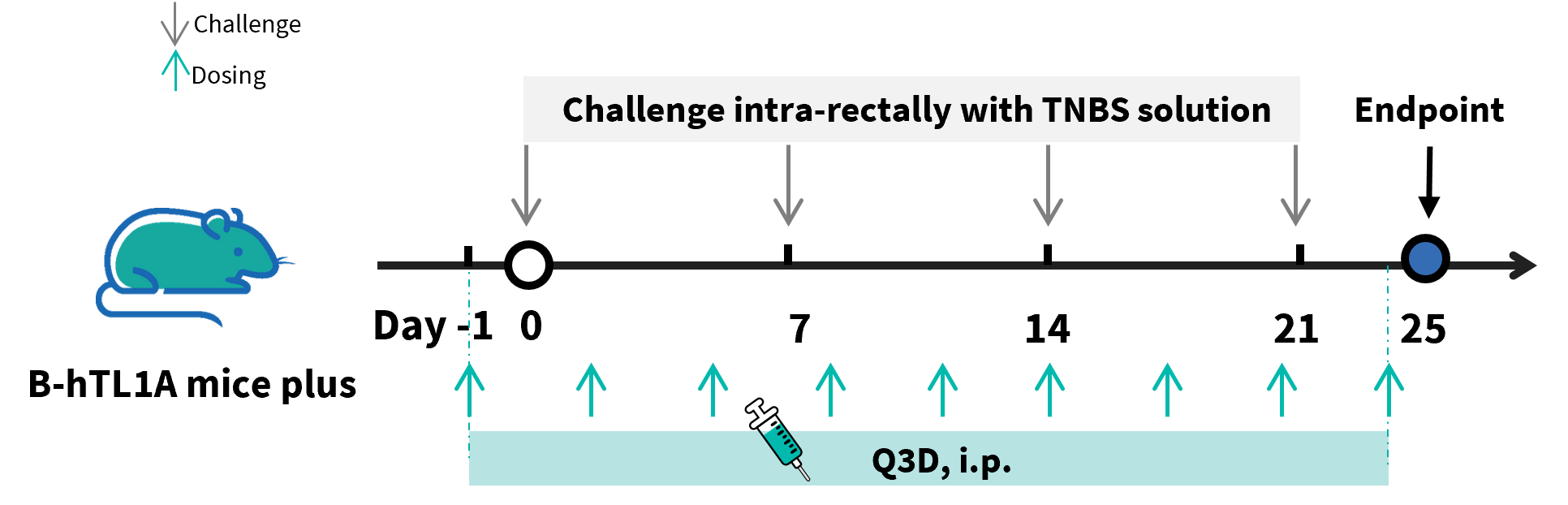
Experimental schedule for TNBS induced chronic colitis and in vivo efficacy of anti-TL1A antibodies in B-hTL1A mice plus. TNBS solution was instilled into the colon lumen of B-hTL1A mice plus on day0, day7, day14, and day21. The control group (Sham) received intrarectal injections of PBS. The treatment groups received anti-TL1A antibody RVT-3101 (8 mpk, provided by WuXi AppTec) and anti-human TL1A antibody TEV-48574 (8 mpk, provided by WuXi AppTec). This animal model can be used to evaluate the research of anti-fibrotic IBD drugs.
Note: This experiment was conducted by WuXi AppTec using B-hTL1A mice plus.
In Vivo Efficacy of Anti-TL1A Antibodies in a TNBS Induced Chronic Colitis
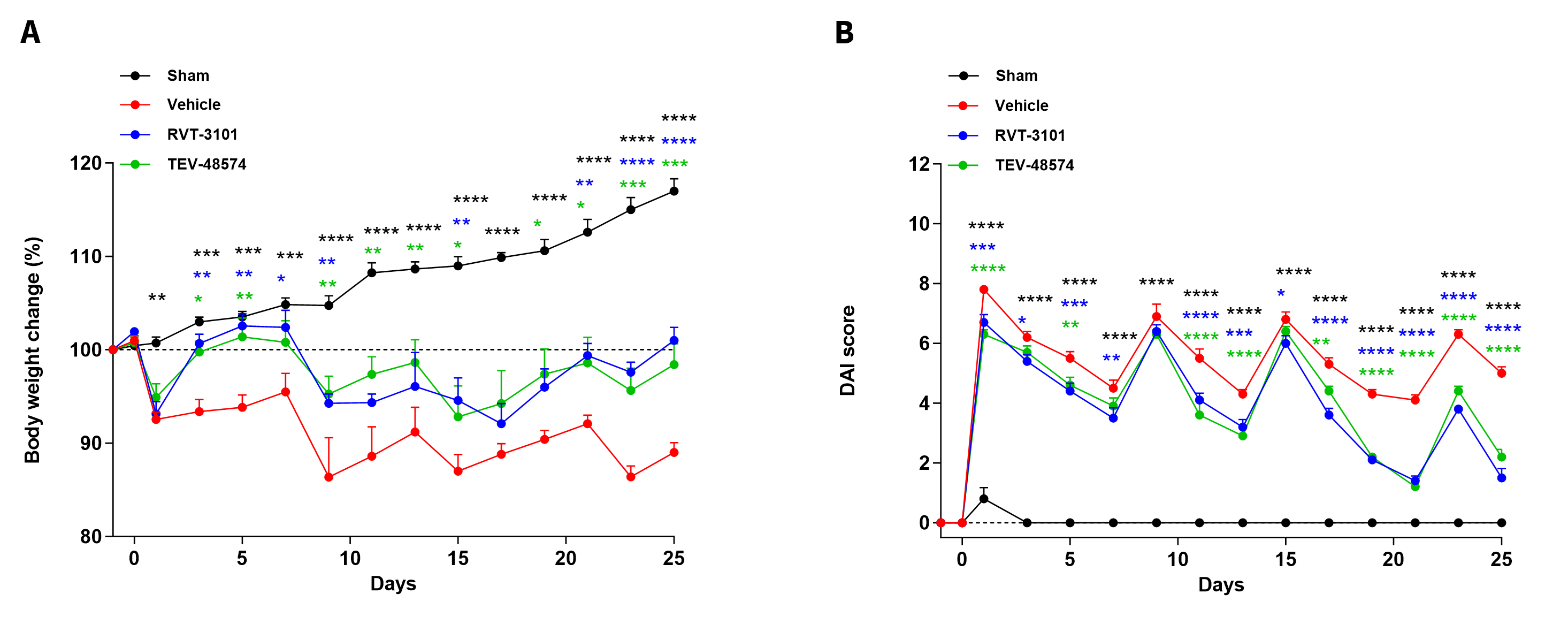
- Anti-TL1A antibodies treatment efficiently improved TNBS-induced chronic colitis.
The therapeutic efficacy of anti-human TL1A antibodies on the TNBS-induced chronic colitis model in B-hTL1A mice plus. TNBS solution was instilled into the colon lumen of B-hTL1A mice plus on day0, day7, day14, and day21. The control group (Sham) received intrarectal injections of PBS. The treatment groups received anti-TL1A antibody RVT-3101 (8 mpk, provided by WuXi AppTec) and anti-human TL1A antibody TEV-48574 (8 mpk, provided by WuXi AppTec). (A) Body weight change. (B) DAI score. A chronic colitis disease model induced by TNBS was established in B-hTL1A mice plus, and administration of anti-TL1A antibodies RVT-3101 and TEV-48574 effectively improved TNBS-induced chronic colitis. Values are expressed as mean ± SEM. *p<0.05, **p<0.01, ***p<0.001, ****p<0.0001, versus Vehicle, ANOVA.
Note: This experiment was conducted by WuXi AppTec using B-hTL1A mice plus.
* When publishing results obtained using this animal model, please acknowledge the source as follows: The animal model [B-hTL1A mice plus] (Cat# 112949) was purchased from Biocytogen.