

Gene targeting strategy for B-hDMD(exon44-46, del45)/hTFR1 mice.
The exon 44, exon 45 and exon 46 of mouse Dmd are replaced by exon 44 and exon 46 of human DMD in B-hDMD(exon44-46, del45)/hTFR1 mice. The human exon 44 is flanked by ~1kb of human intron 43 and human intron 44 sequences, while human exon 46 is flanked by ~1kb of human intron 45 and human intron 46 sequences.
The exons 4-19 of mouse Tfr1 gene that encode extracellular domain are replaced by human counterparts in B-hDMD(exon44-46, del45)/hTFR1 mice. The genomic region of mouse Tfr1 gene that encodes cytoplasmic portion is retained. The promoter, 5’UTR and 3’UTR region of the mouse gene are also retained. The chimeric TFR1 expression is driven by endogenous mouse Tfr1 promoter, while mouse Tfr1 gene transcription and translation will be disrupted.
Note: B-hDMD(exon44-46, del45)/hTFR1 mice were obtained by mating B-hDMD(exon44-46, del45) mice (114088) and B-hTFR1 mice (110861).

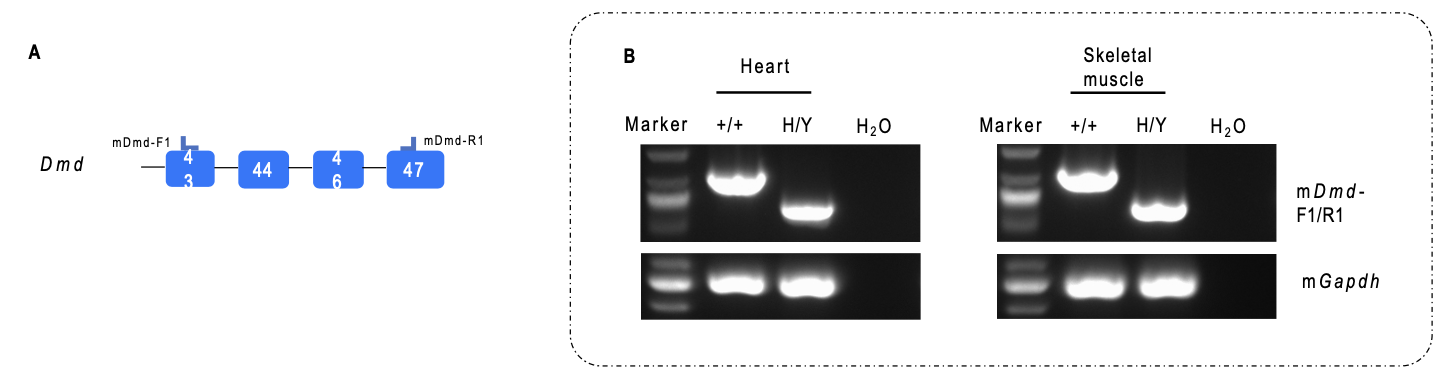
Strain specific analysis of DMD mRNA expression in wild-type C57BL/6JNifdc mice and homozygous B-hDMD(exon44-46, del45)/hTFR1 mice by RT-PCR. Heart and skeletal muscle RNA were isolated from wild-type C57BL/6JNifdc mice (+/+) and homozygous B-hDMD(exon44-46, del45)/hTFR1 mice (H/Y, H/H), then cDNA libraries were synthesized by reverse transcription, followed by PCR with mouse Dmd primers. (A) Primers were designed to detect the human exon 44 and exon 46. (B) The transcripts in homozygous mice are shorter than those in wild-type mice, and the sequences were confirmed via Sanger sequencing, demonstrating the successful exon splicing in B-hDMD(exon 44-46, del45)/hTFR1 mice.

Behavioral performance in wild-type C57BL/6JNifdc and homozygous B-hDMD(exon44-46, del45)/hTFR1 mice. Grip strength tests were conducted to assay the behavioral performance in wild-type C57BL/6JNifdc and homozygous B-hDMD(exon44-46, del45)/hTFR1 mice (male, 6 and 12-week-old, n=12). Grip strength produced by forelimb in homozygous B-hDMD(exon44-46, del45)/hTFR1 mice was significant weaker than that in wild-type control mice. All grip strength measurements are normalized to the individual animal’s body weight. Values are expressed as mean ± SEM. At each time point significance was determined by unpaired t test. *P < 0.05, **P < 0.01, ***P < 0.001.
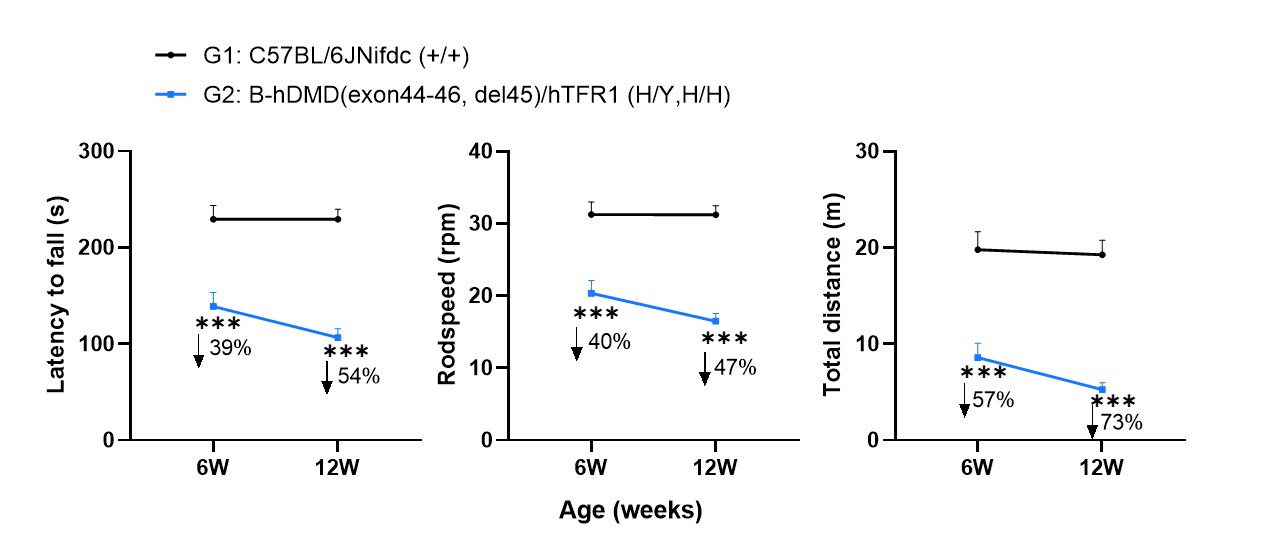
Behavioral performance in wild-type C57BL/6JNifdc and homozygous B-hDMD(exon44-46, del45)/hTFR1 mice. Rotarod tests were conducted to assay the behavioral performance in wild-type C57BL/6JNifdc and homozygous B-hDMD(exon44-46, del45)/hTFR1 mice (male, 6, 12-week-old, n=12). Rotarod tests were performed to assay the motor coordination. The latency to fall, rodspeed and total distance were significantly decreased in homozygous B-hDMD(exon44-46, del45)/hTFR1 mice, showing the impairment of motor coordination and balance. Values are expressed as mean ± SEM. At each time point significance was determined by unpaired t test. *P < 0.05, **P < 0.01, ***P < 0.001.

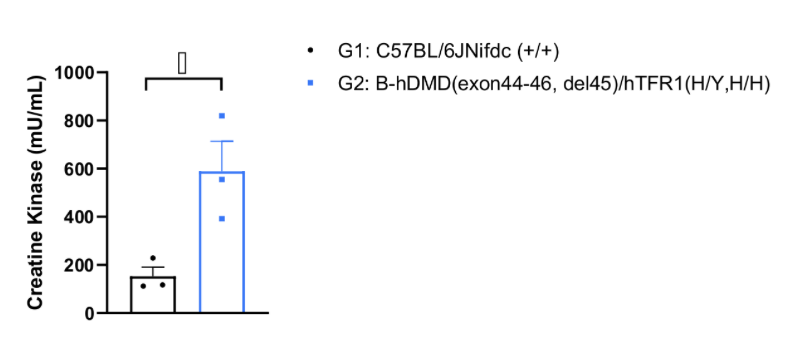
Serum creatine kinase activity analysis in wild-type C57BL/6JNifdc mice and homozygous B-hDMD(exon44-46, del45)/hTFR1 mice by colorimetric. Serum was collected from wild-type C57BL/6JNifdc mice (+/+, n=3, 12-week-old male) and homozygous B-hDMD(exon44-46, del45)/hTFR1 mice (H/Y,H/H, n=3, 12-week-old male). Creatine kinase activity was analyzed by colorimetric in a kinetic mode every 2 min for a total of 36 min at 37℃ (creatine kinase activity assay kit: Abcam, ab155901). OD450 readings were linear between T1 (at time 19) and T2 (12min for WT and homozygous mice). Creatine kinase activity was significantly greater in homozygous B-hDMD(exon44-46, del45)/hTFR1 mice compared to that in wild-type mice. Significance was determined by unpaired t test. *P < 0.05.