

B-hFPR1 mice
C57BL/6N-Fpr1tm1(FPR1)Bcgen /Bcgen • 113054

B-hFPR1 mice

Catalog Number
113054
Strain Name
C57BL/6N-Fpr1tm1(FPR1)Bcgen /Bcgen
Strain Background
C57BL/6N
NCBI gene ID
2357 (Human)
Aliases
FPR; FMLP

이 페이지에서

  • Description
  • Targeting strategy
  • Phenotypic analysis

포스터

모두 보기

    출판물

      Description

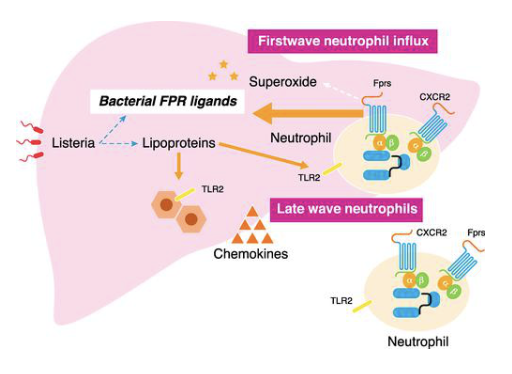
      FPR1: Mediates neutrophil chemotaxis and activation by sensing formylated peptides. 

      • Gene Information: Located on human chromosome 19q13.41, FPR1 encodes formyl peptide receptor 1, a high-affinity G protein-coupled receptor (GPCR). 
      • Protein Expression: It is predominantly expressed on the cell surface of myeloid leukocytes, particularly neutrophils, monocytes, and macrophages. 
      • Signaling Pathway: It binds bacterial and mitochondrial N-formyl peptides to couple with Gi proteins, triggering intracellular calcium mobilization, MAPK/Akt signaling, and directed chemotaxis. 
      • Therapeutic Inhibition: Small-molecule antagonists and blocking antibodies suppress FPR1-mediated leukocyte recruitment to resolve chronic hyperinflammation or inhibit tumor-promoting microenvironments.
      Targeting strategy

      FPR1 

      • The exon 2 of mouse Fpr1 gene that encodes extracellular domain, transmembrane domain, cytoplasmic region and 3’UTR is replaced by human counterparts in B-hFPR1 mice. The promoter and 5’UTR region of the mouse gene are retained. The human FPR1 expression is driven by endogenous mouse Fpr1 promoter, while mouse Fpr1 gene transcription and translation will be disrupted. 
      Humanized B-hFPR1 mice: mRNA Expression Analysis
      • Mouse Fpr1 mRNA was detectable only in wild-type C57BL/6N mice. Human FPR1 mRNA was detectable only in homozygous B-hFPR1 mice but not in wild-type mice.

      Species specific analysis of FPR1 gene expression in wild-type C57BL/6N mice and homozygous humanized B-hFPR1 mice by RT-PCR. Splenocytes were collected from wild-type C57BL/6N mice (+/+) and homozygous B-hFPR1 mice (H/H). 

      Humanized B-hFPR1 mice: Protein Expression Analysis
      • hFPR1 was not detectable in T cells, B cells, and NK cells of homozygous B-hFPR1 mice. 

      Strain specific FPR1 expression analysis in homozygous B-hFPR1 mice by flow cytometry. Splenocytes were collected from wild-type C57BL/6N mice (+/+) and homozygous B-hFPR1 mice (H/H), and protein expression was analyzed with anti-human FPR1 antibody (Biolegend, 391606) by flow cytometry. 

      • hFPR1 was not detectable in monocytes and macrophages of homozygous B-hFPR1 mice. 

      Strain specific FPR1 expression analysis in homozygous B-hFPR1 mice by flow cytometry. Splenocytes were collected from wild-type C57BL/6N mice (+/+) and homozygous B-hFPR1 mice (H/H), and protein expression was analyzed with anti-human FPR1 antibody (Biolegend, 391606) by flow cytometry. 

      • hFPR1 was detectable in DCs and neutrophils of homozygous B-hFPR1 mice. 

      Strain specific FPR1 expression analysis in homozygous B-hFPR1 mice by flow cytometry. Splenocytes were collected from wild-type C57BL/6N mice (+/+) and homozygous B-hFPR1 mice (H/H), and protein expression was analyzed with anti-human FPR1 antibody (Biolegend, 391606) by flow cytometry. 

      hFPR1 was not detectable in T cells, B cells, and NK cells of homozygous B-hFPR1 mice. 

      Strain specific FPR1 expression analysis in homozygous B-hFPR1 mice by flow cytometry. Blood cells were collected from wild-type C57BL/6N mice (+/+) and homozygous B-hFPR1 mice (H/H), and protein expression was analyzed with anti-human FPR1 antibody (Biolegend, 391606) by flow cytometry. 

      • hFPR1 was detectable in T cells and NK cells of homozygous B-hFPR1 mice. 
      • hFPR1 was not detectable in B cells of homozygous B-hFPR1 mice. 

      Strain specific FPR1 expression analysis in homozygous B-hFPR1 mice by flow cytometry. Bone marrow were collected from wild-type C57BL/6N mice (+/+) and homozygous B-hFPR1 mice (H/H), and protein expression was analyzed with anti-human FPR1 antibody (Biolegend, 391606) by flow cytometry. 

      • hFPR1 was detectable in CD11b+ cells (monocytes and macrophages), DCs and neutrophils of homozygous B-hFPR1 mice. 

      Strain specific FPR1 expression analysis in homozygous B-hFPR1 mice by flow cytometry. Bone marrow was collected from wild-type C57BL/6N mice (+/+) and homozygous B-hFPR1 mice (H/H), and protein expression was analyzed with anti-human FPR1 antibody (Biolegend, 391606) by flow cytometry. 

      * When publishing results obtained using this animal model, please acknowledge the source as follows: The animal model [B-hFPR1 mice] (Cat# 113054) was purchased from Biocytogen.