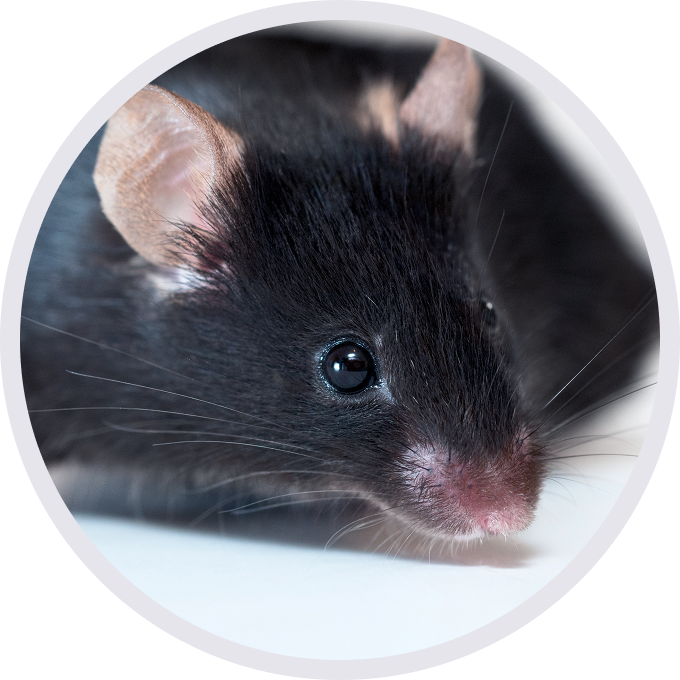

B-hIL17A/hIL17F/hIL17RA/hIL17RC mice were obtained by mating B-hIL17A/hIL17F mice (120554) and B-hIL17RA/hIL17RC mice (120555). For validation data of this mouse model, you can refer to the validation data from the related gene humanized mouse models.

IL17A
IL17F
IL17RA
IL17RC

Mouse IL17F was detectable in wild-type mice. Human IL17F was detectable in homozygous B-hIL17A/hIL17F/hIL17RA/hIL17RC mice.
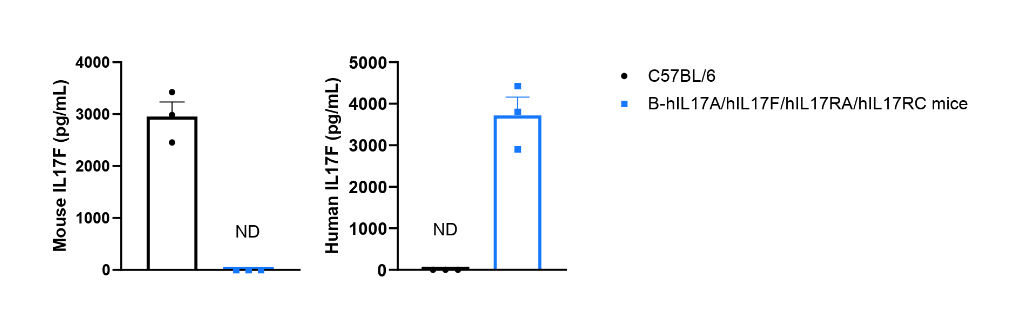
Strain specific IL17F expression analysis in wild-type C57BL/6 mice and homozygous humanized B-hIL17A/hIL17F/hIL17RA/hIL17RC mice by ELISA. Th17 cell culture supernatant was collected from wild-type C57BL/6 mice (+/+) (male, n=3, 9-week-old) and homozygous B-hIL17A/hIL17F/hIL17RA/hIL17RC mice (H/H) (male, n=3, 9-week-old). Expression level of mouse and human IL17F were analyzed by ELISA (anti-mouse IL17F ELISA kit: R&D, DY2057; anti-human IL17F ELISA kit: Biolegend, 435707). Mouse IL17F was only detectable in wild-type C57BL/6 mice. Human IL17F was exclusively detectable in homozygous B-hIL17A/hIL17F/hIL17RA/hIL17RC mice (n=3). Values are expressed as mean ± SEM. ND: Not detected.
Human IL17RC was detectable in wild-type C57BL/6JNifdc mice and homozygous B-hIL17A/hIL17F/hIL17RA/hIL17RC mice. The anti-human IL17RC antibody were cross-reactive between human IL17RC and mouse IL17RC.
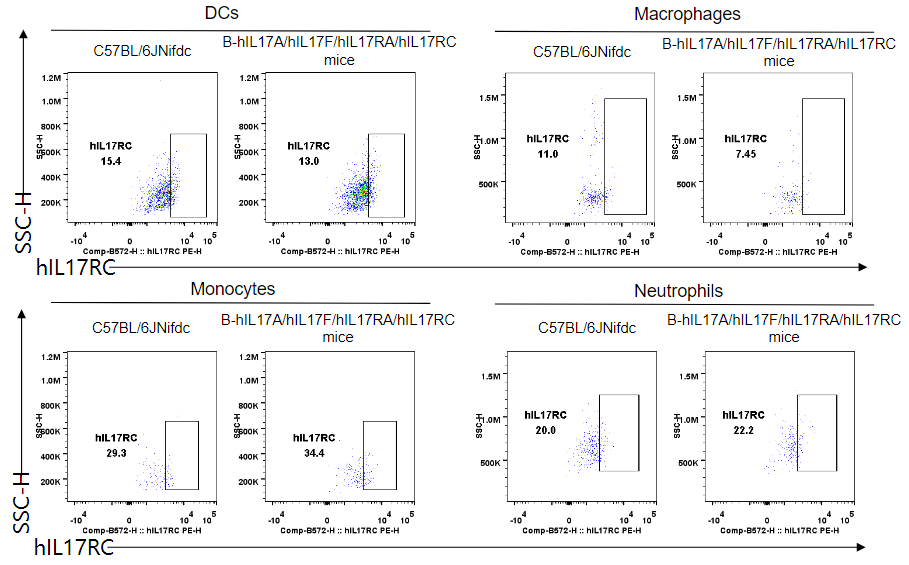
Strain specific IL17RC expression analysis in homozygous B-hIL17A/hIL17F/hIL17RA/hIL17RC mice by flow cytometry. Splenocytes were collected from wild-type C57BL/6JNifdc mice (+/+) and homozygous B-hIL17A/hIL17F/hIL17RA/hIL17RC mice (H/H;H/H;H/H;H/H), and analyzed by flow cytometry with species-specific anti-human IL17RC antibody (RD, FAB22691P). Human IL17RC was detectable in wild-type C57BL/6JNifdc mice and homozygous B-hIL17A/hIL17F/hIL17RA/hIL17RC mice. The anti-human IL17RC antibody were cross-reactive between human IL17RC and mouse IL17RC.
Human IL17RC was detectable in wild-type C57BL/6JNifdc mice and homozygous B-hIL17A/hIL17F/hIL17RA/hIL17RC mice. The anti-human IL17RC antibody were cross-reactive between human IL17RC and mouse IL17RC.
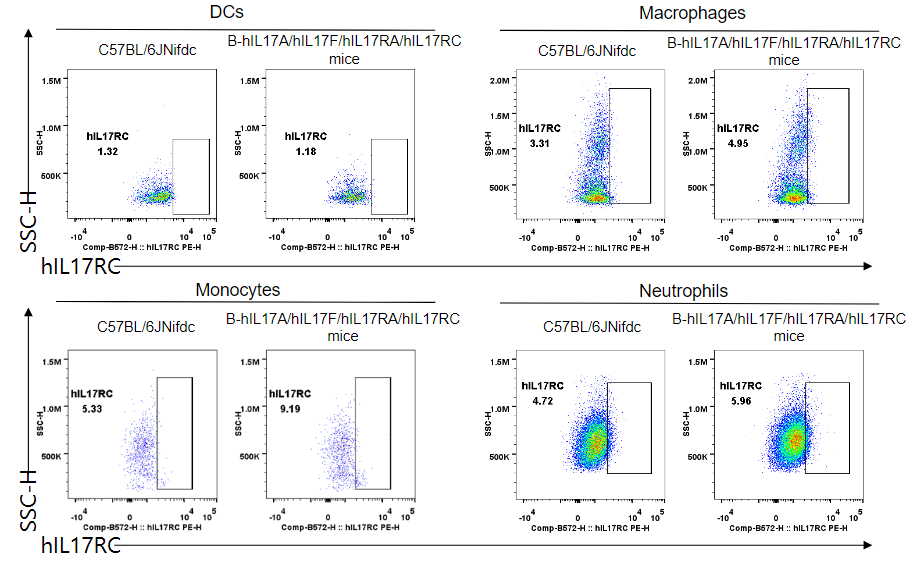
Strain specific IL17RC expression analysis in homozygous B-hIL17A/hIL17F/hIL17RA/hIL17RC mice by flow cytometry. Bone marrow were collected from wild-type C57BL/6JNifdc mice (+/+) and homozygous B-hIL17A/hIL17F/hIL17RA/hIL17RC mice (H/H;H/H;H/H;H/H), and analyzed by flow cytometry with species-specific anti-human IL17RC antibody (RD, FAB22691P). Human IL17RC was detectable in wild-type C57BL/6JNifdc mice and homozygous B-hIL17A/hIL17F/hIL17RA/hIL17RC mice. The anti-human IL17RC antibody were cross-reactive between human IL17RC and mouse IL17RC.
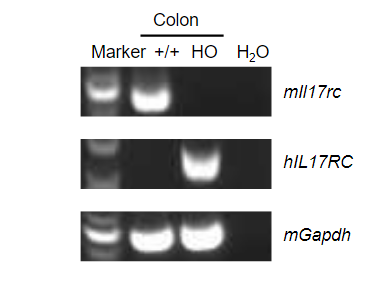
Strain specific analysis of IL17RC mRNA expression in wild-type C57BL/6JNifdc mice and B-hIL17A/hIL17F/hIL17RA/hIL17RC mice by RT-PCR. Colon RNA was isolated from wild-type C57BL/6JNifdc mice (+/+) and homozygous B-hIL17A/hIL17F/hIL17RA/hIL17RC mice(H/H; H/H; H/H; H/H), then cDNA libraries were synthesized by reverse transcription, followed by PCR with mouse or human IL17RC primers. Mouse Il17rc mRNA was only detectable in wild-type mice. Human IL17RC mRNA was exclusively detectable in homozygous B-hIL17A/hIL17F/hIL17RA/hIL17RC mice but not in wild-type mice.

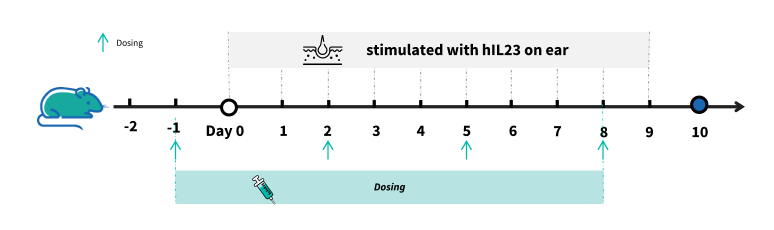
Human IL-23 induces psoriasis model in B-hIL17A/hIL17F/hIL17RA/hIL17RC mice.
(A) Experimental schedule for hIL23-induced psoriasis model in B-hIL17A/hIL17F/hIL17RA/hIL17RC mice. Mice (female, 8 week-old, n=6) were stimulated with hIL-23 on the ear fromDay 0 to Day 8 to induce psoriasis model , and brodalumab-analog (in house) and bimekizumab-analog (in house) were administered on Days -1, 2, 5, and 8.
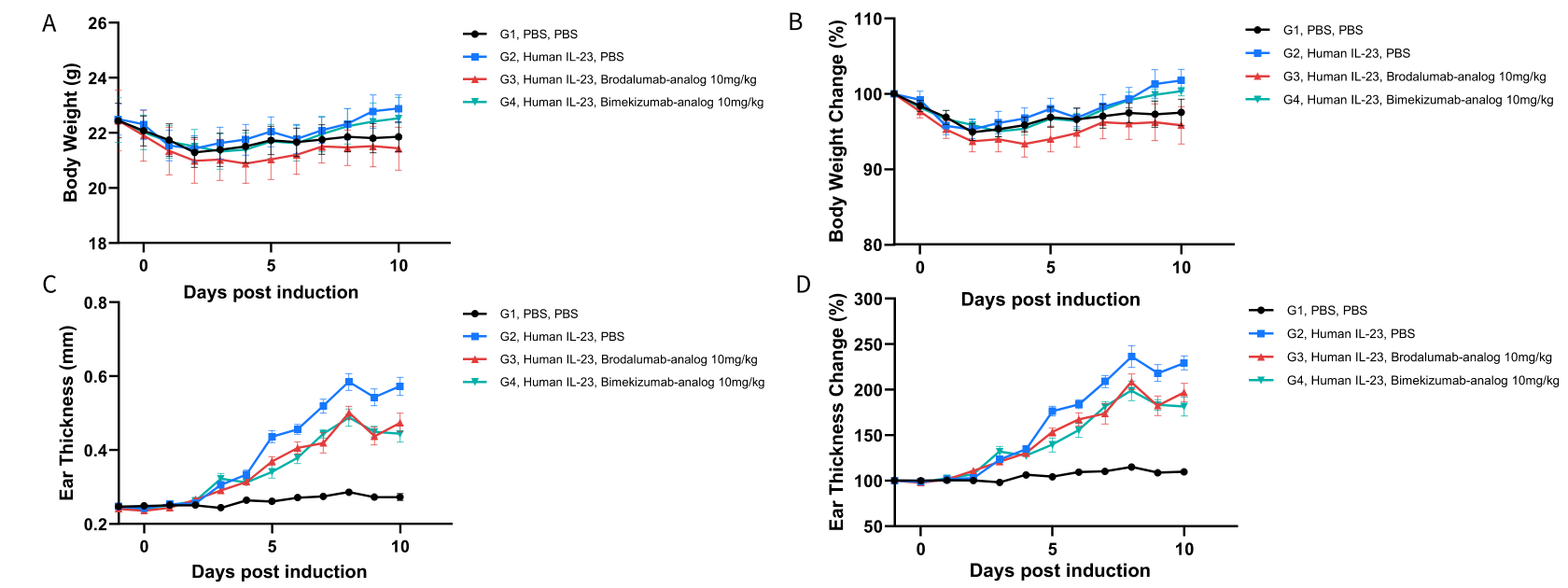
Human IL-23 induces psoriasis model in B-hIL17A/hIL17F/hIL17RA/hIL17RC mice.
(A) Absolute body weight (g) during treatment. (B) Body weight change (%) during treatment. (C) Absolute ear thickness (mm) during treatment. (D) Relative ear thickness change (%)during treatment. Treatment with brodalumab-analog and bimekizumab-analog significantly alleviated hIL-23-induced ear thickening, demonstrating potent therapeutic efficacyagainst psoriasis in B-hIL17A/hIL17F/hIL17RA/hIL17RC mice. Values are expressed as mean ± SEM.
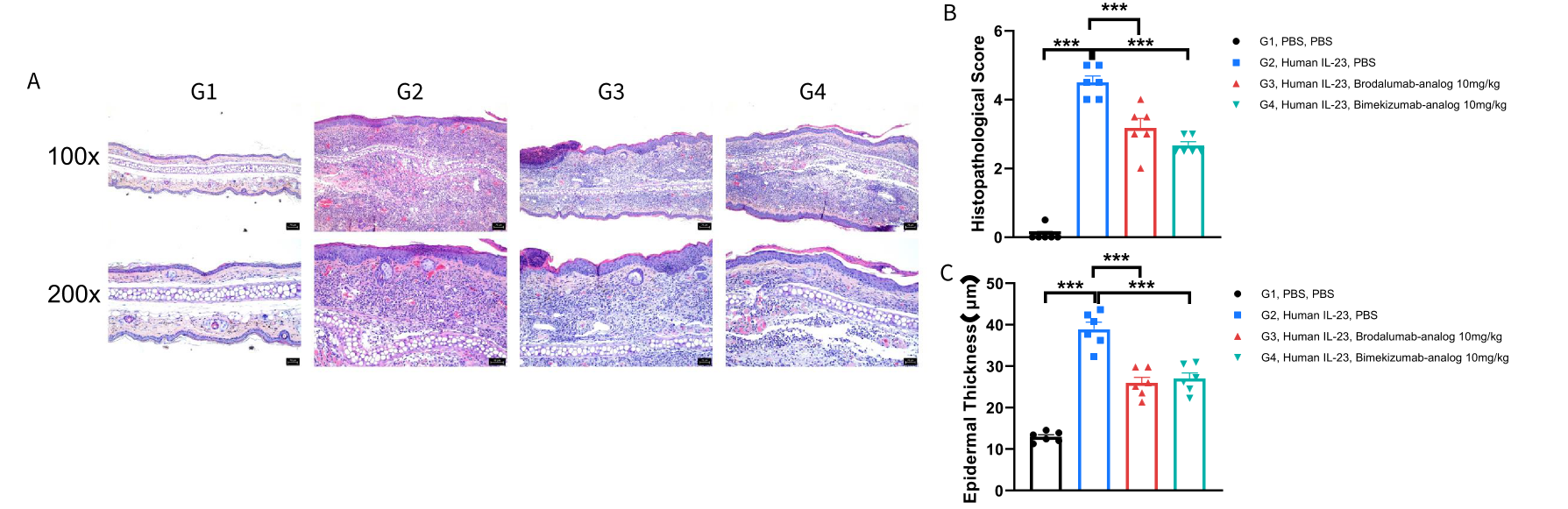
Amelioration of hIL-23-induced psoriasis-like skin pathology in B-hIL17A/hIL17F/hIL17RA/hIL17RC mice.
Ears were collected at the endpoint and stained with Hematoxylin and eosin (H&E). (A) H&E staining of the ear. (B) Histological changes were scored. (C) Epidermal thickness of themice. Results indicated that brodalumab-analog (in house) and bimekizumab-analog (in house) had therapeutic effects on psoriasis skin lesions in B-hIL17A/hIL17F/hIL17RA/hIL17RCmice, confirming that B-hIL17A/hIL17F/hIL17RA/hIL17RC mice provide a powerful model for in vivo evaluation of anti-human IL17A/F and anti-human IL17RA antibodies. Values areexpressed as mean ± SEM.