Description
TNF-α and IL-23: Key effector and polarizing cytokine pathways in chronic inflammatory and autoimmune diseases
- Gene Information: The TNF (encoding TNF-α), IL23A (encoding IL-23p19), and IL12B (encoding IL-12/IL-23p40) genes form a tightly interconnected cytokine network. Notably, the shared p40 subunit (IL12B) pairs with p19 (IL23A) to form IL-23, or with p35 (IL12A) to form IL-12, serving as a critical molecular bridge linking innate and adaptive immunity.
- Protein Expression: TNF-α is a potent pleiotropic effector cytokine produced primarily by activated macrophages, dendritic cells (DCs), and Th1/Th17 cells. IL-12 (p35/p40) and IL-23 (p19/p40) are heterodimeric cytokines secreted predominantly by antigen-presenting cells (DCs, macrophages) in response to microbial and inflammatory stimuli. IL-12p40 is the shared subunit, while p35 and p19 confer distinct functional specificity for Th1 and Th17 polarization, respectively.
- Signaling Pathway: IL-23 engages IL-23R/IL-12Rβ1 to activate JAK2/TYK2-STAT3 signaling, essential for the expansion and maintenance of pathogenic Th17 and γδ T cells (driving IL-17/IL-22 secretion). TNF-α binds TNFR1/2 to trigger NF-κB and MAPK cascades, amplifying systemic inflammatory responses and tissue remodeling.
- Therapeutic Inhibition: Blockade of this synergistic network—either via selective p19 inhibitors (e.g., risankizumab, guselkumab), dual p40 inhibitors (e.g., ustekinumab), or anti-TNF-α agents (e.g., adalimumab)—provides a cornerstone therapeutic strategy for major autoimmune disorders, including psoriasis, psoriatic arthritis, and inflammatory bowel disease (IBD).
Targeting strategy
TNFA
- Exons 1-4 of the mouse Tnfa gene that encode the signal peptide, extracellular domain, transmembrane domain, and cytoplasmic region were replaced by their human counterparts in B-hTNFA/hIL23A/hIL12B mice.
- The promoter, 5' UTR, and 3' UTR regions of the mouse gene were replaced by their human counterparts, allowing human TNFA expression to be driven by the human TNFA promoter, while endogenous mouse Tnfa transcription and translation are abolished.
IL23A
- Exons 1-4 of the mouse Il23a gene that encode the full-length coding region were replaced by human IL23A counterpart gene sequences in B-hTNFA/hIL23A/hIL12B mice.
- The endogenous mouse promoter, 5' UTR, and 3' UTR regions were retained, allowing human IL23A expression to be driven by the endogenous mouse Il23a promoter, while endogenous mouse Il23a transcription and translation are abolished.
IL12B
- Exons 2-8 of the mouse Il12b gene that encode the full-length coding region and 3' UTR were replaced by human IL12B counterpart gene sequences in B-hTNFA/hIL23A/hIL12B mice.
- The endogenous mouse promoter and 5' UTR regions were retained, allowing human IL12B expression to be driven by the endogenous mouse Il12b promoter, while endogenous mouse Il12b transcription and translation are abolished.
Note: The mice were obtained by breeding B-hTNFA mice with B-hIL23A/hIL12B mice.
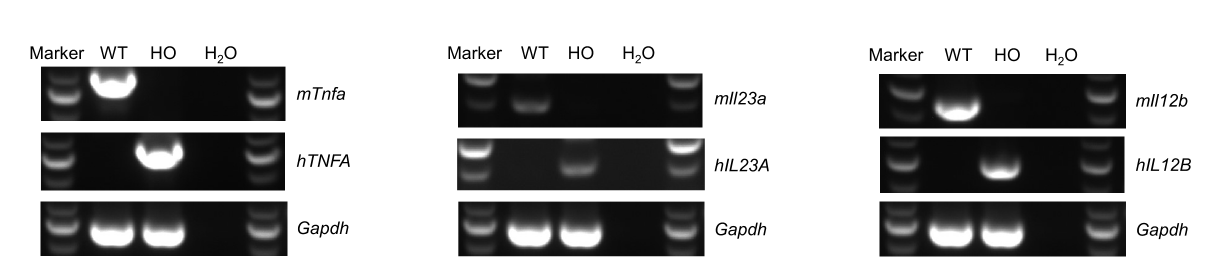
TNFA&IL23A&IL12B mRNA Expression Analysis in Spleen
Strain-specific analysis of TNFA, IL23A, and IL12B gene expression in wild-type C57BL/6JNifdc mice and homozygous B-hTNFA/hIL23A/hIL12B mice by RT-PCR. Spleen RNA was isolated from wild-type C57BL/6JNifdc mice (+/+) and homozygous B-hTNFA/hIL23A/hIL12B mice (H/H;H/H;H/H), and cDNA libraries were synthesized by reverse transcription, followed by PCR with species-specific mouse or human TNFA, IL23A, and IL12B primers. Mouse Tnfa, Il23a, and Il12b mRNA were exclusively detectable in wild-type C57BL/6JNifdc mice but not in homozygous B-hTNFA/hIL23A/hIL12B mice. Human TNFA, IL23A, and IL12B mRNA were exclusively detectable in homozygous B-hTNFA/hIL23A/hIL12B mice but not in wild-type C57BL/6JNifdc mice. WT: wild-type mice, HO: homozygous B-hTNFA/hIL23A/hIL12B mice.
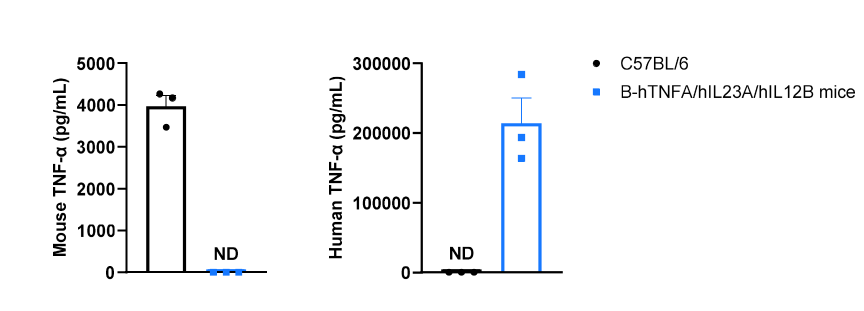
TNFA Protein Expression Analysis in Serum
Strain-specific TNFA expression analysis in wild-type C57BL/6JNifdc mice and homozygous B-hTNFA/hIL23A/hIL12B mice by ELISA. Serum was collected from wild-type C57BL/6JNifdc mice (+/+) and homozygous B-hTNFA/hIL23A/hIL12B mice (H/H;H/H;H/H) (female, 8-week-old, n = 3) stimulated with LPS (20 μg/mouse) in vivo for 1 hour. The expression levels of mouse and human TNF-α were analyzed by ELISA (anti-mouse TNF-α ELISA kit: BioLegend, 430970; anti-human TNF-α ELISA kit: BioLegend, 430204). Mouse TNF-α was exclusively detectable in wild-type C57BL/6JNifdc mice but not in homozygous B-hTNFA/hIL23A/hIL12B mice. Human TNF-α was exclusively detectable in homozygous B-hTNFA/hIL23A/hIL12B mice but not in wild-type C57BL/6JNifdc mice. Values are expressed as mean ± SEM. ND: not detectable.
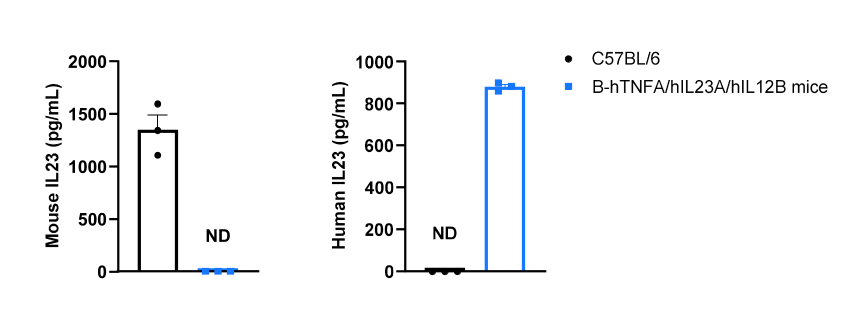
IL23 Protein Expression Analysis in Supernatants
Strain-specific IL-23 expression analysis in wild-type C57BL/6JNifdc mice and homozygous B-hTNFA/hIL23A/hIL12B mice by ELISA. Bone marrow-derived dendritic cells (BMDCs) were isolated from wild-type C57BL/6JNifdc mice (+/+) and homozygous B-hTNFA/hIL23A/hIL12B mice (H/H;H/H;H/H) (female, 8-week-old, n = 3) and stimulated with LPS in vitro for 24 hours. Cell culture supernatants were collected and the expression levels of mouse and human IL-23 were analyzed by ELISA (anti-mouse IL-23 ELISA kit: R&D Systems, M2300; anti-human IL-23 ELISA kit: R&D Systems, D2300B). Mouse IL-23 was exclusively detectable in wild-type C57BL/6JNifdc mice but not in homozygous B-hTNFA/hIL23A/hIL12B mice. Human IL-23 was exclusively detectable in homozygous B-hTNFA/hIL23A/hIL12B mice but not in wild-type C57BL/6JNifdc mice. Values are expressed as mean ± SEM. ND: not detectable.
* When publishing results obtained using this animal model, please acknowledge the source as follows: The animal model [B-hTNFA/hIL23A/hIL12B mice] (Cat# 114157) was purchased from Biocytogen.